


By Steven Jonathan Rummelsburg
Few critiques of modern education have aged as well as C. S. Lewis’s 1943 The Abolition of Man. In “Men Without Chests,” Lewis explains: “we remove the organ and demand the function. We make men without chests and expect of them virtue and enterprise. […] We castrate and bid the geldings be fruitful.” The chest, in this context, is the educated heart that subordinates the appetites to the right use of reason. Although Lewis focused on the chest, we can extend the analysis to the head, where the same surgery is practiced on both the “mind” and the “intellect.”
Lewis foresaw the present crisis of the intellect when he described the men produced by a demythologizing education. He called them Men Without Chests; we call them “critical thinkers.” Of them he wrote: “It is an outrage that they are commonly spoken of as Intellectuals. This gives them the chance of saying that he who attacks them attacks Intelligence.” Today, “intelligence” has suffered the same fate as “intellectual.”
“Mind” and “intellect” are words that refer to realities of an immaterial nature. Systematically eradicating everything immaterial from educational theory leaves these concepts especially exposed to abuse. Ask any faculty to explain what “intelligence” is and you will probably hear qualifiers such as multiple, emotional, and artificial. The noun they modify has become an organ donor.
The word “intellect” comes from the Latin intus legere: to read within. Our senses perceive external qualities; the intellect grasps what things are, conceptually. A man sees and recognizes a particular dog, but his intellect grasps the nature it shares with all dogs. Unlike sight, it is not tied to a bodily organ; schools should cultivate its use and its proper end. St. Thomas Aquinas teaches that the end of the intellect is truth, the conformity of the mind with reality, and that therefore our intellectual nature bears the image of God, a likeness that finds its fullness in Christ, the Logos, who is Truth itself.
The intellect is a power of the soul with two operations that St. Thomas calls intellectus and ratio. Josef Pieper, in Leisure, the Basis of Culture, describes intellectus as “simple gazing,” the mind at rest that receives reality. The student who grasps the structure of a fugue, a demonstration, or a proverb does more than perceive: he apprehends what the thing is. The ratio, or reasoning, is the active capacity to move from what is known by first principles to what was previously unknown.
Reasoning is left without roots when it is not preceded by the intellect’s apprehension of first principles. And yet we continue to demand “higher-order thinking” after having banished the receptive mode of intellectus. With this extirpation we produce an army of men without minds, well trained to criticize, but incapable of engendering a higher culture.
Separated from the truth that exists to be known, intelligence becomes mere technical skill and leaves no room for true learning. St. Paul described a generation like ours, “always learning and never arriving at the knowledge of the truth” (2 Timothy 3:7).
Three modern notions illustrate St. Paul’s words, and each takes the name of the mind to give it to something inferior. Howard Gardner’s “multiple intelligences” divide the unity of the intellect into eight or more capacities, such as mathematical, kinesthetic, and musical; the intellect exercises these skills, but they are not the intellect itself. “Emotional intelligence,” the premise of social-emotional learning programs, inverts the order between the intellect and the passions. Artificial intelligence resembles intelligence as much as artificial flowers resemble flowers: it simulates their effects, not the thing itself. Only the habit of judging by appearances allows us to confuse the two.
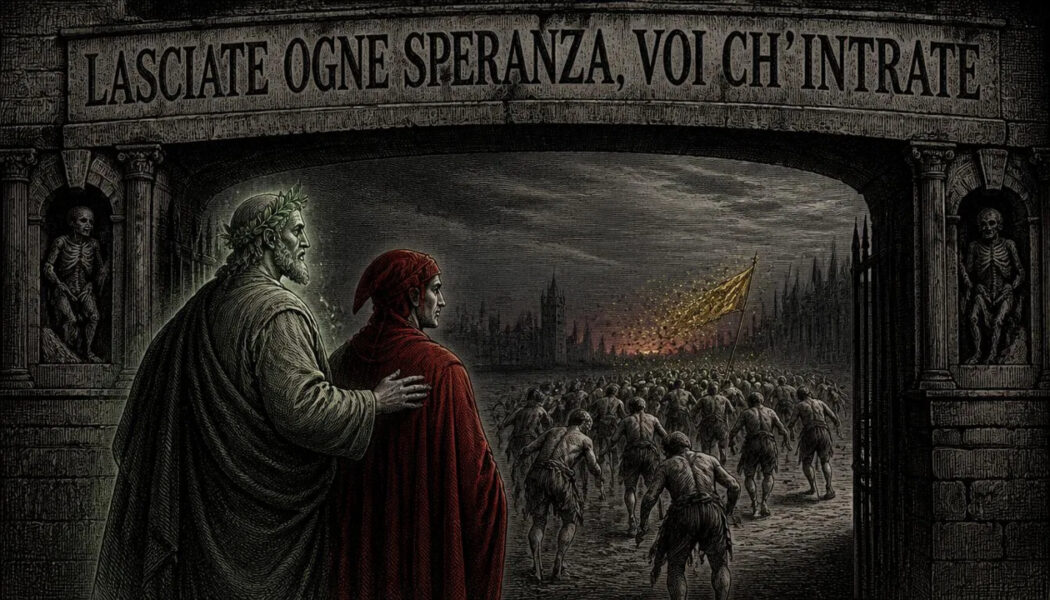
Dante, crossing the gate of Hell in Canto III of the Inferno, hears from Virgil that he will see the sorrowful who have “lost the good of the intellect”: not the capacity to think, but its object, the truth that is God—the Good. The first souls he encounters “lived without infamy and without praise,” rejected by both Heaven and Hell. He sees a vast multitude that moans and pursues a banner that spins ceaselessly, stung by wasps, while worms at their feet gather their blood and tears. They are “the indifferent,” sorrowful souls who never resolved to choose the good and avoid evil. Their restless pursuit is the image of reason separated from the contemplative rest of the intellect.
Our schools now pursue the same spinning banner in the Inferno. Outcome-based rubrics and standardized tests have produced generations of graduates with useless skills and mountains of data for mindless experts to exploit. We have extirpated the immaterial and yet demand that students be fruitful.
The remedy is simple. In my classes we put everything away and sit together in silence until I begin to present the first principles, such as that the whole is greater than its parts. I intentionally ask them to receive what is set before them in a state of leisure, rest, and passive receptivity. When we ground our educational methods in rest, receptivity, and the direct grasp of first principles, children not only learn to reason well through the liberal arts, but ultimately become impossible to deceive.
Lewis is clear: the heart “can, and must, obey” the head, provided the head is formed to grasp reality. His castrated were commanded to be fruitful. Our graduates are commanded to think critically. Both demands are vain. Recovery begins at home, where parents, trusting in grace, must restore leisure and truth before asking children to reason. Before granting another year to modern education, we must rediscover what the mind is and what it is for, lest we turn our own children into men without minds.
About the author
Steven Jonathan Rummelsburg directs City of Truth Educational Consulting for the Diocese of Charleston and writes St. Isidore’s Artisan Academy, a newsletter that seeks to recover authentic Catholic education through the wisdom of the Church’s 2,500-year intellectual tradition.