


By John M. Grondelski
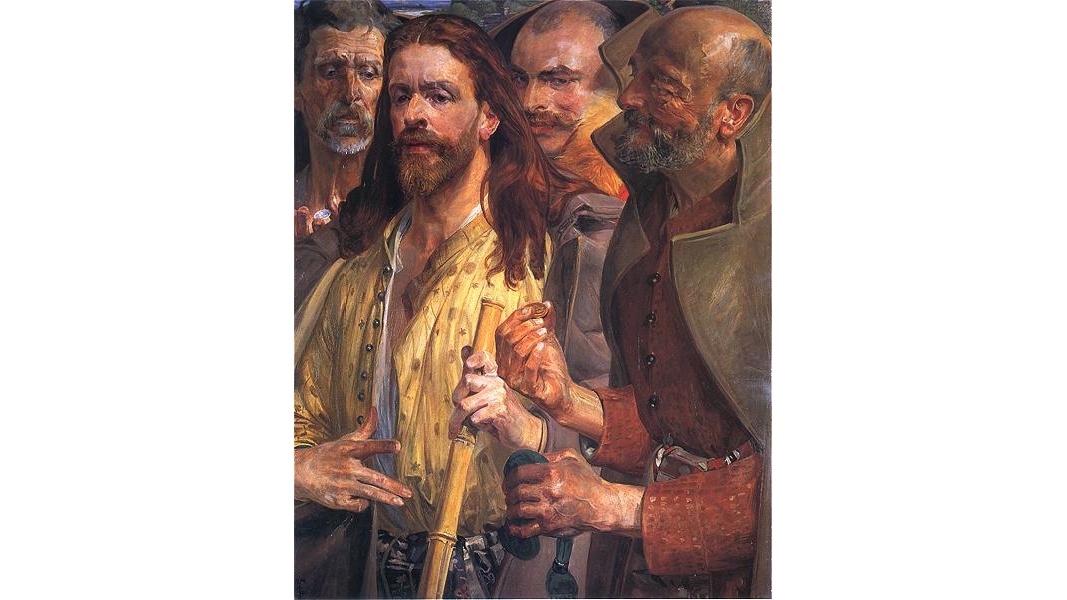
This Sunday’s Gospel presents one of those teachings that people can always quote, believing they understand what Jesus meant—until they start discussing the topic with others: “Give to Caesar what is Caesar’s, and to God what is God’s” (Matthew 22:21).
The context of Jesus’ teaching was, of course, an attempt to trap him: the Pharisees were looking for a “gotcha” moment in which they could use Jesus’ words either to turn the people against him or to get him into trouble with the Romans. By asking whether it was “lawful” to pay taxes to the Romans, they knew that an affirmative answer would separate Jesus from the vast majority of Israel, which had been enduring Roman occupation with growing irritation for nearly a century, while a negative answer would amount to defying the government of Rome. Jesus evades the trap by speaking of the things of Caesar and the things of God—without explicitly saying what belongs to whom.
Jesus’ words were social teaching: a recognition of civil government and its autonomy. In that sense, they remain cornerstones of Catholic social ethics. But just as those words left some ambiguity in first-century Israel, today—in a different world—many who hear them project their own context onto them.
Jesus acknowledges that both God and Caesar are rulers who exercise authority and to whom their subjects owe certain obligations. Jesus is not saying that God and Caesar are rulers of the same kind or that their relationship is symmetrical. It is not.
There are things owed to God and things owed to Caesar. But recognizing that some things are owed to Caesar does not mean that they are not also owed to God. God and Caesar do not divide things in a mutually exclusive way. There is nothing that belongs to Caesar that has not first belonged to God and does not still belong first and foremost to him—including Caesar himself.
To hold otherwise is to fall into the errors of pagan Rome, where, at various times, the emperor himself was made a god. Caesar is not a competitor to God or an alternative “power base.” In antiquity, what we today call “Church” and “State” were not separate. The ruler was often seen as God’s representative, although his all-too-frequent apotheosis was idolatry.
The idea of the ruler as a divine representative is not far-fetched. The reason Israel had no king for so long was that God was its king and Israel his people. That was the essence of the Covenant. Of course, Israel eventually demanded a king so that “we also may be like all the nations” (1 Samuel 8:19-20). The demand proved prophetic: with few exceptions, the kings of Israel and Judah dragged the people down to a moral level “like that of all the nations” (1 Samuel 8:5).
But, at its best, kingship in Israel was seen as a representation of God because the king was to lead Israel in the ways of God: that is why Solomon asks for wisdom “to govern your people, [so] that I may discern between good and evil” (1 Kings 3:9). The same concept operates in the Western notion of the divine right of kings. The king is appointed by God not to exercise his own arbitrary will, but to guide the people in the ways of justice. Yet both in Israel and in the West, reality rarely matched the ideal.
Jesus’ response to the Pharisees was meant to acknowledge temporal authority, but without excluding divine primacy. Even kings, even Caesar, are subject to the Ten Commandments. Admitting the limited scope of what is owed to Caesar is to recognize the legitimate autonomy of created things, a concept affirmed by the Second Vatican Council (Gaudium et spes, no. 36).
The created world has its own intrinsic order: in that sense, God is a kind of divine watchmaker who builds into his creatures the mechanisms of their functioning. But—and here it is important to distinguish the legitimate autonomy of earthly realities from deism—God does not walk away after Creation or from history. The autonomy of earthly realities is not an autonomy separate from God, independent of him, or that is ultimately not rooted in him: it is God’s design.
The “privacy” that drives the Western world still waits, in vain, to find a positive answer to the psalmist’s question: “Where can I flee from your presence?” (Psalm 139:7), even in “autonomies” radically divorced from God. That same “hope” persists in the way some read what Jesus says about the things of God and the things of Caesar. It is a hope that goes back to the Garden of Eden, when our first parents succumbed to the illusion that a part of the garden could be fenced off and placed beyond the reach of its owner.
The modern notion of the separation of Church and State comes into play here, including the way some read Jesus’ response to the Pharisees. Caesar does not have unlimited autonomy before God. Civil life cannot be fenced off to keep God or his Law out. Jesus certainly never intended his words to serve as the basis for a public square stripped bare from which Caesar could banish God for invading his “things.” That is the underlying assumption behind the caricatures of conscience of the “personally opposed” type that various contemporary politicians defend, convinced that the limited autonomy of public life gives their partisan ambitions free rein in moral matters.
The best of the American tradition affirms something very different. Jefferson grounds the right to revolution in the principle that when “any form of government” becomes destructive of the inalienable rights conferred by God, the people have “the right to alter or abolish it.” The Constitution seeks to contain overreaching caesars by dividing and enumerating powers. John Adams sums it up when he observes: “Our Constitution was made only for a moral and religious people. It is wholly inadequate to the government of any other.”
Because only a “moral and religious people” will recognize that Caesar’s arms are too short to box with God.
About the author
John Grondelski (Ph.D., Fordham University) was associate dean of Seton Hall University’s Immaculate Conception Seminary School of Theology in South Orange, New Jersey. All opinions expressed herein are exclusively his own.