


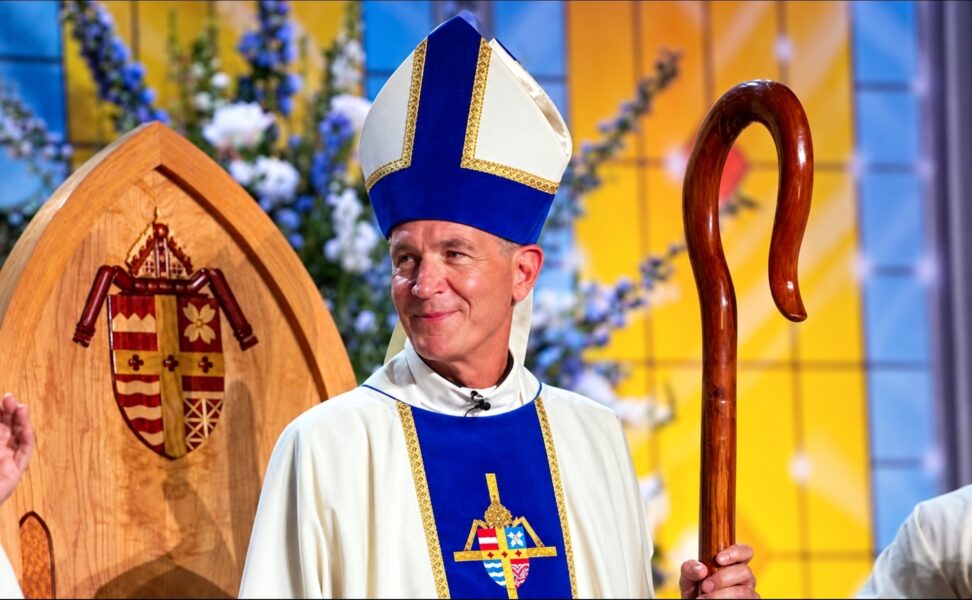
Monsignor Mark Beckman, bishop of Knoxville (Tennessee), has published a column in his diocesan newspaper titled “Saint Michael the Archangel, pray for us.” Under that heading, with the serenity of someone signing a routine document, he announces that he has asked his priests to discontinue the prayers the faithful recite together before Mass and immediately after it. The first to fall is precisely the prayer to Saint Michael. The title invokes the archangel, and the text expels him from the church.
A panegyric with an order of exile
The column overflows with praise. Leo XIII composed the prayer, Saint John Paul II asked that it be recited, Francis recommended it, it forms part of the Church’s treasury of prayer, and the world today needs, the bishop himself says, the archangel’s protection. With all of this acknowledged in writing, the conclusion is incomprehensible: outside the church. The urgency of the battle is admitted, yet the order is given to sheathe the sword. No sane general would issue such an instruction to his troops in the middle of combat.
The bishop acknowledges that his faithful love these prayers and that losing them will pain them. He knows it and does it anyway. That affection of the people, which any pastor would guard as a treasure, appears in his text as a resistance to be overcome with patience and catechesis.
No law requires it
The liturgical pretext collapses as soon as it is examined. Mass ends with the dismissal. Whatever the faithful pray after “Go in peace” lies outside the celebration, just as personal prayers or a candle lit before an image do. No rubric forbids it. Sacrosanctum Concilium, the document Monsignor Beckman cites with devotion, warmly recommends in its number 13 the pious exercises of the Christian people, and canon 214 protects the faithful’s right to their own spiritual life. To suppress a prayer that no norm forbids requires something more than liturgical zeal. It requires the will to suppress it.
And “active participation,” that conciliar formula invoked for everything, is used here to silence an assembly that prays aloud and in unison. Rarely has an expression been so twisted.
Who benefits
The classic jurist’s question, cui prodest, has in this case a chilling answer. The prayer to Saint Michael expressly asks that Satan and the evil spirits be cast into hell. Removing it from the church does not benefit the faithful, who lose a beloved devotion; nor the liturgy, which remains intact; nor the priests, condemned to explain the inexplicable. There is only one possible beneficiary, and it is precisely the one against whom the prayer was directed. It is difficult to imagine a diocesan order that the enemy would sign with greater pleasure.
Paul VI spoke in 1972 of the smoke of Satan that had infiltrated the temple of God through some crack. Half a century later, that smoke no longer needs cracks: a circular ordering silence to those who asked for defense against it is enough. In 2018, amid the abuse crisis, dozens of North American bishops, including the then-bishop of Knoxville, Richard Stika, called for the recovery of this prayer after Mass because they sensed that the rot also had a preternatural origin. His successor removes it. Evil has not disappeared from the Church; only the prayer that named it has been suppressed.
A Pope named Leo
Under the pontificate of Leo XIV, a bishop buries the prayer of Leo XIII with all honors and a smile. Leo XIII composed it, according to tradition, after a vision that showed him the siege of the devil upon the Church. Today that siege seems to find unexpected allies inside the very citadel.
The Catholics of Knoxville, and all Catholics concerned about the Mass, know what they have to do. Kneel when the priest withdraws to the sacristy and pray, aloud and without asking permission:
Saint Michael the Archangel, defend us in battle. Be our protection against the wickedness and snares of the devil. May God rebuke him, we humbly pray, and do thou, O Prince of the heavenly hosts, by the power of God, cast into hell Satan and all the evil spirits who prowl about the world seeking the ruin of souls. Amen.