


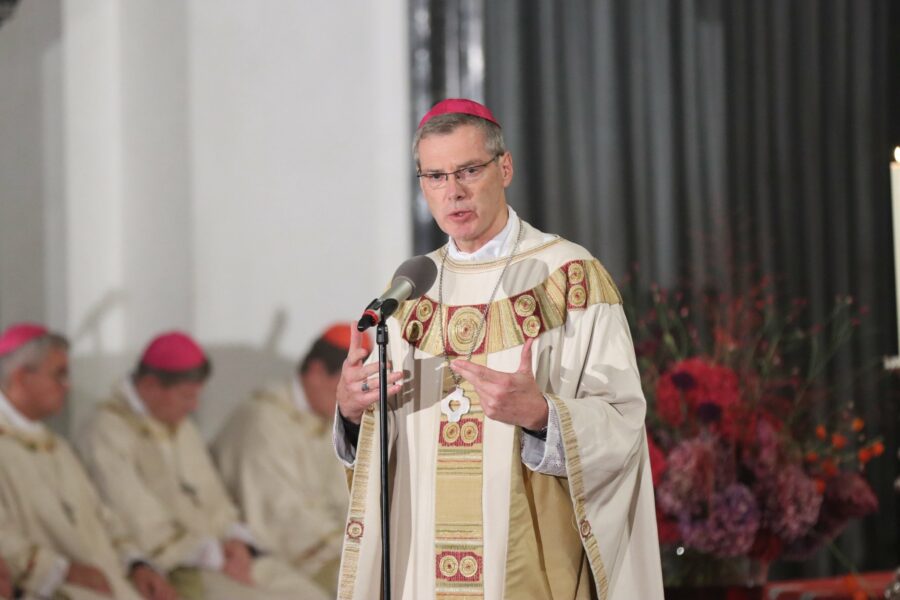
The president of the German Episcopal Conference, Heiner Wilmer, has acknowledged that the admission to communion of the divorced and civilly remarried was discussed controversially at the meeting held in Rome from October 7 to 14, bringing together the presidents of the episcopal conferences from around the world on the occasion of the tenth anniversary of Amoris laetitia. In the summary released by the German Episcopal Conference on Thursday, October 15, the bishop of Münster states that on this point “different opinions emerged regarding the relationship between canonical norms and the pastoral perspectives of Amoris laetitia”, and concludes: “These questions remain a challenge”.
This is confirmation, from a participant, that the meeting convened by Leo XIV did not settle the issue that has divided the Church since 2016. The synthesis report of the working groups, which was to be released at the end of the proceedings, has not been published. According to CNA Deutsch, the Pope’s intervention forced its postponement, and Leo XIV himself indicated that he would speak on the matter in due time. The German Catholic agency KNA adds that the Pope wanted to see the text before its release and, if necessary, complete it, and the president of the Pontifical John Paul II Institute, Philippe Bordeyne, acknowledged at the final press conference that it is still unclear how the conclusions will be made public.
Wilmer was part of an Italian-language working group that, according to the German statement, included two bishops from China, one from Mongolia, Poland, Mexico, Croatia, Bulgaria, Slovenia, Greece, and Italy, as well as the prefect of the Dicastery for the Doctrine of the Faith, Cardinal Víctor Manuel Fernández. The note does not attribute positions to any of them nor does it state that the group reached a common conclusion on the communion of the divorced and civilly remarried.
The rest of the summary addresses other matters. Wilmer highlights the family as a place for the transmission of faith, mentioning grandparents, Catholic nurseries, and the Epiphany choir children, and maintains that the debates showed the need to study more deeply the texts of the Second Vatican Council on the family, the transmission of faith, and Sacred Scripture. He also says he wanted to draw attention to violence within families, particularly violence against women up to femicide, which he describes as a shocking reality that cannot be ignored when speaking of marriage and family. He concludes with a statement of intent: “As a Church, we do not only want to find answers for families, but to be willing to learn from them.” And with a judgment on Francis’s document, which in his view “remains, ten years after its publication, a reference that marks the way” for the pastoral care of couples, marriage, and the family.
Wilmer has presided over the German episcopate since February 24, 2026, and Leo XIV transferred him from Hildesheim to Münster in March. Before traveling to Rome, at the end of the autumn plenary assembly in Fulda, he announced that he would bring to the meeting the experiences gathered in conversations with “very different” couples, including same-sex couples and divorced persons living in a second civil union. The main pronouncement of the German bishops on Amoris laetitia is the document The joy of love lived in families is also the joy of the Church, approved by their Permanent Council on January 23, 2017. That text rejected both a general exclusion and a general authorization of the sacraments and affirmed that “a decision in favor of receiving the sacraments must also be respected”.
At the other end of the debate, the bishop of Trondheim, Erik Varden, who also participated in the meeting, defended after its conclusion that the faithful in irregular situations live what he called a “sacramental exile” and placed the issue in the realm of conversion. Between these positions, the final report has yet to see the light of day. Ten years after Amoris laetitia, the president of the German bishops returns from Rome with the communion of the divorced and civilly remarried turned, in his own words, into a pending challenge.
Read also
- Wilmer will bring to Rome experiences of “homosexual couples” and divorced and civilly remarried persons at the meeting on Amoris laetitia
- The Amoris laetitia summit report reinterprets “fragility” and converges on discernment
- Varden, after the meeting on Amoris laetitia, claims the “sacramental exile” of the faithful in irregular situations