


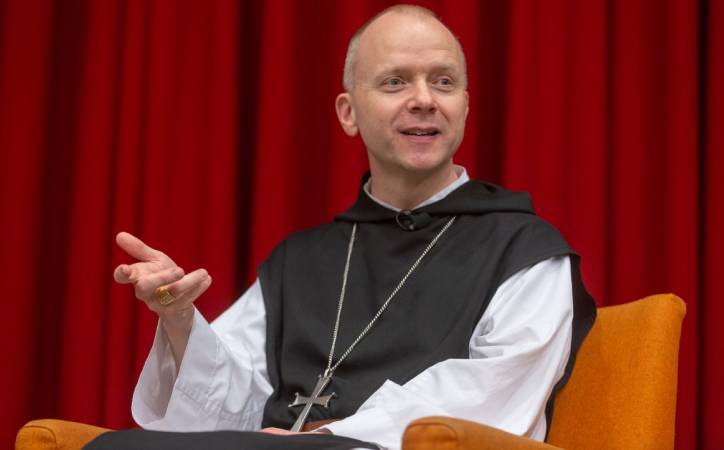
The words of Varden have been spread by journalist Michael Haynes on the social network X. They respond to a question about his participation in the meeting and about the possibility that divorced people who have remarried civilly may receive Communion. The Norwegian prelate places the issue in the realm of conversion: «A main pastoral concern in such situations is to remember the bigger picture, allowing those who suffer to discover the potentially fruitful meaning of their difficulties, which can serve to diminish selfishness and purify love». And he adds: «Marriage, no less than monastic life, is a school of conversion».
«It is acknowledged, not relativized»
Varden states that, in his experience, Catholic communities usually welcome these situations «with maturity». For those living in an irregular relationship, he maintains, it can be «liberating» to find themselves in an environment where that irregularity «is acknowledged, not relativized». In that same environment, nonetheless, they are welcomed with Christian friendship and can contribute to community life.
The bishop gives as an example many faithful he knows who, «Sunday after Sunday», come forward to receive a blessing at the time of Communion, «knowing that they cannot access the sacrament, but entrusting themselves to the mercy of God who acts in the Church». In his view, that fidelity builds up the community and bears witness «to the living realism of the sacrament and to the virtue of hope». And he concludes: «A sacramental exile sustained over time can prepare a joyful return home».
Christ, Varden writes, gave us his «rigorous commandments» to educate us and free us from ourselves. His purpose, he recalls with words from Eucharistic Prayer IV, is that «we may no longer live for ourselves, but for him, who died and rose again for us». The goal that must be proposed to people, he emphasizes, is always the new and divinized life, «not mere human affirmation, although we all also need a little of that».
A meeting focused on «fragility»
The meeting was entitled «Ten years after Amoris laetitia: proclaiming the Gospel with families today». Leo XIV convened it from October 7 to 14 with the presidents of the episcopal conferences and the heads of the Eastern Churches, and work was carried out using «conversation in the Spirit», the method of the Synod on synodality.
The session on Monday the 12th addressed divorced and remarried people within the so-called family «fragilities». In it, theologian Julie Hanlon Rubio recounted the case of an elderly woman with dementia who refused the Eucharist because her husband had been married before. According to the magazine America, Cardinal Joseph Tobin stated that day that he had not heard anyone who wanted to return to the practice prior to Amoris laetitia.
The synthesis document of the meeting has not been made public. According to Fr. Giacomo Costa, it was Leo XIV himself who asked to receive it personally in order to review the materials and issue a statement after his hospitalization.
The controversy over Francis’s exhortation has focused since 2016 on footnote 351. Also influential was the interpretation of the bishops of the pastoral region of Buenos Aires, which in some cases allowed access to Penance and the Eucharist after an accompanied discernment. Familiaris consortio, on the other hand, had reaffirmed the practice of not admitting divorced and remarried persons to Eucharistic Communion.
On the very day of the opening, Varden published on his blog Coram fratribus some reading notes on the exhortation. Among them is the passage in which Francis warns that the Church must in no way renounce proposing the full ideal of marriage (n. 307). In his new text he does not propose access to the sacraments. What he describes is sacramental abstinence lived as a path of conversion and hope.