


By Msgr. Alberto José González Chaves
Ninety years have passed since the tradition that attributes to Saint Teresa of Jesus – or to Our Lady of Sonsoles, or to Both? – the preservation of the City of the Knights during the terrible summer of 1936. Disdainful smiles at what our elders believed? Credulity that turns pious tradition into a notarized deed? Faced with the contemporary mania of thinking that, when a story possesses some supernatural dimension, the historian must choose between swallowing it whole or tossing it entirely into the basket of superstitions, there is a third, more honorable possibility: first establish what happened; then determine when the extraordinary account began to be told and observe how the narrative was transformed. The reader will decide at that mysterious point where the documents end and interpretation begins. But let us say from the outset: the story of the little old woman who stopped Julio Mangada’s troops was not a fable invented years later, when everything was over: it circulated in the very months of the war.
Ávila: vulnerable and intact in July 1936
In the last days of July 1936, Ávila experienced the hours of greatest military anxiety of the entire conflict. The city, having joined the Uprising, was scantily garrisoned. Lieutenant Colonel Julio Mangada was advancing from Madrid at the head of a heterogeneous column of militiamen and public-order forces that, after passing through Cebreros and Navalperal de Pinares, positioned itself to seriously threaten the capital. On 24 July, while the funeral for Commander Gabriel Moyano was being held in the church of San Juan, alarming news arrived about the proximity of that column. The Ávila historian José Belmonte Díaz, who was present and left testimony of those moments, recalls the haste with which volunteers were called for, weapons were distributed at the Military Government, and groups of civilians with virtually no training were organized. A force sent to meet Mangada had to fall back before his manifest superiority. For several hours the road to Ávila remained disturbingly open. Mangada crossed the Malagón pass, reached Aldeavieja and could have headed toward Ávila, but he did not: he preferred to advance toward Villacastín, threatening the communications and rear of the forces fighting at Alto del León, and shortly afterward returned toward El Espinar and Madrid. When he resumed operations in the province with much larger forces—several thousand men—he likewise did not launch an assault on the capital. Historians point to various possible reasons: lack of organization and logistical support, uncertainty regarding opposing forces, different strategic objectives, or simple indecision. What is indisputable is that at that first moment Ávila was militarily far more vulnerable than later epic memory would suggest. And not a few Ávila residents wondered why Mangada did not enter.
On Christmas Day 1936, barely five months after the events, journalist Léo Gerville-Réache, special correspondent in Spain for the Parisian newspaper Le Matin, published an article with an unequivocal title: «Le dernier miracle de sainte Thérèse d’Avila», «The Last Miracle of Saint Teresa of Ávila» (Le Matin, no. 19,272, 25 December 1936). Three days later, on 28 December, El Diario de Ávila carried the story; it is not a lost reference reconstructed in modern times. Researcher Nicolas Mollard, in an academic study published in Slavica Occitania, documents both versions, noting that already in December 1936 the account was circulating according to which Teresa of Jesus had appeared before a Republican commander in the guise of an old woman to dissuade him from seizing Ávila.
According to that first narration, when it was very possible for Mangada’s forces to advance on Ávila, an old woman appeared who described a formidably protected city, populated with soldiers and weapons, absolutely prepared to repel any attack. In material terms, the garrison of Ávila was far from matching such a description: if one accepts even as an internal hypothesis of the story the identification made by tradition—Our Lady of Sonsoles for some, Saint Teresa for others—it is not plausible to attribute to the Blessed Virgin or to the Saint a falsehood intended to deceive the adversary. The religious interpretation can be considerably deeper: that woman spoke of a city that was truly defended, although its defenders were not countable in a military dispatch. For the faith of the people of Ávila, Ávila was under the custody of heaven, sheltered by the intercession of its saints and by the angelic armies that Sacred Scripture so often presents as invisible and yet real. «Many, many» could be true in a sense that Mangada understood as strictly military: the angels of God, under the command of the Guardian of the Kingdom, were guarding Ávila of the King. As in the biblical scene of Elisha, human eyes could see few defenders while faith repeated: «Those who are with us are more than those who are with them» (2 Kgs 6:16). The French chronicle expressly placed the story under the protection of Saint Teresa. It is not a Teresian identification added years later: before the end of 1936 the episode was already being told as «the last miracle of Saint Teresa of Ávila». If the old woman was who the old people of Ávila believed she was, she was not inventing defenders: she saw a city guarded by the heavenly militia, while Mangada understood it as military information.
An old peasant woman on horseback?
The story continued to circulate and acquire more distinctly Ávila profiles. After the war, El Diario de Ávila returned to the episode, headlining its front page of 7 May 1939: «The poor old woman who saved Ávila». Mangada would have asked an old woman who had just left the city about the forces inside. The answer multiplied soldiers, rifles, and machine guns: – «Many, many». Virtually every battlement would be defended.
The parallel with the old tradition of Jimena Blázquez is inevitable. At the beginning of the twelfth century, when Ávila was a frontier city and its men had gone out to fight, Ávila memory places that valiant woman organizing the defense of an almost ungarrisoned stronghold: she had the women dressed as warriors, posted them on the walls with weapons, torches, and trumpets, and succeeded in making the Muslim forces of Abdalá, believing the city much better defended than it really was, desist from the attack. Eight centuries later, the 1936 tradition repeats the same pattern: another woman would have made Mangada believe that behind those same walls an imposing army awaited. Jimena defended Ávila from atop its towers; Teresa, according to the account, from the road. In both cases, the city is saved without the need to give battle. Did the city’s memory lend ancient forms to the modern episode? But literary kinship does not prove that the story was fabricated from beginning to end: it simply shows how collective memory works, clothing new events with images a community has known for centuries. Now, for some, the little old woman had been Saint Teresa; for others, the Virgin of Sonsoles. For all, the protection of the One and the Other was inseparable.
According to the version that took deepest root in oral tradition, the old woman, on a mount, meets Mangada’s men in the vicinity of Sonsoles.
—Where are you going?
—To take Ávila.
The woman warns them that it would be madness to attempt it because the city is crammed with troops, weapons, and defenders. Then she continues on her way and disappears. Anthropologist María Cátedra collected this tradition directly from Ávila informants and published it in 2001 in a wide-ranging Complutense University study on devotion to Our Lady of Sonsoles. One of her witnesses recalled having heard of that lady «with a little donkey», dressed as a peasant woman, who had warned the forces: Ávila was «full of troops» and they could not enter. The researcher adds in a note that the versions vary regarding the identity of the old woman: «either the Virgin of Sonsoles or Saint Teresa». We are not, therefore, dealing only with wartime journalistic literature, but with an oral Ávila tradition that survived for generations. There is also something delightfully Teresian in it: if someone wished to invent a spectacular apparition of the Saint, they would probably have chosen radiances, ecstasies, angels, or walls covered with prodigies. Ávila tradition preferred an old peasant woman mounted on a mule: very little supernatural stagecraft for a woman who had written that «the Lord walks among the pots and pans». And if it was Our Lady of Sonsoles, neither could the Virgin of the Ávila countryside have chosen a better disguise.
Sonsoles, bombs, martyred priests
With the passage of time another set of memories related to the bombings suffered by Ávila became mixed with this story; yet the chronological clarification does not harm, but rather supports the veracity of the account. The military airfield of Cruz de los Llanos, built between the Chico River and the sanctuary of Sonsoles, did not yet exist when Mangada threatened the capital in July; it began to be prepared from September 1936 onward. It would later become an important aviation base, used by Spanish, Italian, and German forces; the enclosure included hangars, barracks, arsenals, depots, and powder magazines. That airfield must not be confused with Mangada’s decision in July: they are successive episodes, not simultaneous ones; but the airfield explains why the Sonsoles area later became an aerial target. Already in November 1936 the base was bombed, and in 1937 attacks against the airfield and other strategic Ávila targets were repeated. Antiaircraft defense was eventually reinforced at various points, including the heights near the sanctuary. And here too María Cátedra records a precise popular memory: her informants remembered that next to Sonsoles were the powder magazines, that during a heavy bombardment bombs fell in that area and that some did not explode. Recalling the small number of deaths compared with the danger those military installations posed, they linked the fact to the Virgin’s protection. As thanksgiving, a small votive airplane remained in the Sanctuary for many years, and popular memory thus ended up fusing two distinct episodes: the city Mangada did not enter in July and the city that, later having an airfield and powder magazines of evident military importance next to Sonsoles, suffered bombings without enduring the destruction that might have been feared. If that fusion does not authorize turning every detail into verified military information, neither does it invite us to dismiss it: it tells us how the people of Ávila interpreted what they had lived through.
The Republican bombing of 31 August 1936 produced three deaths when one of the bombs fell on the San Vicente area, where the Circo Maravillas had been set up. Some sources raise the toll to five when counting wounded who later died; hence the «five or six» deaths preserved by oral tradition. But the complete story requires adding something more. That bombing provoked a brutal reaction in the Nationalist rear: during the following night twenty-nine prisoners were murdered. Catholic memory does not need to erase the sins committed by those on its side. Nor would it be historically honest, conversely, to erase the religious persecution unleashed in broad areas dominated by revolutionary forces during that summer. Not all Republicans were Marxists, nor did all left-wing men persecute the Church, but the explicitly anti-Catholic component of the revolutionary process of 1931-1936 is a stubborn fact. In the diocese of Ávila there were thirty-three martyred priests, in addition to numerous laypeople and profaned, damaged, or burned churches; and archives and objects of worship were destroyed in the southern zone of the diocese. On the very 24 July when Ávila lived in suspense over Mangada’s advance, Don José Máximo Moro Briz, parish priest of Cebreros and brother of Don Santos, exemplary Bishop of the diocese from 1935 to 1968, was murdered in El Tiemblo. Later would come Don José García Librán, parish priest of Gavilanes; Don Juan Mesonero Huerta, parish priest of El Hornillo; Don Damián Gómez Jiménez, parish priest of Mombeltrán; and Don Agustín Bermejo Miranda, parish priest of Hoyo de Pinares. The five were beatified as martyrs in Tarragona in 2013. Their remains are venerated in Ávila Cathedral. This is the context in which the fear of the people of Ávila must be read. For those who looked from the walls toward the places through which Mangada’s column was advancing, it did not simply mean that the City Council would change hands: a few kilometers away churches were burning and priests were being persecuted.
The hand of the Saint of the Race guides the Caudillo’s hand
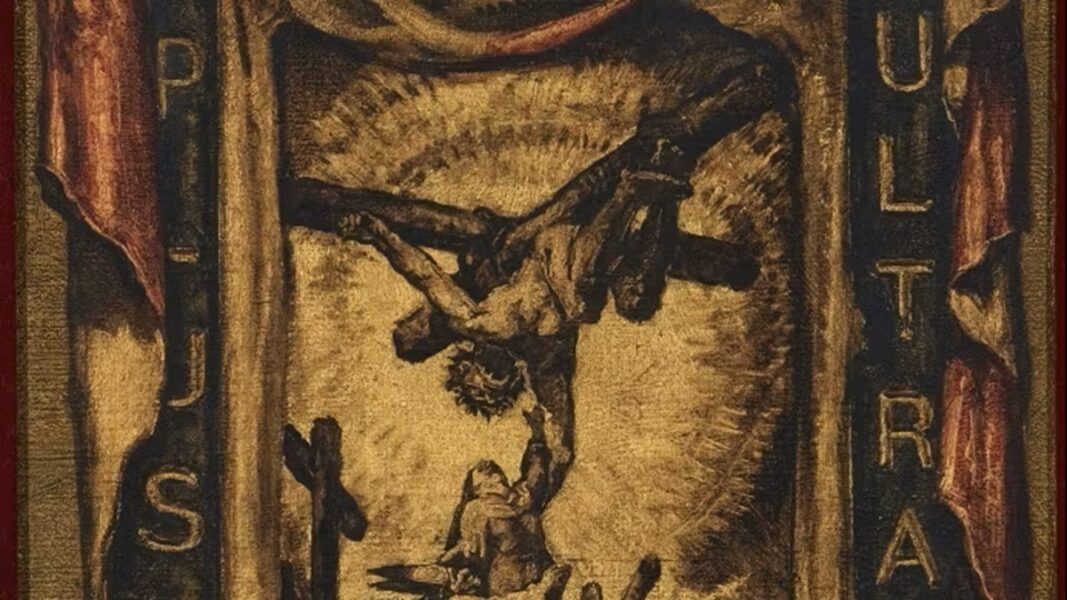
Belief in a special intercession of Saint Teresa during the Civil War overflowed the Ávila tradition of Mangada. In broad Catholic circles of the Nationalist side, which interpreted the conflict as a «Crusade», the Saint of Ávila was considered the protectress of Spain. The historian cannot present that conviction as proof of a supernatural intervention, but neither can he ignore it because of the discomfort its language may arouse today. A singular iconographic testimony is offered by José María Sert, who in 1937 painted for the Spanish chapel of the Pontifical Pavilion at the Paris International Exposition the Intercession of Saint Teresa of Jesus in the Spanish Civil War, a work documented in the holdings of the Museo Reina Sofía, which also preserves a preparatory study. While the Republican pavilion exhibited Picasso’s Guernica, the Pontifical one proposed another interpretation of the tragedy: Teresa interceding for Spain.
That conviction found a tangible symbol in the incorrupt hand of the Saint, separated from her body shortly after her death by Father Jerónimo Gracián and kept in Lisbon and, after various vicissitudes, from 1926 onward in the Carmel of Ronda. Confiscated on 29 August 1936 by the city’s Revolutionary Committee, it was recovered by Nationalist forces in Málaga in February 1937, and Franco wished to keep it with him until his death. The national press attributed a providential meaning to it. José María Muñoz Sánchez, as Nicolas Mollard records, wrote: «How well the Caudillo of Spain does […] to keep Teresa’s hand always beside him!», attributing Franco’s «success» during the war to the Saint. Teresa «is seeking Franco to save Spain», the chaplain told the foundress and prioress of Ronda, Mother María de Cristo, who nevertheless repeatedly requested the relic from the Caudillo, without success. During the war the saintly hand was in Salamanca, Burgos, and Madrid; afterward, until 1975, it remained in the Palacio de El Pardo, according to some testimonies in the private oratory; according to most, in Franco’s personal apartments, and he also carried it with him on certain journeys.
Giuliana Di Febo has studied the political use of Teresa as the «Saint of the Race», particularly in her chapter «The Hand of Teresa and the Charisma of Franco». That instrumentalization existed, but it does not exclude the sincerity of the devotion: public use of a symbol and private piety can coexist. Thus three distinct episodes are linked: the presumed protection of Ávila in 1936, Sert’s painting in 1937, and the presence of the relic beside the leader of the Nationalist side. Recognizing that devotion does not require justifying political or military decisions or turning its protagonists’ beliefs into supernatural certainties. It requires understanding that, for many Spaniards marked by religious persecution, Teresa was a close intercessor in an extreme hour of their history. Political instrumentalization does not prove that faith was feigned, just as its authenticity does not demonstrate the interventions attributed to her.
After Franco’s death, on 9 December 1975 his widow Doña Carmen Polo delivered the relic to the primate cardinal Don Marcelo González Martín, who on 21 January 1976 restored it to the Discalced Carmelite nuns of Ronda, to whom it returned after nearly forty years.
So, was it a miracle of two women?
This is the least historical question. The historian can demonstrate that Mangada was in a position to threaten Ávila and did not enter it; that the city had a precarious defense in those first hours; that before the end of the same year 1936 a French newspaper already headlined the episode of a mysterious old woman as «The Last Miracle of Saint Teresa of Ávila» and that El Diario de Ávila reproduced it immediately; and he can document that the memory remained alive in oral tradition half a century later. What the historian cannot demonstrate is that that old woman was Saint Teresa, or the Blessed Virgin under human appearance. Nor can he demonstrate that she was not. Quite simply, those are not propositions susceptible of being resolved with an operations report.
Faith does not declare it a miracle: the Church has always been far more cautious than devotees sometimes are. Between believing that God governs history and demanding that every providential episode be accompanied by a verifiable suspension of natural laws lies a considerable distance. The most exact word is tradition. Faced with objectively dangerous circumstances and a military decision that spared Ávila something that could have been terrible, a religious account arose to explain that unexpected preservation, pointing to two names: Teresa and Sonsoles. It does not seem too strange. Ávila did not need to look far for her protectresses: inside the walls was Teresa; outside, beside the fields through which for centuries farmers, shepherds, and people of the Amblés Valley had come, was Sonsoles. In the urban and crowded housing, Teresa de Ahumada was the daughter of the city; the Lady of Sonsoles, her Mother, always in the open air, among roads, peasants, and beasts of burden. And memory ended by imagining that, when armed men asked how Ávila could be conquered, a woman, as aged as that city, came out on a mule to meet them and advised them to go away. No heavenly armies or flaming swords, not even a great lady: an old village woman who knew more than she seemed.
Teresa would have smiled at such a method. The Virgin of Sonsoles would have too.
__________________________
Principal sources consulted: Léo Gerville-Réache, «Le dernier miracle de sainte Thérèse d’Avila», Le Matin, no. 19,272, 25-XII-1936; El Diario de Ávila, 28-XII-1936 and 7-V-1939; María Cátedra, «La ciudad y su tierra: la Virgen de Sonsoles», Revista de Antropología Social, 10 (2001), pp. 71-121; José Belmonte Díaz, Ávila en la Guerra Civil; Nicolas Mollard, «Thérèse d’Avila au service du renouveau de l’Église catholique, puis du nationalisme espagnol (1882-1962)», Slavica Occitania, 61 (2025), pp. 99-116; Giuliana Di Febo, La Santa de la Raza. Teresa de Ávila, un culto barroco en la España franquista (1937-1962), Barcelona, Icaria, 1988; José María Muñoz Sánchez, Santa Teresa de Jesús, síntesis de su vida, sus patronazgos, Ávila, 1961; Gonzalo Huesa Lope, La mano de Santa Teresa de Jesús; Teresian documentation on the Saint’s relics; documentation of the Diocese of Ávila on José Máximo Moro Briz and companion martyrs; and the Ávila newspaper archive of July-August 1936; Antonio Pirala, «La historia de la mujer Jimena Blázquez. Heroica defensora de Ávila», Álbum de señoritas y Correo de la moda, 31-I-1859, pp. 25-26.