


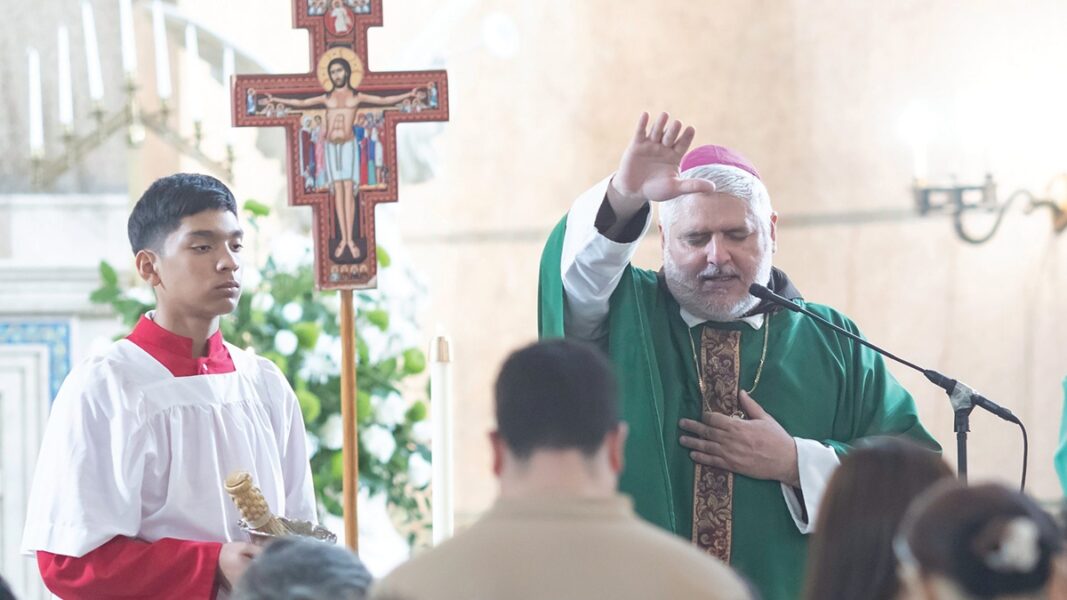
The Bishop of Venice, in Florida, Emilio Biosca Agüero, O.F.M. Cap., led a pilgrimage of young adults to the National Shrine of Our Lady of La Leche, located at the historic Mission Nombre de Dios in St. Augustine, on October 10 and 11. It was the first diocesan pilgrimage presided over by the new bishop, with one of the most important sites in the history of Catholicism in the United States as its destination.
The initiative, organized by the Diocese of Venice, responded to an invitation from the Bishop of St. Augustine, Erik Thomas Pohlmeier, and his predecessor, Felipe de Jesús Estévez. Over two days, the participants, young people between 18 and 35 years old, shared moments of prayer and fellowship before walking the path that leads to the Marian shrine.
On Saturday, October 10, the young people gathered at a campsite on the beach of St. Augustine, where the day was spent in prayer, fellowship, and an evening around a bonfire. On Sunday the 11th, after breaking camp, the pilgrims set out early in the morning and walked approximately five kilometers to Our Lady of La Leche. There they were joined by families and parish groups from various parts of the diocese, and Bishop Biosca Agüero celebrated Mass at 11:00 a.m. at the rustic outdoor altar of the shrine. The day concluded with a shared lunch.
The place where the permanent Catholic presence began
Mission Nombre de Dios is linked to the arrival of the Spanish in Florida in the 16th century. On September 8, 1565, the adelantado Pedro Menéndez de Avilés landed on the shores of present-day St. Augustine, accompanied by settlers and religious. Shortly afterward, the priest Francisco López de Mendoza Grajales celebrated a Mass of thanksgiving.
That event holds a prominent place in U.S. religious history. The diocese recalls that the first permanent Catholic parish community in the territory that now constitutes the United States was established there. The 1565 celebration is also often remembered as the first documented Mass in the permanent European settlement that gave rise to St. Augustine, although there are precedents of Catholic celebrations in other regions of present-day U.S. geography.
The founding of St. Augustine preceded other European settlements that would later acquire greater political and economic importance. Its history recalls that the Catholic presence in North America began long before the formation of the United States as an independent nation and was closely linked to Spanish evangelization.
The devotion to Our Lady of La Leche
During the 17th century, a chapel dedicated to Our Lady of La Leche and Good Delivery was established at Mission Nombre de Dios. The devotion represents the Blessed Virgin nursing the Child Jesus and recalls the reality of the Incarnation, by which the eternal Son of God assumed a true human nature and chose to be born of a mother.
Over the centuries, the shrine became a place of pilgrimage especially frequented by couples wishing to have children, pregnant women, and families entrusting their needs to the Virgin. Although the chapel suffered damage and had to be rebuilt at different times in its history, the devotion has continued to the present day.
The National Shrine of Our Lady of La Leche is recognized as one of the main testimonies of the ancient Marian presence in the United States. Its location within Mission Nombre de Dios allows the veneration of the Virgin to be connected with the beginnings of Catholic evangelization in Florida.
A pilgrimage to remember the roots of the faith
Bishop Biosca Agüero’s call was directed especially to young adults of the diocese. The program began on Saturday with prayer and fellowship activities, while the walking pilgrimage and the episcopal Mass took place on Sunday, coinciding with the shrine’s annual feast.
In his invitation, the prelate had highlighted the opportunity to give thanks to God in the place where a fundamental part of the country’s Catholic history began and to entrust the pilgrims to the protection of the Blessed Virgin. It was, in the bishop’s words, about “walking together in faith” and entrusting “the young people and the entire Diocese of Venice” to Mary’s maternal care.
The initiative allowed participants to get to know up close a religious heritage that often remains in the background in accounts of the origins of the United States. The presence of Spanish missionaries, the celebration of Mass, and the founding of Christian communities were part of Florida’s history from the 16th century.
Thus, this weekend’s pilgrimage united prayer and Marian devotion with the memory of the first steps of the Catholic Church in this region of North America.