


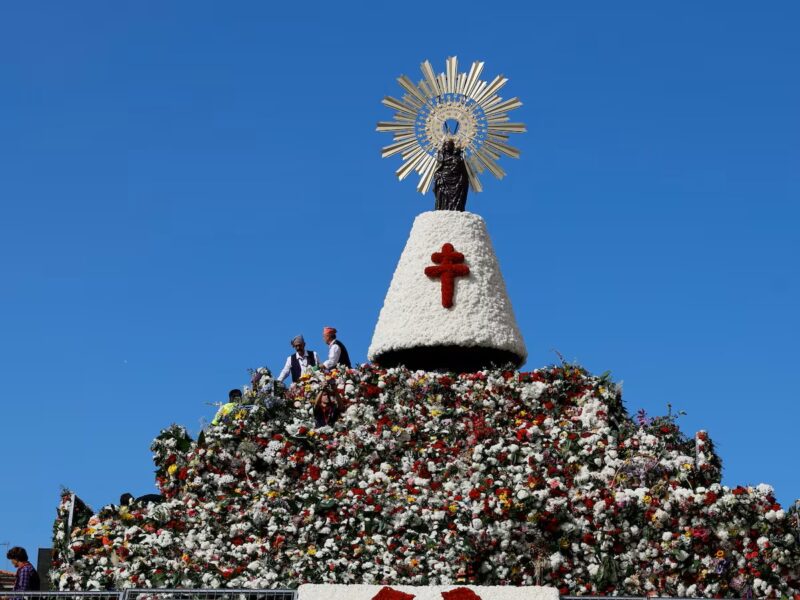
Archbishop Luis Marín de San Martín, an Augustinian from Madrid, almoner of Leo XIV and prefect of the Dicastery for the Service of Charity, presided over the main Mass of the Pillar. COPE (the bishops’ radio station, which never misses these things) found the headline at once: the prelate asked the Virgin that Spain overcome the permanent temptation to turn “political choice into disqualification of those who think differently.” He also asked for help against walls, ideologies and selfish interests, without the report clarifying which ones—safest way for no one to feel targeted.
There is something of a beauty pageant in all this. In the final round of Miss Universe, the finalist listens to the jury’s question, straightens her sash, smiles at the camera and gives the only answer that cannot cost her a vote: world peace. Sandra Bullock settled the matter in Miss Congeniality, and since then the response has not changed; only the finalists have. The homily at the Pillar, in a way, competes for the Miss Congeniality sash: it offends no one, commits no one and is forgotten before the Offering ends.
It is not the almoner’s invention, and that is where it gets serious. In June, at the Royal Palace, Leo XIV called for abandoning “divisive and polarizing narratives”; two days later, before the Cortes, he warned against “the permanent disqualification of the adversary,” and that same afternoon, at the Almudena, he spoke of tearing down walls. In April, Argüello had already devoted a good part of his inaugural address at the Plenary Assembly to polarization. The almoner himself referred in Zaragoza to the papal message, so October at the Pillar is a rerun of June in Madrid, with the same script (to repeat what the Pope said, the trip was unnecessary: the Sala Stampa bulletin would have sufficed).
No one defends insults; the problem is symmetry.
The formula places all political options on the same shelf and leaves tone as the only sin. The Church has written something else, and with a signature. The Doctrinal Note of the Congregation for the Doctrine of the Faith on Catholics in political life, dated 24 November 2002, signed by Joseph Ratzinger and approved by John Paul II, distinguishes legitimate plurality of temporal opinions from relativistic pluralism and recalls that there are “moral principles that admit of no derogation, exception or compromise.” Heading the list are abortion and euthanasia.
And there is more. The same Note uses the word now preached in Zaragoza, though pointing the other way: it calls intolerant secularism the political disqualification of Christians for being consistent with their conscience. It also distrusts irenic peace, the kind that ends up secularized (the Miss Congeniality sash, to be clear).
This has a date in Spain. In April, the Council of Ministers sent Congress a reform of article 43 of the Constitution so that public authorities would guarantee abortion, and on 30 April the Chamber rejected sending it back. Is opposing that polarizing? Is it just another disagreement, to be settled with good manners? Should it be treated with the delicacy due to regional financing…?
The feast, moreover, does not lend itself to that. According to tradition, the Virgin came to Zaragoza to sustain a discouraged James and left him a column so that the faith might stand firm in Hispania (the almoner, in the same homily, presented the Virgin of the Pillar as a symbol of firmness and called for tearing down walls: celebrating the pillar while demolishing the work is a bold architectural idea). The image venerated on that column holds a Child in her arms. It is the same Child of whom Simeon announced to Mary that He would be a sign of contradiction, in signum cui contradicetur, while a sword would pierce her own soul.
Christ does not divide through bad manners. He divides because He forces a choice. Equidistance before that is not pastoral prudence: it is another way of choosing, the most comfortable one.
Catholic means universal, not misuniversal.
The almoner asked the Virgin of the Pillar to help us tear down walls. She, according to tradition, came to leave us a column.
Read also