


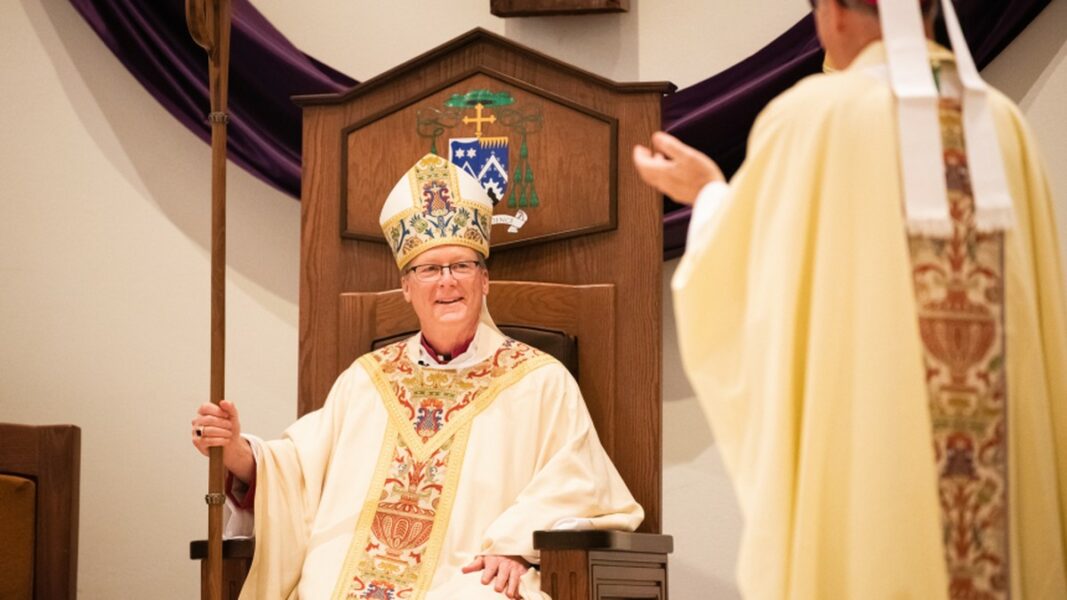
The Diocese of Gaylord, in northern Michigan, made public on October 8 three decrees from its bishop, Most Rev. Jeffrey J. Walsh, concerning the celebration of Mass. Dated October 2, they will take effect as particular law on the 15th, the feast of Saint Teresa of Ávila. Two of them—the one regulating the priest’s orientation at the altar and the one mandating the use of lay ministers—have been challenged by American writer Peter Kwasniewski, a specialist in traditional liturgy, who considers them unfounded and lacking legal force.
No “ad orientem” Masses on Sundays and only two during the week
The first decree establishes that on Sundays, holy days of obligation and their vigils, all Masses with a congregation must be celebrated “at a freestanding altar versus populum.” The rest of the week each parish may have at most two Masses ad orientem, provided the pastor has first consulted the parish council and catechized the faithful. Funerals, weddings and other ritual or votive Masses must be celebrated facing the people.
Bishop Walsh invokes canon 223 §2, which allows ecclesiastical authority to regulate the exercise of the faithful’s rights for the sake of the common good, and maintains that no. 299 of the General Instruction of the Roman Missal indicates that celebration versus populum is desirable whenever possible. The Latin text states that the altar should be built apart from the wall so that it can be walked around and Mass celebrated facing the people, “quod expedit ubicumque possibile sit,” and the Congregation for Divine Worship clarified in 2000 that expedit neither imposes an obligation nor excludes the other possibility.
On October 11, Kwasniewski objected on the social network X that versus populum was not “restored,” because the original tradition was celebration ad orientem; that no. 299 does not command celebration facing the people; and that a bishop’s particular law cannot override universal law, which permits and even presupposes the ad orientem Mass. Priest and blogger John Zuhlsdorf endorsed all three objections and added that continuing to invoke the English translation of no. 299 after the Roman clarification is, in practice, tantamount to lying.
Women readers, altar servers and extraordinary ministers by decree
The second decree starts from the motu proprio Spiritus Domini, by which Pope Francis in 2021 opened the instituted ministries of lector and acolyte to women, and reasons that “the greater includes the lesser”: if women can be instituted on a stable basis, they can exercise those functions without formal institution. Consequently, in every parish or church of limited use, laypeople may proclaim the readings, serve at the altar or act as extraordinary ministers of Holy Communion, and no pastor may reserve these functions to men.
The norm adds that at every Mass with more than one hundred faithful present, whether on Sunday or not, extraordinary ministers of Holy Communion must be used, unless a sufficient number of deacons and priests participate in the celebration to distribute Communion without unduly prolonging the Mass. Like the previous decree, this one does not apply to celebrations with the 1962 Missal.
Kwasniewski maintains that this text “likewise lacks legal force.” He rejects the idea that such ministries derive solely from baptism and have no relation to holy orders; he denies that there is any obligation to employ lay ministers, which the law permits but does not impose; he defends as ancient and praiseworthy the custom of reserving them to men; and he calls the threshold set for extraordinary ministers absurd.
Two Roman documents frame the discussion. The instruction Ecclesiae de mysterio (1997), which Kwasniewski himself cites, admits extraordinary ministers when ordained ministers are lacking or when a particularly large number of the faithful would unduly lengthen the celebration, and calls for the elimination of their habitual use at Mass. The Congregation for Divine Worship further responded on July 27, 2001, that a bishop may permit female altar service but may not oblige his priests to use it.
A text copied from Erie and a third decree of a different tone
A comparison of the documents shows that the norm on orientation reproduces almost word for word the one promulgated by Most Rev. Lawrence T. Persico for the Diocese of Erie (Pennsylvania) on January 14, 2022, with a single notable addition: priests with several parishes or “churches of limited use” may not distribute the celebrations among them in order to increase their number.
The third decree, on liturgical decorum, has a different tone: it demands fidelity to the rubrics, encourages the use of the bell at all Masses and of incense on solemnities, gives preference to the singing of the Mass texts, and subjects any change in the sanctuary to the bishop’s approval. Bishop Walsh presented the set of norms as coherent guidelines for the diocese’s 56 parishes and defined the liturgy as “our source of unity and our bond of charity.” The instruction Redemptionis Sacramentum (no. 21) recognizes the bishop’s faculty to issue liturgical norms within his competence, but asks him to ensure that the freedom provided in the liturgical books is not suppressed. No appeal or pronouncement by the Holy See has been recorded so far.