


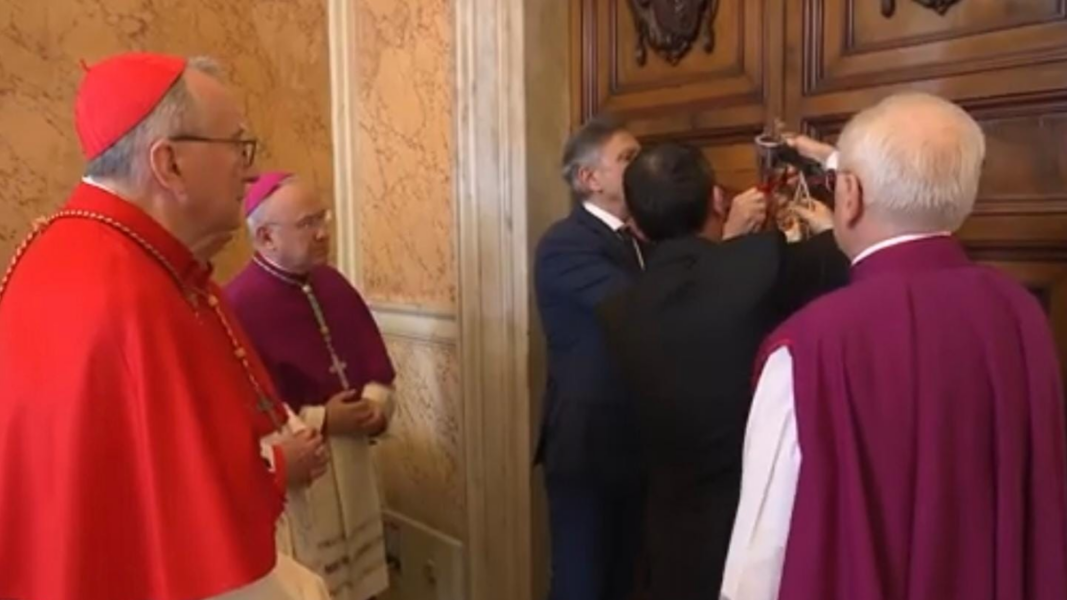
Cardinal Pietro Parolin, Secretary of State, rejected on Friday the idea that the execution by firing squad of Nidal Hasan, perpetrator of the 2009 Fort Hood massacre, be broadcast live, and announced that the Holy See will issue a statement on the case. “It is truly incomprehensible that this system is being considered today,” he told journalists on the sidelines of an event held in Rome on Saint John Henry Newman, according to Vatican News.
Parolin added that he does not know the reasons behind the decision and that it is not acceptable to turn death into a spectacle, no matter how guilty the condemned person may be, because other means exist. He recalled that the Church’s teaching is totally opposed to the death penalty, which it does not consider in line with human dignity nor effective as a deterrent, and noted that the president of the United States Conference of Catholic Bishops, Archbishop Paul Coakley, had already spoken on the matter.
The Pentagon confirmed on Thursday that the execution by firing squad will be broadcast live, after its head, Pete Hegseth, stated in an interview with the conservative network Real America’s Voice that the execution would be “public” and would take place at Fort Hood on December 3. On Monday, Pentagon spokesperson Sean Parnell announced that Donald Trump had approved the execution by firing squad at Hegseth’s proposal. When asked whether Hasan had made any last requests, Hegseth replied that he did not care. The White House referred questions about the broadcast to the Pentagon.
Hasan, then an Army commander and psychiatrist, opened fire on November 5, 2009, at a medical center on the Fort Hood base in Texas, and killed thirteen people, twelve active-duty soldiers and one retiree, while wounding another 32. During the attack he shouted “Allahu Akbar,” and later explained that he wanted to prevent those soldiers from going to Afghanistan to kill Muslims. A military jury sentenced him to death in August 2013. If the sentence is carried out, it will be the first military execution in the United States since 1961, when soldier John Bennett was hanged, and the first by firing squad since the Second World War, according to Hegseth himself. Experts cited by the AP agency note that Hasan could still appeal to the civil courts through a habeas corpus, which would delay the execution.
Coakley, Archbishop of Oklahoma City and president of the U.S. episcopate, told Vatican media that he received the news with shock and great sorrow. He described the decision as “a barbaric promotion of a culture of death,” called for it to be reconsidered, and warned that a public execution would further damage the country’s moral fabric. The archbishop cited Saint Paul’s exhortation not to return evil for evil and commended the nation to Our Lady of Good Counsel.
The day before Parolin’s remarks, the Holy See had called at the United Nations for a moratorium on executions with a view to abolishing the death penalty. Number 2267 of the Catechism, revised by Francis in 2018, declares the death penalty “inadmissible, because it attacks the inviolability and dignity of the person” and commits the Church to working for its abolition worldwide. The revised text acknowledges that for a long time the use of capital punishment by legitimate authority was considered an admissible, though extreme, means of safeguarding the common good. The previous wording, from 1997, only allowed it when it was the only possible way to effectively defend human lives from an unjust aggressor.
To date, the Holy See Press Office has not released the statement announced by the Secretary of State.
Read also