


By: A (former) perplexed Catholic
Since his election to the Chair of Peter, Leo XIV has called for “unity” in the Church: unity of all the baptized around the pope.
In the early days of his pontificate, some of his moves seemed to suggest that better times were coming for the Traditional Mass. Perhaps, an end to the restrictions.
In July 2025, journalist Diane Montagna published the scoop of the great lie on which Traditionis Custodes was justified. She obtained the Vatican’s overall assessment of the consultation with the bishops that, it was claimed, “motivated” Pope Francis to revoke Summorum Pontificum, Benedict XVI’s 2007 apostolic letter that liberalized the vetus ordo. The previously undisclosed text, a crucial part of the official report of the Congregation for the Doctrine of the Faith on its 2020 consultation with the bishops regarding Summorum Pontificum, reveals that “the majority of the bishops who responded to the questionnaire stated that making legislative changes to Summorum Pontificum would cause more harm than good.” Thus, the overall assessment directly contradicted the stated justification for imposing Traditionis Custodes and raises serious doubts about its credibility. On this basis, a great opportunity was presented to give free rein to the celebration of the Traditional Mass under the same conditions that Benedict XVI had allowed with Summorum Pontificum in 2007. But nothing happened. He had just been elected and such a sharp turn was not easy.
Later, on March 5 of this year, Leo XIV granted a private audience to two authors of a major work dedicated to the presence and vitality of the faithful attached to the Traditional Latin liturgy, Stephen Bullivant and Stephen Cranney, authors of the book titled Trads: Latin Mass Catholics in the United States, to be published later this year by Oxford University Press. Another sign of interest in the Traditional Mass: the objectivity of data and facts.
Over time, however, those hopeful signs have faded and his words calling for unity have contrasted with his actions. The most flagrant case was his attitude before and after the episcopal consecrations in the Priestly Fraternity of Saint Pius X: not only has he excommunicated them, but he even refused to meet with them once, while he has had time to meet with all kinds of people who, surely, presented issues of far less importance for the good of the Catholic Church.
Leo has finally just visited France, possibly the country with the most active and numerous traditional world. The trip has been sold as a resounding success that will restore France to its Catholic essence. However, the pope has not granted even a second to the tens of thousands of traditional Catholics both in liturgy and in doctrine. Even though, immediately prior to his visit, a devastating report was published on the decline of the Church in France since the Second Vatican Council and it was pointed out that 50% of priests between 25 and 34% celebrate the Traditional Mass.
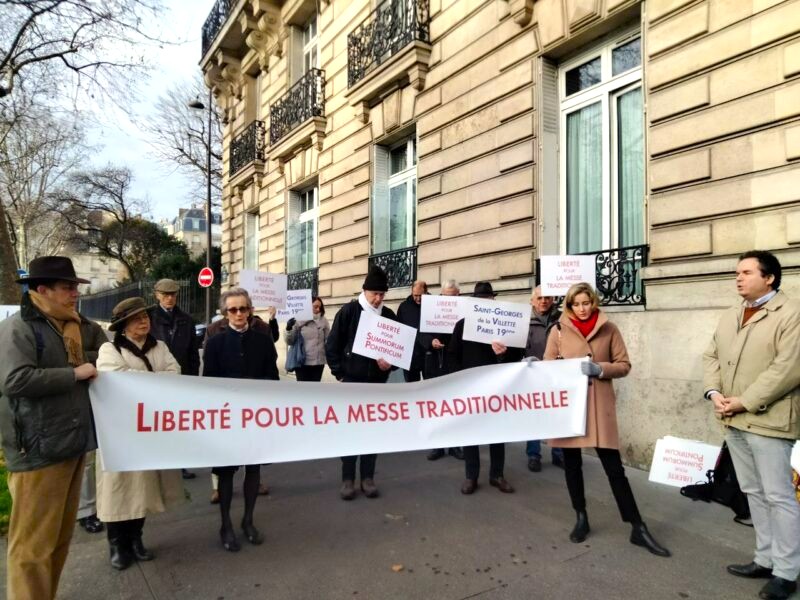
Not only has he not granted them a private audience, but even the traditional faithful who were asking for more freedom for the celebration of the Mass of all time have appeared in some images as a tiny and marginal group.
Leo XIV has done nothing to ensure that traditional faithful, who love the liturgy prior to the Missal of Paul VI and profess the integral faith they received from their ancestors before the revolution of the Second Vatican Council, its spirit and synodality, are part of the “all, all, all” who fit in the Church. On the contrary, it is noted that these are precisely the ones who have no place. While Leo boasts that Catholics and Lutherans “have a shared mission,” he describes the option for the Traditional Mass as mere “personal preferences,” which the baptized must renounce in order to be united around him in the Church.
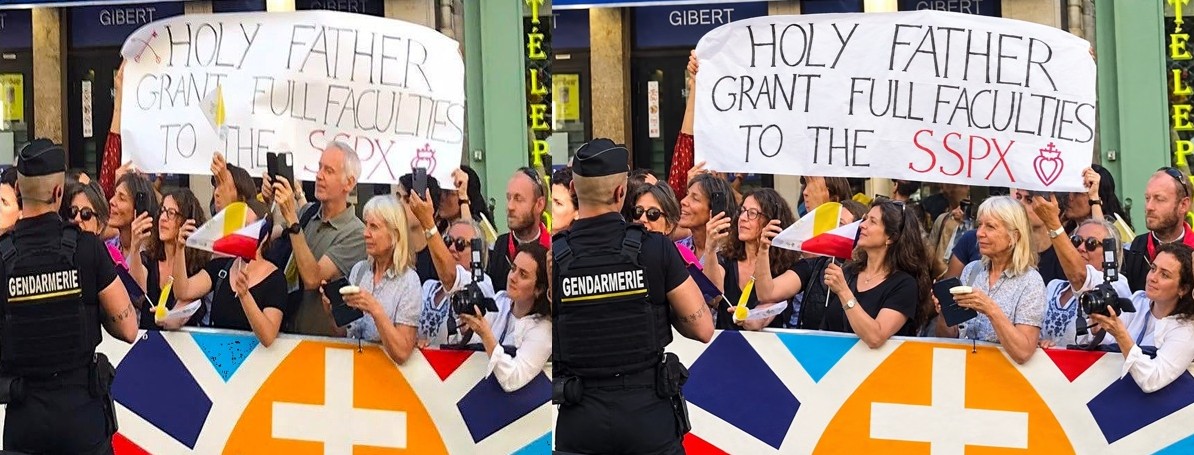
As an anecdote related to his recent trip to France and the writing of this text, when I asked chat gpt, as can be seen in the images below, to remove the man who does not allow the full screen to be read and to see the initials of the Fraternity of Saint Pius X, chat gpt turned the banner “Holy Father, grant full faculties to the FSSPX” into “Holy Father, grant full faculties to the synod” (SYNOD). It was not clearly visible and the machine opted for what, in the ideology that feeds it, seemed most logical. God deliver us. Obviously, artificial intelligence, Leo XIV’s great social concern, is not neutral.
However, I believe there is even greater harm than Leo XIV’s ignorance or contempt for what we might define as the “traditional world,” that of the faithful, communities and institutes that wish to continue celebrating the Traditional Mass and professing the faith of all time, and that is the lamentable division that exists. A division that, moreover, seems to me to have been aggravated and deepened after the consecration of four bishops in Écône last July 1 by the FSSPX.
In this regard, we can largely agree that there are sectors of the FSSPX with sectarian attitudes, and one might almost say proud of not being “accepted” by Rome. But that is not the reality of the entire Fraternity, on the one hand, and on the other, it cannot be denied that their doctrine is the bimillennial doctrine of the Church, just like their liturgy (except for the post-1955 Holy Week).
For their part, it also cannot be denied that the ex-Ecclesia Dei communities have had to make many concessions to the requests or demands of Rome. Let us remember that Ecclesia Dei was a pontifical commission created in 1988 by Saint John Paul II in response to the consecration of bishops by Archbishop Marcel Lefebvre, with the aim of facilitating the return to full communion with the Catholic Church of those priests, seminarians and faithful attached to the traditional world who did not wish to be excommunicated or break communion with Rome.
Ecclesia Dei had its lights and shadows. As Jean Madiran explained in his book “History of the Forbidden Mass,” Rome did not negotiate. Rome imposed conditions on all traditional priests and communities to remain in ecclesiastical communion. The case of Dom Gérard, of the Benedictine abbey of Barroux, is paradigmatic in his long process for his abbey to be recognized: he had to yield to the demand for concelebration and the concept of false religious freedom that had been imposed after the Second Vatican Council. In fact, the same has happened after the new consecrations in 2026: the TRucho demanded a kind of profession of faith that implied the acceptance of all the texts of the Second Vatican Council, including its ambiguities and manifest errors. What a sad paradox: a heretic elevated to prefect of the Congregation for the Doctrine of the Faith demanding that tens of thousands of baptized people who profess the faith of all time, the true one, forcibly convert to the new synodal faith (apostatize?) if they wish to remain in the Church. The devil is working tirelessly.
Is it possible to end the division in the traditional world, to achieve its unity? Everything is in God’s hands, but humanly speaking, just as it seems that little progress can be made in this pontificate with the liberalization of the Traditional Mass and a healthy and legitimate call for a review of ambiguous, problematic and even revolutionary points in the texts of the Second Vatican Council, unity in the traditional world also seems unlikely, divided since 1988 between, on the one hand, the FSSPX and, on the other, the ex-Ecclesia Dei institutes and communities.
In this regard, Michael J. Matt, director of The Remnant newspaper, has for years been proposing the union of the clans, of the different traditional families, against the modernism that currently dominates among the hierarchy of the Church, including the supreme pontiff. His call aims to urge traditional Catholics to set aside internal disputes and unite in defense of Catholic tradition.
Michael J. Matt has reviewed the history of the traditional Catholic movement, especially regarding the Priestly Fraternity of Saint Pius X and the Priestly Fraternity of Saint Peter, and has raised the question of whether, “despite three decades of bitter internal disputes, can we set aside our differences long enough to allow the ancient faith to unite us in the fight against those who seek to crush us all? Can we go to war together? The Church, in its human dimension after the Second Vatican Council, found itself at war with itself, pitting fathers against sons, mothers against daughters, bishops against the Pope. But could there have been good men on both sides? The modernist hierarchy of the Church divided us all. Will we stand idly by and let them conquer us too? Can we unite the clans against a common enemy, or must we let them polarize us forever?”
The phrase “Unite the clans” (Unite the clans) is inspired by a scene from the film Braveheart, by Mel Gibson, where the Scottish clans overcome their divisions to fight against a common enemy. That is why Matt applies it to the aim of stopping internal struggles between different factions of traditional Catholicism that argue over secondary details or minor theological differences, seeking to create solidarity and joint resistance against the advance of modernism and normative changes in the hierarchy of the Church, with the aim of rebuilding and restoring Christendom.
To this cry of Unite the clans, Matt organizes the XXX conferences every year, which this year 2026 took place from October 2 to 4. You can visit his website here (https://catholicidentityconference.org/).
“Unite the clans” is nothing more than a call to do what every fighting force has always done after suffering an initial defeat on the battlefield: seek out the scattered remnants of its army, regroup with them and resist the occupying force behind enemy lines.
Is this union of the clans possible? Let us remember that, for God, nothing is impossible. What is in our hands is to ask for it and work for it; because, in the end, it does not pose an endless struggle against the modernist Church, but victory over the neo-synodal church, the synodality that holds Rome captive, and the restoration of Christendom.