


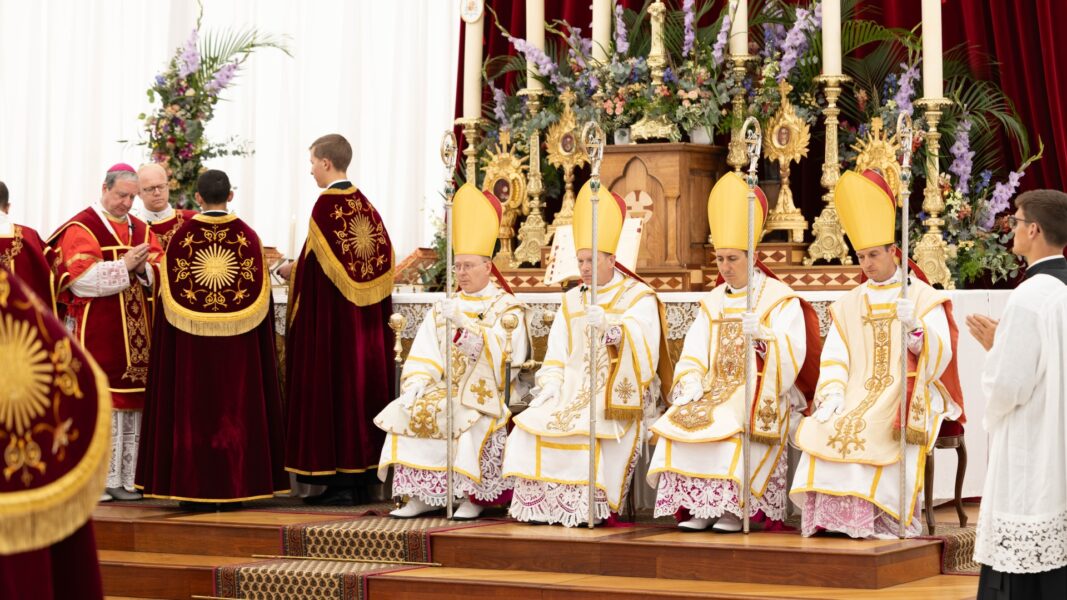
The Priestly Fraternity of Saint Pius X (FSSPX) has once again defended the episcopal consecrations celebrated on July 1 in Écône and has questioned whether the excommunications declared by Rome can be considered a definitive response to a situation that, according to its position, requires examining the extraordinary circumstances in which they were carried out. James Vogel, communications director of the Fraternity, has recalled that an excommunication, however grave, does not constitute an infallible decision and can be reviewed if there are grounds to question its justice or validity.
In an interview granted to LifeSiteNews, published this Thursday, Vogel addressed the accusations of schism directed against the Fraternity after its bishops consecrated four new prelates without a pontifical mandate. The statements were made during the Catholic Identity Conference, held in Pittsburgh, United States, where the spokesperson also presented some historical precedents of episcopal consecrations carried out in exceptional circumstances.
“Every Catholic must feel horror at excommunications and at schism,” Vogel acknowledged. However, he added that “excommunications are grave in themselves, but they are not infallible,” recalling that the history of the Church knows of sanctions that were later considered unjust or invalid.
The Fraternity also maintains a canonical appeal against the decree published by the Dicastery for the Doctrine of the Faith on July 2. According to Vogel, they had not yet received a definitive response.
An excommunication is not an infallible definition
Vogel’s argument focuses on a distinction that has occupied much of the canonical debate following the consecrations: the disciplinary decisions of ecclesiastical authority, even when imposing the gravest sanctions, do not thereby possess the character of irreformable dogmatic definitions.
The Vatican declared that the six bishops participating in the Écône consecrations had incurred automatic excommunication for proceeding without a pontifical mandate and against the express will of Leo XIV. An explanatory note from the Dicastery for the Doctrine of the Faith also described the events as schismatic and extended their canonical consequences to the entire Fraternity and to those who formally adhere to the schism.
The breadth of these measures provoked a new controversy regarding their legal foundation and the circumstances that must concur for canonical penal responsibility to exist.
The FSSPX filed an appeal on July 11 against the decree of the Dicastery, relying on the provisions of the Code of Canon Law concerning the challenge of administrative acts and the suspensive effects of certain appeals.
The Fraternity maintains that its action was motivated by a state of grave necessity and that this circumstance must be taken into account in determining both the responsibility of those involved and the application of penalties.
Vogel insisted that recognizing the gravity of the excommunications does not require renouncing their legal examination. In his view, canon law contemplates circumstances such as necessity and acting in good faith, which can be decisive in assessing conduct.
The spokesperson did not therefore ask that the sanctions be ignored, but that it be examined whether their application is justified in this case.
The precedent of the Ukrainian bishops consecrated under communism
During his intervention in Pittsburgh, Vogel recalled an episode from the recent history of the Church that he considers especially significant: the episcopal consecrations carried out clandestinely by Cardinal Josyf Slipyj in the 1970s.
The Ukrainian cardinal had spent eighteen years imprisoned by the Soviet authorities for refusing to abandon his fidelity to Rome and submit to the Russian Orthodox Church.
Concerned about the survival of the Ukrainian Greek-Catholic Church, persecuted by the communist regime, Slipyj consecrated three bishops without having previously requested authorization from Paul VI.
According to Vogel, the cardinal feared that the request would be rejected and considered it necessary to ensure the existence of bishops capable of ordaining priests and guaranteeing the administration of the sacraments.
Those consecrations were eventually recognized by the Holy See. One of the consecrated prelates, Lubomyr Husar, would even be created cardinal by John Paul II.
Vogel presented this precedent to recall that, at certain moments in history, the need to preserve the sacramental life of the faithful has led some bishops to make extraordinary decisions without previously having a pontifical mandate.
Naturally, the circumstances of the communist persecution in Ukraine are not identical to those of Écône. However, the precedent allows for a question that the Fraternity considers essential: whether every consecration carried out without the Pope’s authorization necessarily constitutes an act of schism or whether the intention of the consecrators, the circumstances, and the purpose pursued must also be examined.
“We have no intention of creating a parallel Church”
Vogel especially rejected the idea that the July episcopal consecrations imply the will to establish a hierarchy independent of Rome.
The spokesperson recalled that sanctions against consecrations without a pontifical mandate are closely related to the need to prevent the emergence of parallel ecclesiastical structures, as occurred with the interventions of the Chinese communist regime in the organization of a hierarchy subject to political power.
In his view, the situation of the FSSPX is substantially different.
“There is no intention of creating a parallel Church,” he assured, also emphasizing that the bishops of the Fraternity do not claim ordinary jurisdiction over dioceses or territories.
This distinction has been part of the FSSPX’s argumentation since the consecrations carried out by Archbishop Marcel Lefebvre in 1988. Its bishops exercise sacramental functions, particularly the ordination of priests and the administration of confirmation, without claiming ordinary governance of a particular Church.
Vogel considers that the Fraternity’s actions over the past decades demonstrate that it has not sought to establish a Church separate from the Catholic Church.
The underlying question remains whether an episcopal consecration carried out against the pontifical will constitutes in itself a schismatic act or whether, to establish that qualification, it is also necessary to examine the effective will to break communion with the Roman Pontiff.
The crisis of the Church and the state of necessity
The FSSPX spokesperson also defended that the consecrations must be understood within the doctrinal and sacramental crisis that, in the Fraternity’s view, the Church has been experiencing for decades.
During his conference, he presented various data on the decline of religious practice in the West. Among them, he cited a 2025 Pew Research Center study according to which only 28% of American Catholics declare attending Mass weekly and 23% go to the sacrament of confession at least once a year.
For Vogel, these figures reflect a situation that requires guaranteeing the continuity of priestly formation rooted in traditional Catholic doctrine and the availability of the sacraments for the faithful linked to the Fraternity.
The state of necessity constitutes, in fact, the central argument of the FSSPX to justify its decision to consecrate four new bishops.
Last September, the Fraternity explained why it considers that this necessity persists despite the existence of other traditional institutes recognized by Rome. Its argumentation maintains that the breadth of the ecclesial crisis and the limitations affecting the traditional apostolate prevent considering the problem resolved.
A question that remains pending resolution
Three months after the consecrations, the situation between Rome and the Fraternity continues without finding a satisfactory solution for both parties.
The Holy See maintains its assessment of the facts and the sanctions declared by the Dicastery for the Doctrine of the Faith. The FSSPX, for its part, maintains that it acted to preserve the continuity of its apostolate and has resorted to the procedures provided by Canon Law itself to challenge the measures.
Vogel’s statements once again place the debate on a terrain that goes beyond mere disciplinary disobedience: the relationship between pontifical authority, the preservation of Tradition, the state of necessity, and the limits of the application of canonical penalties.
The Fraternity insists that it recognizes the authority of the Roman Pontiff and that it does not intend to constitute an independent hierarchy. Rome, however, considers that the consecrations carried out against the express will of Leo XIV gravely harm ecclesial communion.
The question thus remains open while awaiting a response to the appeal filed by the FSSPX, which continues to defend that the extraordinary circumstances of its action must be examined before considering definitively resolved a controversy that affects both the discipline of the Church and the pastoral care of numerous faithful linked to Tradition.