


On November 29, Spaniards will go to the polls to elect a new Government. That same day, the Church commemorates Blessed Bernardo Francisco de Hoyos, the young Jesuit who in 1733 received from the Sacred Heart of Jesus a promise destined to mark profoundly the religious history of our homeland: «I will reign in Spain, and with greater veneration than in many other places».
The coincidence deserves more than a pious mention. Spain will hold general elections precisely on the date linked to one of the most significant promises of its Catholic tradition, at a time when it is going through a profound crisis of religious and cultural identity and after a legislature marked by political confrontations over issues as fundamental as abortion, euthanasia, the family, or the presence of faith in public life.
Few questions seem more timely for Spain today than the one implicit in the Great Promise: what place does Christ occupy in a nation that for centuries publicly recognized itself as Catholic and that today seems determined to erase much of the traces of that heritage?
«I will reign in Spain»
On May 14, 1733, while in Valladolid, the young Jesuit Bernardo Francisco de Hoyos received, according to what he wrote to his spiritual director, a revelation from the Sacred Heart of Jesus.
Concerned that this devotion was barely known in Spain, he had asked the Lord that its cult might spread throughout our homeland. It was then that, according to his testimony, he heard those words: «I will reign in Spain, and with greater veneration than in many other places».
Father Hoyos died on November 29, 1735, at just 24 years of age. His life had been brief, but his apostolate contributed decisively to the spread of a devotion that would eventually take root in churches, convents, homes, and towns throughout Spain.
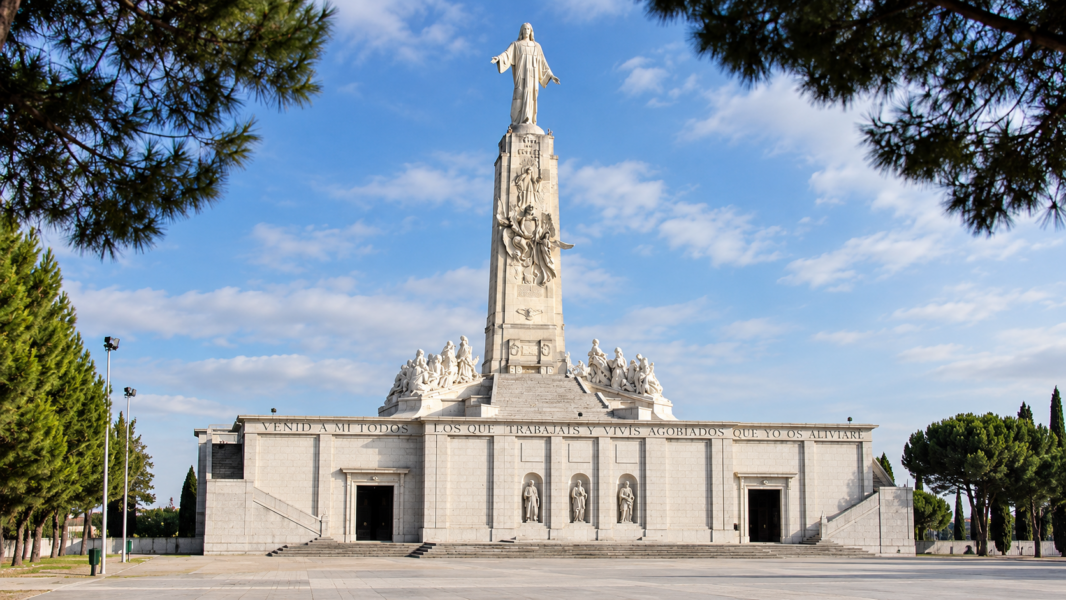
Almost two centuries later, on May 30, 1919, Alfonso XIII solemnly consecrated Spain to the Sacred Heart of Jesus at Cerro de los Ángeles. The king, before the bishops and a multitude of the faithful, publicly recognized a sovereignty that no earthly authority can claim: that of Jesus Christ.
More than a century has passed since the consecration. Spain has changed its customs and its laws. Its public relationship with the faith has also changed, and greatly.
What once formed part of the nation’s religious consciousness is today, all too often, presented as an uncomfortable vestige of the past.
A Spain that legislates as if God did not exist
There is no need to resort to an apocalyptic interpretation of our times to see how far Spanish legislation and political culture have moved away from the principles that for centuries inspired its public life.
Abortion has ceased to be presented simply as a practice decriminalized under certain circumstances and has become, in the dominant political language, a right whose protection is intended to be reinforced even through constitutional reform. Euthanasia has been incorporated into the legal system as a healthcare provision. The Christian conception of marriage and the family has been progressively displaced from legislation and much of institutional discourse.
At the same time, the presence of Christianity in the public sphere is questioned with arguments that, under the appearance of exquisite neutrality, seem to reserve for the faith an increasingly narrow place.
It would be naïve, however, to reduce all of Spain’s ills to a Government or a political party. Spanish secularization dates back much earlier and has advanced under different parliamentary majorities. It has also found accommodation in broad sectors of society that have come to accept as inevitable transformations that would have been unthinkable for previous generations.
Nor can responsibility be exempted from a Catholicism that, at times, has preferred to accommodate itself to the dominant language rather than explain without complexes what the Church teaches.
Dechristianization does not occur only when a Government passes a law contrary to natural morality. It also advances when families stop transmitting the faith, when parishes renounce preaching with clarity, or when Catholics themselves consider that the demands of the Gospel belong exclusively to the private sphere.
The Spanish crisis is political, certainly. But it is, above all, religious and moral.
The reign of Christ does not depend on a parliamentary majority
The Great Promise to Father Hoyos refers to a truth that today seems especially forgotten: Jesus Christ is not only Lord of individual conscience. His sovereignty also reaches social life, institutions, and nations.
The doctrine of the social reign of Christ, solemnly set forth by Pius XI in the encyclical Quas primas, reminds us that human authority does not constitute the ultimate foundation of good and evil.
No parliamentary majority can turn an injustice into a moral good simply by approving it. The dignity of the human person, the protection of innocent life, and the fundamental obligations of justice do not arise from a vote.
That is why the discussion about the future of Spain cannot be limited to the alternation of parties. A nation is not regenerated merely by changing those who occupy the ministries if a conception of public life that seeks to dispense with God remains intact.
Catholicism also cannot reduce its social presence to a nostalgic cultural resistance. Defending the Christian roots of Spain requires more than invoking its history: it requires living the faith, transmitting it, bearing witness to it, and publicly upholding its moral consequences.
November 29, a date that deserves prayer
This year, moreover, November 29 coincides with the first Sunday of Advent. Although the liturgical commemoration of Blessed Bernardo de Hoyos is displaced by the precedence of the Sunday, the coincidence retains its historical meaning: the anniversary of his death and election day fall on the same date.
While Spaniards decide at the ballot box who will govern them, the Church begins to prepare for the coming of Jesus Christ.
These are two events of completely different natures. One belongs to the political order; the other, to the mystery of salvation. But their coincidence reminds us that the destiny of a nation is not exhausted in its institutions or in its electoral cycles.
Spain needs just rulers, laws that respect human dignity, and institutions that serve the common good. It also needs Catholic bishops and priests, solid families, a youth with hope, and a society capable of recovering the sense of duty, responsibility, and truth.
But, above all, it needs to return to God.
It is fitting that, during this electoral period, Catholics pray especially for our homeland. For those who exercise authority, for those who aspire to exercise it, and for all Spaniards who face the consequences of political decisions.
At Cerro de los Ángeles the monument to Christ remains standing, with his arms open over Spain. Governments pass, majorities change, but there is another promise, the one Father Hoyos wrote nearly three centuries ago, that continues to remind us that the history of Spain cannot be fully understood without its faith.
«I will reign in Spain».
May these words not be for Spanish Catholics a mere inscription on a monument or a memory of times past, but a call to conversion and fidelity.
And may we, in this time of political uncertainty, know how to turn to the Sacred Heart of Jesus to ask of him what no ballot box can guarantee: the spiritual renewal of our homeland.