


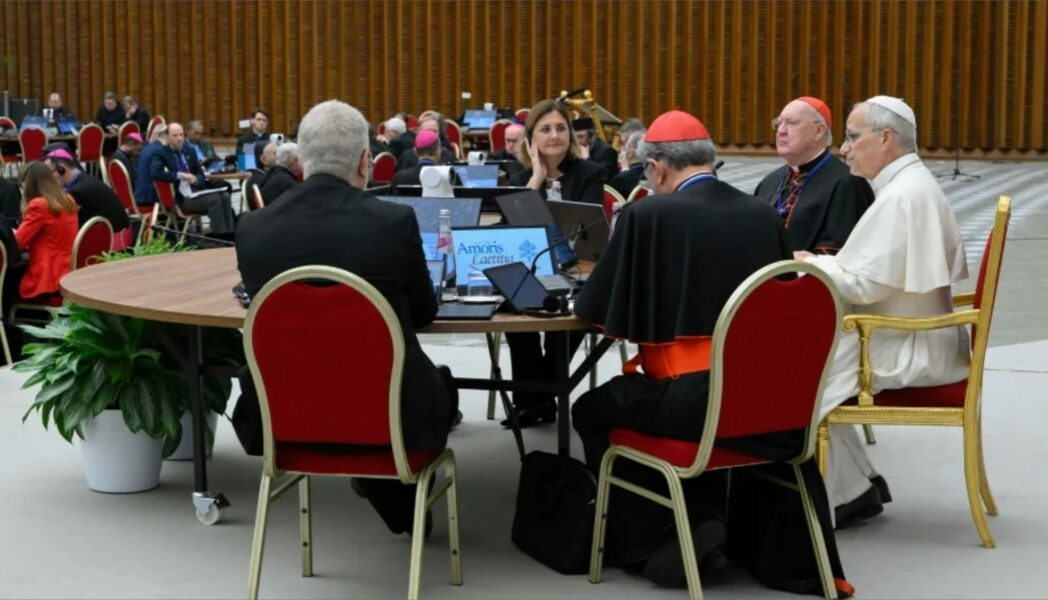
The second day of the meeting convened in Rome to mark the tenth anniversary of Amoris laetitia left this Thursday with an idea that well summarizes the tone of the family conclave. Before the presidents of the episcopal conferences and the heads of the Eastern Churches, Professor Vincenzo Rosito, vice-dean of the Pontifical Theological Institute John Paul II and lecturer at the Lateranense, maintained that the transformations the family is undergoing “are not problems, but human activities,” processes “in which persons and families act, react, learn and develop new resources.”
The day, dedicated to “Families today: reality, beauty and challenges,” gathered in the Paul VI Hall the interventions of Cardinals Mario Grech, Kevin Farrell and Filipe Neri Ferrão, as well as that of Rosito himself. In the afternoon, the work continued in closed-door groups.
Rosito: learning from family practices
The speaker, whom Vatican News itself presents as a “political philosopher,” structured his intervention as questions for discernment. He began with Pope Leo XIV’s encyclical Magnifica humanitas to ask that “each one pay attention to the relationships he builds within his own family and within the Church,” and set forth the central thesis: “family practices help us understand how Churches and families learn from one another. Both the Church and the family, in fact, also learn through the practices of their daily life.”
He proposed a personal examination to the bishops: “Am I able to recognize and present to others at least one new thing that I have learned to do, or to do differently, during the last years of my family or pastoral life?” Then came the phrase of the day, about changes that “are not problems, but human activities.” As an example, Rosito chose the digital realm: “Let us think, for example, about how the use of new digital technologies is transforming the daily habits of families and the education of children.” Families and Churches, he added, “learn together amid the transformations.”
He also spoke of communities that, “through the experience of refugee and migrant families,” are “reconfiguring themselves as ‘refuge churches,’” and of violence: “The insecurity that comes from social and political violence is a worrying reality that many Churches must face today in their daily life,” capable of “devouring also family affections and ecclesial relationships themselves.”
He closed with a program: “To dream, to imagine new forms for the Church also means renewing what we already do. Imagining the Church means being willing to learn from one another, while we transform ourselves together, as Churches and as families.” And with a final question: “What do we need, amid the lights and shadows of the present, to learn and imagine new ways of being family and new ways of being Church?”
In the entire intervention that was released, there is not a single reference to the doctrine on marriage, to sin or to conversion. Change is described as learning, without any criterion to distinguish what builds from what destroys.
Ferrão: “There is no single stereotyped model of the ideal family”
The main address was given by Cardinal Filipe Neri Ferrão, Archbishop of Goa and Damán and president of the Federation of Asian Episcopal Conferences. He opened with a weighty statement, reported by Vida Nueva: “There is no single stereotyped model of the ideal family, but rather a complex mosaic of diverse realities, marked by joys, hopes, difficulties and wounds.”
For the cardinal, “the family is not only a place where the Church proclaims the Gospel, but also a place from which the Gospel comes to life, from generation to generation, from one family to another and from family to society.” He posed to the assembly a question that reverses the usual direction: “What change does the Holy Spirit ask of the Church?” referring “not only to what we do for families, but to how we understand them, accompany them and make them protagonists of the Gospel.” And he specified the method: “We do not arrive with prefabricated answers. We discern together with the families and, in doing so, we learn how the Church itself is asked to change.”
His portrait of Asia was stark: “Growth is rapid, but unequal; opportunities increase, but access to them remains discriminatory.” He denounced that “Christian families in various parts of India and Asia are forced to live with growing polarization and religious hostility, which makes it increasingly difficult to express publicly and transmit the faith.”
Regarding the pastoral response, he explained that after Amoris laetitia the Asian Churches “began to listen to families,” and that they now consider “preparation for marriage as the beginning of a lifelong journey.” He proposed “moving from a mission directed to families to a mission among families” and warned: “We cannot act as guides from a distance and limit ourselves to pointing out the goal. We must be a beacon and a lamp.” He also left a watchword that captures the spirit of the meeting: “Let us not ask what families lack, but what God is already doing in their midst,” together with another phrase of delicate reading in light of chapter VIII: “Fragility is not absence of grace.”
Grech admits “tensions and different interpretations”
The Secretary General of the Synod, Cardinal Mario Grech, opened the morning by presenting the meeting as “an exercise of attentive listening” to the “echoes” that reach the pastors. He acknowledged that the reception of Amoris laetitia “has not been uniform” and that “it has known tensions and different interpretations,” and maintained that in each particular Church “the same truth of the Gospel has inspired diverse pastoral responses, shaped by different cultural contexts.” The formula chosen to reconcile both was this: “While the message remains unchanged, its reception and application manifest the richness and creativity of the Holy Spirit.”
Grech insisted that the Gospel “is the fundamental voice from which all pastoral action must be inspired,” mentioned the Magisterium as the second echo and reserved the third for families: “Families are protagonists of the Church’s mission, and from them we have much to receive and learn,” according to Vatican News. He admitted that “fidelity and fragility are often intertwined in family history.”
Cardinal Kevin Farrell, Prefect of the Dicastery for Laity, Family and Life, limited himself to presenting the theme of the day, recalling words of Leo XIV, “our time is marked by rapid transformations,” and announcing that the participants would ask themselves “where we can find support and signs of hope to live marriage.”
What no one named
None of the interventions released from this second day alluded to chapter VIII of the exhortation, to footnote 351 or to the access to the sacraments of divorced and remarried persons, the point that divided the episcopate for a decade and that motivated the dubia that were never answered. The meeting, which will conclude on October 14 with a Mass of the Pope and a synthesis document, will continue tomorrow with the day dedicated to young people and the vocation to marriage, followed by the first press conference of the Holy See.