


By Michael Pakaluk
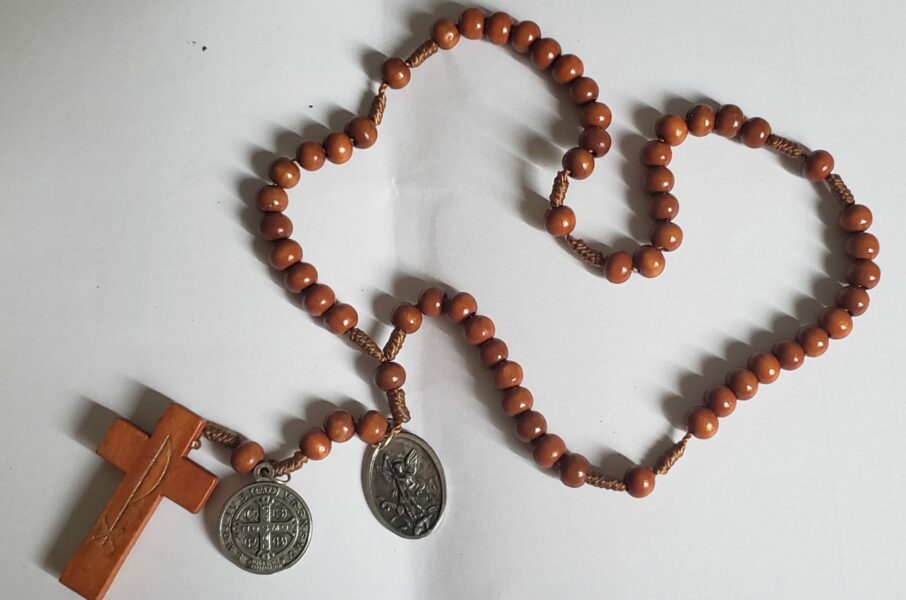
Many Protestants who become Catholic go through three stages in their Marian devotion. They begin by thinking that the Rosary is not something bad, as they had supposed; then they come to think that it is very good; and finally, with experience and as their faith grows, they may come to see that it is very powerful.
As today falls between the feast of Our Lady of the Rosary and the memorial of St. John Henry Newman, I want to write about Newman and the Rosary.
I see in him none of this progression, but rather a recognition of the great goodness of this devotion from his earliest days as a Catholic. And yet, he keenly perceives the difficulties that other converts have with it, and advises them with wisdom. Less than three years after his own conversion, he writes in a letter to the Marquise de Salvo: “You know perfectly well that devotion to the Blessed Mother of God is not imperatively required of all. It is a gift which God gives to whom He will. Therefore I do not see that a person ought to force himself to use certain manuals or exercises which do not come natural to him.”
But he continues:
I do not see how this observation applies to the Rosary; and, for my own feelings, nothing is more delightful than the contemplation of the Mysteries of the Incarnation under the invocation, so to say, of her who was its human instrument. At the same time, it is not necessary that we should feel this equally at all times; and I quite understand that a recent convert is obliged to use his reason and to make explicit acts of faith, love, etc., when all this rises naturally and without effort in one who has been a Catholic from his birth.
To George Ryder, three months later, Newman writes:
I certainly think that you should be gradually entering into Catholic forms of devotion. Perhaps the Rosary will be less heavy said with others. . . . Try it in this way. . . before each mystery, set before you an image of it, and fix your mind on that image (e.g., the Annunciation, the Agony, etc.) while you say the Our Father and the ten Hail Marys, without thinking on the words, only saying them correctly. Let the exercise be little more than a meditation. Perhaps thus you may get over any sense of tediousness.
Ryder, from Newman’s circle at Oxford, had resigned his Anglican living to become a Catholic in 1846. His Rosary seems to have borne fruit: his son, Henry Ignatius Dudley Ryder, became a priest of the Birmingham Oratory and succeeded Newman as its superior.
A decade after his conversion, Newman focused on what the Rosary accomplishes. By 1856 it had become for him a practically necessary part of the path to perfection:
If I am asked what must be done to be perfect, I say, first: do not lie in bed beyond the due time of rising; give to God your first thoughts; make a good visit to the Blessed Sacrament; say the Angelus devoutly; eat and drink to God’s glory; say the Rosary well; be recollected; keep out bad thoughts; make your evening meditation well; examine yourself daily; go to bed at a reasonable time, and you are perfect.
As rector of the new Catholic University of Dublin, he reflects on how a preacher should address his students. “As youth is the occasion of excess and sensuality, so also the intellect is accidentally the occasion of religious error, of rash speculation, of doubt, and of unbelief.” The preacher must choose his topics accordingly. But he must approach them indirectly: “even when he addresses some special danger or some probable deficiency or need of his hearers, he must do so covertly, without showing on the surface of his discourse what he is aiming at.”
Commonplaces, Newman says, are “nothing but blunt weapons,” whereas
it is the concrete subjects which penetrate and hit the mark. Such subjects are, for example, the good employment of time, the avoiding the occasions of sin, the frequenting the sacraments, the divine warnings, the inspirations of grace, the mysteries of the Rosary. . .
On the feast of the Rosary in 1866, the anniversary of Lepanto, he speaks plainly of its power:
We know well that we are on the winning side, and that the prayers of the poor, the weak, and the despised, when offered in a true spirit, can do more than all the wisdom and all the resources of the world. This 7th of October is the very anniversary of that day on which the prayers of St. Pius, and the Holy Rosary said by thousands of the faithful at his instance, broke for ever the dominion of the Turks in the great battle of Lepanto.
But his most moving words present the Rosary as the gateway to a place of refuge. In his address “To the Students of St. Mary’s College, Oscott” (5 October 1879), he says that the special virtue of the Rosary is that “with all our thoughts about Him are mingled thoughts of His Mother, and in the relations between the Mother and the Son we are presented with the Holy Family, the Home in which God lived.”
And so:
This is what I most wish you to bear in mind in the years that are to come. For all of you will have to go out into the world, and going into the world means leaving home; and, my dear boys, you do not yet know what the world is. . . . Most men who know the world find it a world of great trouble and disappointment, and even of misery. If so it turns out to you, seek a home in the Holy Family, which is brought before you in the mysteries of the Rosary.
He concludes by asking them “to make the Holy Family your home, to which you may turn from all the sorrow and care of the world, and find a consolation, a compensation, and a refuge.”
About the author
Michael Pakaluk, a scholar of Aristotle and ordinary member of the Pontifical Academy of St. Thomas Aquinas, is professor of Political Economy at the Busch School of Business of The Catholic University of America, distinguished senior fellow of the Gibbons Institute, and director of the American Catholic Quarterly Review. He lives in Hyattsville, Maryland, with his wife, Catherine, also a professor at the Busch School, and their children. His most recent book, on natural law and civic friendship, Walk in the Good Way, will be published soon by The Catholic University of America Press. You can follow him on Substack at Michael Pakaluk.