


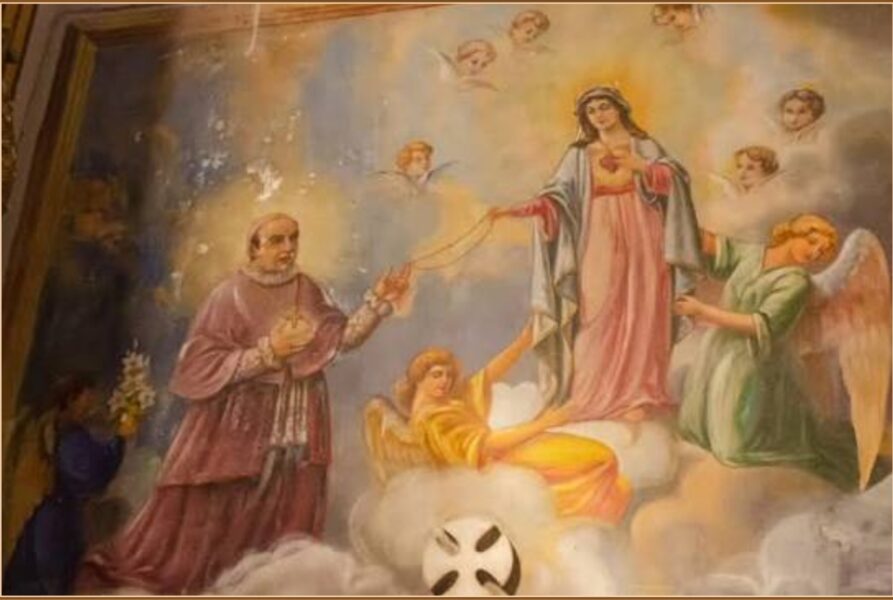
“Antonio, preach my Rosary without ceasing; in it lies the salvation of your homeland.”
I have not found these words of the Blessed Virgin to Saint Anthony Mary Claret in the saint’s Autobiography, yet they do not appear to be a pious invention. The earliest reference I have been able to locate so far—may some Claretian scholar provide a better-documented one—is from 1920, fourteen years before his beatification, in the work of the Dominican friar Paulino Álvarez, Saints, Blesseds, and Venerables of the Order of Preachers. Álvarez relates that Claret was in Madrid and that the Virgin had already spoken to him several times about the need to preach the Rosary. One night she is said to have appeared to him accompanied by Saint Dominic, showing him her Heart, and to have addressed those words to him. Claret later had an image painted according to that vision. A later account, published in 1926, adds Saint Catherine of Siena to the scene. The critical edition of Claret’s writings acknowledges that there had been an earlier communication from the Virgin concerning this Rosary mission, which the saint did not record in writing. While we cannot simply identify that communication with the phrase transmitted by the biographers, neither can we say that the phrase lacks any basis in the autograph testimonies. Quite the contrary.
“You shall be the Dominic of these times”
On 9 October 1858, at four o’clock in the morning, according to the two autograph accounts closest to the event, Claret recorded a communication: “The Blessed Virgin Mary repeated to me what she had already told me on other occasions: that I was to be the Dominic of these times in spreading the Rosary.” The critical edition itself highlights the decisive detail: Claret did not write down when he had received those earlier communications. The Autobiography initially placed them in 1857, but the immediate manuscripts allow the date to be corrected to 1858.
It was not, therefore, a private devotional preference. Claret believed he had received from the Virgin a true apostolic mission: to do in the nineteenth century something similar to what tradition attributed to Saint Dominic and later to Alan de la Roche. That is why he immediately wrote about the Rosary. And in The Most Holy Rosary Explained, published in 1864, he places himself entirely at Mary’s disposal for that task: “Ecce ego, mitte me,” here I am, send me; and he adds that he offers himself with joy, even if, in order to spread it, he must endure hardships and even suffer death.
When Anthony was very young, he received a Rosary “as if it were the acquisition of the greatest treasure.” He led it with the children at school; at home he prayed it with his family, and while working at the loom he recited its three parts every day. The great apostle of the Rosary began as a child with the beads in his hands.
The evils of Spain and three remedies
Years later, this Marian mission took on a dimension expressly related to Spain. On 27 August 1861, in the Rosary church of La Granja, during the blessing with the Blessed Sacrament after Mass, Claret wrote that the Lord made known to him “the three great evils threatening Spain: Protestantism—or rather, de-Catholicization; the republic; and communism.” And, in response to them, three remedies were shown to him: the Trisagion, the Blessed Sacrament, and the Rosary. Concerning the last, he specifies: to pray it every day, in full or at least in part, “meditating on the mysteries and applying them to one’s own conduct.”
Those words must be read in the troubled context of Spain in 1861, yet Claret’s diagnosis retains striking relevance today. He says “Protestantism” and immediately seems to search for a deeper word: “or rather, de-Catholicization.” There lay the real problem: more than any specific doctrine, the slow fading of a people’s faith; the process by which God ceases to count in minds, in customs, in families, and finally in public life. And faced with a malady whose root is spiritual, Claret knew that purely human weapons were not enough.
“Yes, Anthony, do what my Mother tells you”
Yet another confirmation was still to come. On 6 December 1862, at a quarter to seven in the evening, Claret wrote in his own hand: “The Blessed Virgin Mary told me that I was to spread devotion to the Most Holy Rosary, as the Venerable Alan de la Roche had done.” He adds that the Virgin said it to him twice. Immediately he heard Jesus Christ: “Yes, Anthony, do what my Mother tells you.” And at seven o’clock that same evening Mary insisted again: “Yes, Anthony, I want it. I want it.” Jesus added: “Courage, Anthony, courage.”
Thus the phrase “in the Rosary lies the salvation of your homeland” does not appear as such in the surviving autographs, but it admirably summarizes an indisputable documentary chain: the Virgin had already spoken to him about the Rosary; in 1858 she commanded him to be the “Dominic of these times”; in 1861 the Rosary appears as one of the remedies for Spain’s ills; and in 1862 Mary again commands him to spread it, with Christ’s express confirmation.
Claret did not conceive of the Rosary merely as a pious custom: in his writings he calls it an effective means against spiritual needs and affirms that through this devotion a remedy had been found even for “public necessities such as wars, plagues, famines, and other calamities.” He regarded it as a simple yet powerful means of combating ignorance and error, precisely because, mystery by mystery, it introduces the Christian into the school of Jesus Christ.
The new Lepantos
On 7 October 1571, while the decisive battle of Lepanto was being fought, Saint Pius V had summoned the faithful to pray the Rosary. Because the victory was linked in the Christian conscience to Mary’s intercession, the Dominican Pope instituted the feast of Saint Mary of Victories, Auxilium christianorum, which would later become Our Lady of the Rosary.
Yet not all Lepantos are fought at sea. There are silent Lepantos within a family, in the heart of a child drifting from God, in the fidelity of a marriage, in a wavering vocation, in the perseverance of a priest, in the handing on of the faith to the next generation. There is also a great battle for the soul of nations, lost far more in consciences than in institutions. Against such battles an instrument formed by a crucifix and a string of beads still seems ridiculously small. Precisely for that reason it is so of God.
Fatima came to repeat the same pedagogy. On 13 May 1917, Nossa Senhora chose neither the wise nor the powerful, but three pastorinhos, asking them to pray the terço—or “third,” as the Portuguese call each of the three parts of the Rosary—every day: “Rezem o Terço todos os dias, para alcançarem a paz para o mundo e o fim da guerra.” In July she insisted again: “Continuem a rezar o Terço todos os dias, em honra de Nossa Senhora do Rosário.” And on 13 October she introduced herself simply: “Eu sou a Senhora do Rosário.”
Recovering the simplicity of a child is not childishness. To pray like a child means to trust like one. To take up the Rosary without first claiming to understand all the ways of God; to let the Hail Marys pace the contemplation of Bethlehem, Nazareth, Calvary, and the Resurrection; to pray it without haste, without superstition, without turning it into a partisan banner, without being ashamed to expect much from it.
Claret, a man of almost superhuman activity, knew that before organizing one must pray. And Fatima, half a century later, placed the same Rosary in the hands of children. Today the new Lepantos must be fought in the same way: a family that manages to gather each night to pray together; a mother who prays for the child who has lost the faith; a priest who recites the Rosary after an exhausting day; a sick person who can scarcely pronounce the Hail Marys; a child who learns from his parents to pass the beads between his fingers. Nothing spectacular or noisy: a Rosary! Of which Mary promised Claret: “Antonio, preach my Rosary without ceasing; in it lies the salvation of your homeland.”