


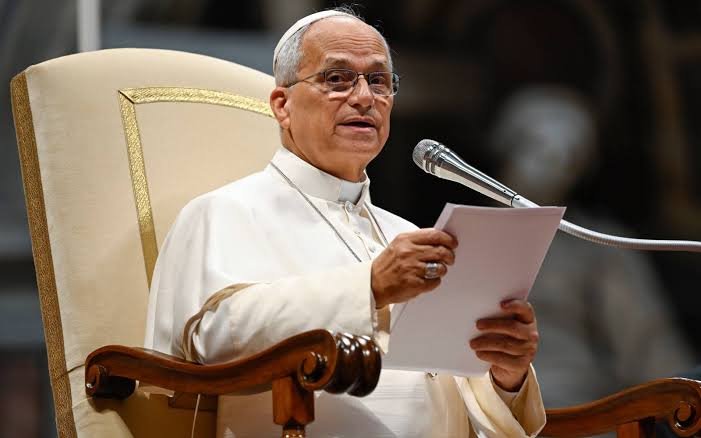
Pope Leo XIV has warned that the Church cannot adapt the content of the Gospel to “cultural fashions” to make it more acceptable, and has recalled that the Word of God and Tradition must remain the ultimate criterion for discerning the changes in society.
During the general audience held this Wednesday, October 7, in St. Peter’s Square, the Pope resumed his cycle of catechesis on the documents of the Second Vatican Council and devoted his reflection to the mission of the Church in the contemporary world, based on numbers 40-45 of the pastoral constitution Gaudium et spes.
The Pontiff noted that the Church must look positively at the world and pay attention to what is happening in society, while maintaining at the same time “a balanced spirit free from cultural fashions” and remaining firm “in safeguarding and presenting the evangelical message in its integrity.”
“Certainly, it is not by diluting the contents and softening the demands that Christianity can be made attractive,” stated Pope Leo XIV, recalling words he had spoken last May before the Dicastery for Evangelization.
The Pope also recalled that the separation between professed faith and daily life constitutes, according to Gaudium et spes, “one of the most serious errors of our time,” and particularly highlighted the mission of the laity, called to bring the Christian spirit into the family, work, and the various spheres of society.
Below, we offer the full catechesis of Pope Leo XIV:
Catechesis – The documents of the Second Vatican Council. IV. Pastoral Constitution Gaudium et spes 5. The mission of the Church in the contemporary world (GS, 40-45)
Brothers and sisters, good morning and welcome!
Resuming the reflection on the Conciliar Constitution Gaudium et spes (GS), today we consider the fourth chapter of the first part, dedicated to the mission of the Church in the contemporary world.
Above all, the Council recalls that the Church is not “above” or “beside” the world, but is grafted into it. «Mundus reconciliatus Ecclesia», wrote Saint Augustine (Sermon 96): the Church is a world already reconciled with God; we are pilgrims on earth and with this world we share fragility and beauty (cf. GS, 40).
As the Son of God became incarnate to give life to the world and reconcile it with the Father, so the Church dwells in the world as a sign of God’s incarnation to manifest his plan of making us all his children in one great human family. Therefore, the Church walks in history among peoples and cultures, and “this intertwining of life with peoples makes her understand more and more that her mission has a historical scope and implies a responsibility with regard to the way social relations are woven” (Encyclical Letter Magnifica humanitas, 19).
The first mission of the Church is to help people pay attention to the deep questions of life: those about our origin and our destiny, as well as those about the meaning of love and suffering (cf. GS, 41). The logic of profit at all costs and the manipulation of information run the risk of exerting undue pressure for people to adapt to a lifestyle centered on the consumption of material goods, but our heart is made to look upward.
The Fathers of the Council recall that the mission of the Church is also carried out by contributing to the building of the earthly city. However, its methods and purpose are not primarily political in nature, but consist in the witness of faith and charity, together with the commitment to justice, peace, and fraternity. By adoring Christ, the Just One who died for the unjust, the believer cannot accept the oppression of the small and the poor, nor those unjust structures that perpetuate conditions of dependence and injustice. The Social Doctrine of the Church guides the action of Christians, who collaborate with all people of good will in promoting the common good. The Church, therefore, “desires nothing more than to develop freely, in the service of all, under any political regime that recognizes the fundamental rights of the person and the family and the imperatives of the common good” (GS, 42).
To effectively fulfill the evangelical mission, it is necessary that every baptized person commit to cooperating with the grace of the Holy Spirit, so that their faith may be alive and expressed in consistent behavior. In fact, as the conciliar Fathers recall, the separation between professed faith and daily life “must be considered one of the most serious errors of our time” (GS, 43).
Gaudium et spes reserves a particular mention (cf. ibid.) to the mission of the lay faithful, who, by virtue of Baptism, are called to animate the world with the Christian spirit and the vision of the Gospel. The principal places of this action, which may well be defined as priestly, are undoubtedly the family and work, but it extends to all areas of life.
Finally, the Church is always attentive to what is happening and developing in society (cf. GS, 44). It is the task of the entire People of God, especially pastors and theologians, to discern what in the cultures of our time is worthy of consideration, always having as the supreme criterion of discernment the Word of God and the Tradition of the Church. This requires a balanced spirit free from cultural fashions, capable of looking at the world in a positive way and, at the same time, firm in safeguarding and presenting the evangelical message in its integrity. In fact, “Certainly, it is not by diluting the contents and softening the demands that Christianity can be made attractive” (Address to the Plenary of the Dicastery for Evangelization – Section on fundamental questions of the evangelization of the world, May 28, 2026).
Dear friends, the Church, while walking in history, “intends only one thing: the coming of the kingdom of God and the salvation of all humanity” (GS, 45). To this end, it is oriented above all through personal holiness and fraternal love. Saint Paul VI wrote: “Without this mark of holiness, our word will hardly make an impact on the hearts of the people of our time. It risks becoming empty and fruitless” (Apostolic Exhortation Evangelii nuntiandi, 76). Therefore, let us be docile to the action of the Holy Spirit, so that he may help us to live in holiness and charity, so that the world may believe and have hope.