


By Kristen Ziccarelli
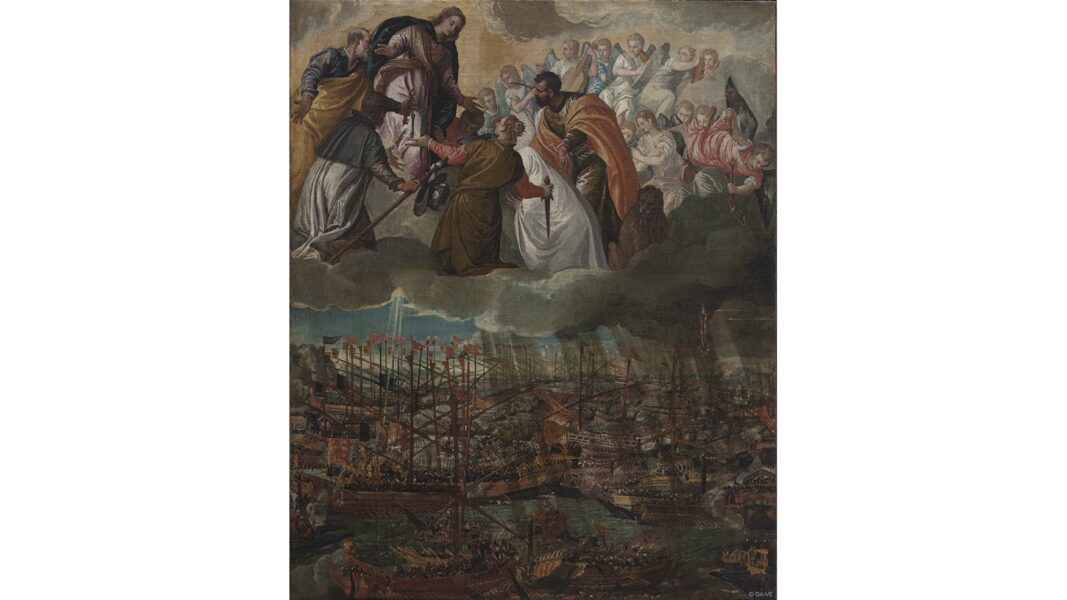
On October 7 in the year of Our Lord 1571, the fleet of the Holy League, under the command of one Don Juan of Austria, defeated the Turkish fleet in the Gulf of Lepanto. That is how they would tell it; that is how they would teach it to their children. And it was a mistake. Because what really happened was that God used several of His servants to halt the advance of the Crescent in the holy name of the Cross.
– Louis de Wohl, The Last Crusader: A Novel about Don Juan of Austria (The Last Crusader)
Louis de Wohl’s biographical masterpiece, written from the perspective of Don Juan of Austria, calls the hero who gives the book its title “the last crusader.” The novel begins with his childhood, when he plays “Moors against Christians,” and ends on the afternoon of October 7, 1571, when he had already achieved the miraculous victory at the Battle of Lepanto. His men invite him to leave the ship for dinner and remind him that he had fought all day without eating more than “a few biscuits and a cup of wine.”
Today we celebrate that victory, which is impossible to remember without God. Four hundred years ago, Christian Europe was mired in the Reformation, while the Ottomans repeatedly threatened its Mediterranean borders.
Pope Pius V, an austere Dominican, responded to the growing Islamic aggression both with the zeal of action in the world and with supplication to heaven. Using a power of convocation that only he possessed, the Holy Father formed a coalition of military forces from across the continent that were otherwise rivals and enemies: the Spanish Empire of Philip II (including Naples and Sicily), the Republic of Venice, the Republic of Genoa, the Knights of Malta, the Grand Duchy of Tuscany, the Order of St. Stephen, the Duchy of Savoy, the Duchy of Urbino, and the Duchy of Parma. Its commander was Don Juan of Austria, twenty-four years old, half-brother of Philip II of Spain and illegitimate son of Emperor Charles V.
The Ottoman Islamic naval forces had conquered Cyprus; their naval power was virtually undefeated and threatened the Christian states of the Mediterranean and, ultimately, Rome. Although he trusted in Don Juan’s military genius and was undoubtedly aware of the exhaustive preparations, the Pope called the faithful of Europe to pray the Rosary for victory.
He had consecrated the Holy League as an alliance and crusade, had fasted personally for the cause of Christianity against Islam, and had received a vision of victory before the news reached Rome. He attributed the triumph to the intercession of the Blessed Virgin Mary, Auxilium Christianorum (“Help of Christians”).
Among those who fought and were wounded that day was Miguel de Cervantes, author of Don Quixote, who recalled the battle as “the highest occasion that the centuries have seen.” Don Juan’s men, more than 100,000 strong, received the sacrament of Penance and boarded their ships (each of which had a crucifix affixed) armed with rosaries. Don Juan himself carried a relic of the True Cross.
Outnumbered and under the command of a twenty-four-year-old leader, the Holy League decimated the Ottoman fleet and ended its naval supremacy. The Ottoman commander Ali Pasha died after Don Juan rammed his ship, and the crescent banner was captured. Many Christian slaves were freed from the enemy galleys.
G. K. Chesterton’s poem Lepanto recounts the drama of that day and the miracle wrought by Our Lady. In 1571, Europe was a house divided:
And Christian killeth Christian in a narrow dusty room,
And Christian dreadeth Christ that hath a newer face of doom,
And Christian hateth Mary that God kissed in Galilee,
But Don John of Austria is riding to the sea.
The Church was undergoing the Protestant Reformation, which was beginning to fracture the continent. Catholic monarchies pursued conflicting dynastic ambitions and clashed with new religious and political antagonisms in Protestant territories.
Maximilian II, Holy Roman Emperor, and France, under King Charles IX, refused to join the Holy League. There were disputes among the galley men at Lepanto, but Don Juan insisted that they work together on pain of death.
A powerful lesson of Lepanto (there are many) is that Christendom would not have been saved without the historic unity among Catholics who were otherwise divided by politics, economics, or culture. Genoese and Venetians were, as is well known, great rivals, but that day they all obeyed the Holy Father, besought God, and charged forward together, facing a single existential enemy, in a spirit of crusade.
In remembering Lepanto, we recall two men—a holy Pope and a military commander—who led the members of a divided and troubled Catholic Europe to a decisive victory. Both in prayer and in action, they were focused on a single goal, on which the whole of Christendom depended.
This is also a lesson for the present: prayer, particularly the Rosary, is not only for interior holiness. We have no promises that miraculous victories will be repeated, but we can have greater confidence if we understand that our battles are spiritual: that the evils we fight are far more than political and economic power.
The civilizational challenges Europe faces today resemble those of the sixteenth century. The “interior battle”—fought among native Europeans themselves—is not so much between Protestants and Catholics as between revolutionaries and traditionalists.
Mass Islamic immigration, which has given rise to Islamist movements and jihadist violence, together with demographic replacement, threatens to destroy not only European culture but also the Church and its institutions.
Quo vadis, Europa? As in the time of Pius V, the continent today faces a reckoning. Will the remaining faithful, and our allies who believe this heritage is worth defending, resolve that not all disputes need to be settled before acting together? That there is a good that transcends immediate rivalries and must be defended both with prayer and with action?
Four hundred fifty-five years later, Don Juan riding to the sea lives on in memory. With gratitude toward the defenders of our Catholic faith, we may ask: “How shall we ever repay them?” Perhaps by recovering today the ability to recognize that, amid all our differences, our civilization will be saved only if those who love it act, together.
About the author
Kristen Ziccarelli is a writer living in Washington, D.C.