


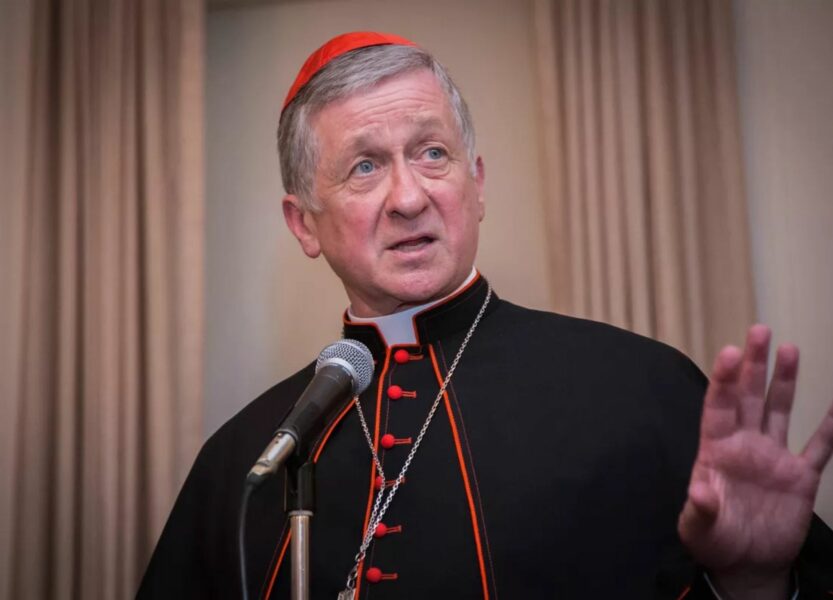
Cardinal Blase Cupich has taken his defense of immigrants to a directly Eucharistic level. During a celebration in Chicago, the archbishop stated that remaining indifferent toward the foreigner while venerating the consecrated Host constitutes “a fundamental rupture of Eucharistic logic” and presented the encounter with immigrants and people in need as “the doctrine of the Real Presence expanded to its fullest dimension.”
Cupich delivered these words on Saturday, October 3, at Old St. Patrick’s Church in Chicago, during a celebration under the theme Celebrating a City of Welcome, where Catholic solidarity and the path of immigration meet.
The cardinal began by situating his remarks within Chicago’s migratory history, but soon shifted the discourse to the current American debate. In his view, the “spirit of welcome” has weakened in the country and immigration policies are generating “fear and anxiety.”
To support this critique, Cupich recalled the statement approved by the U.S. bishops in November 2025, in which the episcopate expressed concern over conditions in detention centers, family separations, loss of legal status, and what he described as an “inhumane” enforcement of immigration laws.
“We told our immigrant brothers and sisters that we are with them,” the archbishop recalled, before reiterating his opposition to “the indiscriminate mass deportation of people.”
Cupich also called on policymakers for “meaningful immigration reform,” which he presented as “the only path forward for the good of all.”
Read also: U.S. bishops send a message to immigrants and the Trump administration
From immigration policy to worship
The homily took on a different tone when Cupich directly linked the defense of immigrants with Christian worship.
“The Word of God given to us today makes clear that our defense of immigrants is no less important to our discipleship of Jesus than our worship,” he stated.
The cardinal insisted that prayer inside a church cannot be separated from what happens outside it and maintained that defending the immigrant “belongs to every disciple of Jesus” and constitutes, “in its most authentic sense, an act of divine worship.”
Drawing on the commandment from Deuteronomy—“You shall love the sojourner, for you were sojourners in the land of Egypt”—Cupich asserted that authentic worship of God cannot coexist with indifference toward the foreigner.
“We cannot claim to worship God while remaining indifferent to the foreigner, because the God we worship is the God of justice who liberates the displaced,” he declared.
The archbishop then turned to the Letter to the Hebrews to urge Catholics to go “outside the gate,” toward “the margins, the shelters, the processing centers,” and the neighborhoods where newly arrived families live.
“The Real Presence expanded to its fullest dimension”
The most striking moment came when Cupich invoked chapter 25 of the Gospel of Saint Matthew: “Truly, I say to you, as you did it to one of the least of these my brothers, you did it to me.”
The archbishop emphasized that Christ does not say “you did it for me,” but “you did it to me,” and concluded:
“This is the doctrine of the Real Presence expanded to its fullest dimension.”
Cupich developed the comparison by noting that if the Eucharist is an encounter with Christ, Matthew 25 also requires recognizing Him in those who suffer.
“When a mother walks thousands of miles with her children to escape violence, Christ is walking. When a young man stands in the cold outside a shelter waiting for a hot meal, Christ is waiting. When undocumented workers are exploited because they lack legal protection, Christ is being exploited,” he stated.
The cardinal then applied this same logic to the charitable work of parishes. In his view, when parishes provide food, clothing, legal assistance, or English classes, they are not merely performing social work but “encountering Christ.”
“We are recognizing the Real Presence of Christ in the broken and walking bodies of our brothers and sisters,” he maintained.
According to Cupich, recognizing Christ in this way transforms charity “from a mere moral duty into an act of profound worship.”
“A fundamental rupture of Eucharistic logic”
Cupich returned to this idea by citing Saint John Chrysostom and his insistence that the worship of Christ cannot be separated from care for the poor.
“To bow before the consecrated Host while remaining indifferent to the foreigner is a fundamental rupture of Eucharistic logic.”
The archbishop also linked the breaking of the bread during the liturgy with “the fractured and walking bodies of humanity,” marked by “poverty, illness, rejection, and trauma.”
In the final part of his remarks, Cupich translated this reflection into a series of concrete demands regarding immigration policy. He called for “meaningful and commonsense” reform, a “humane” application of the laws, accountability for possible rights violations, and guarantees for pastoral access to immigrants held in detention centers.
He also called for expanding aid to “feed, clothe, house, and educate” those in need.
Cupich closed the homily by returning to the same thesis that had framed his entire address: that defending immigrants should not be understood as a merely social or political issue, but as part of Christian discipleship itself.
“May our North Star always be the firm conviction that our defense of immigrants belongs to every disciple of Jesus and is, in its most authentic sense, an act of divine worship.”
Read also: Cupich: public disputes over the liturgy weaken the Church’s voice on war, peace, and climate