


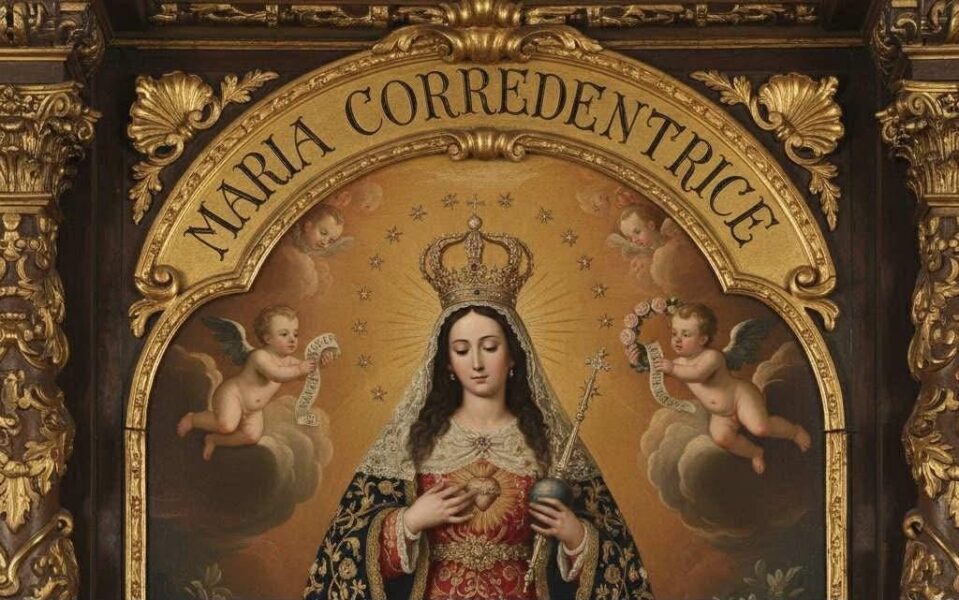
Cardinal Raymond Leo Burke has openly claimed the title of Co-redemptrix for the Virgin Mary and has warned that fear of the term being misinterpreted should not end up weakening Catholic doctrine on the singular cooperation of the Mother of God in the work of Redemption.
The cardinal made this defense on Wednesday during the opening of the international congress The Mystery of Mary in Dogma and in the Magisterium, held at the Augustinianum Patristic Institute in Rome. The full text of his address, titled Our Lady of Guadalupe and the Kingdom of Christ the King: the Mission of the Co-redemptrix and of the Co-redeemers, has been published by La Nuova Bussola Quotidiana with the organizers’ permission.
The address enters fully into the debate reopened by Mater populi fidelis, the doctrinal note published in November 2025 by the Dicastery for the Doctrine of the Faith, which described the use of the title Co-redemptrix as “always inopportune” on the grounds that it could obscure Christ’s unique salvific mediation.
Burke begins precisely from the affirmation that Jesus Christ is the sole Redeemer, yet he rejects the notion that this truth prevents recognition of a real and subordinate cooperation on Mary’s part.
“The Most Holy Virgin Mary, Mother of God, has participated in an absolutely unique way in the mystery of the redemptive Incarnation and is rightly called Co-redemptrix,” he stated. He added that Christians themselves, insofar as they unite their lives and sufferings to Christ’s sacrifice, may also be called “co-redeemers,” always in a subordinate sense.
Objective Redemption and the Application of Its Fruits
A large part of Burke’s reasoning rests on the traditional distinction between the Redemption objectively accomplished by Christ and the application of its fruits to souls.
Citing theologian Arthur B. Calkins, the cardinal explained that the Virgin participates in a unique way in both dimensions. In what is called Redemption in actu primo, Mary cooperates singularly in the Incarnation and in Christ’s sacrifice. In Redemption in actu secundo, she participates in the application of the graces obtained by her Son.
Other Christians, by contrast, can cooperate only in this second sense, uniting their prayers, sacrifices, and sufferings to the redemptive work already fully accomplished by Christ.
“Our Lady participates in both phases of the work of Redemption, whereas all other Christians can participate only in the application of the graces of the Redemption to concrete persons and situations. Therefore, we can all be co-redeemers in actu secundo,” he explained.
Burke supported this idea with St. Paul’s words to the Colossians about completing in one’s own flesh “what is lacking in the sufferings of Christ,” clarifying that nothing is lacking in the Lord’s redemptive sacrifice, but that its fruits must come to life in each baptized person.
More Than Five Centuries of Use of the Term
The cardinal recalled that the term “Co-redemptrix” has been employed for more than five hundred years in theological tradition to express that Mary, without being equal to Christ and depending totally on Him, cooperated in a unique way in His saving work.
Burke insisted that the prefix “co-” must not be understood as equality. In his argument, it designates a secondary, subordinate collaboration entirely dependent on Christ’s action.
He also recalled that the Second Vatican Council did not explicitly use the title, although it did teach Mary’s active cooperation in the Redemption. In his view, the omission of the term was due fundamentally to the fear that it might be misinterpreted in the ecumenical sphere, not to a rejection of the doctrine it seeks to express.
Mater populi fidelis itself acknowledges that the term appeared in the fifteenth century, that it was used by some Popes, and that St. John Paul II employed it on several occasions. Nevertheless, the Dicastery concluded that its use is inadvisable because of the risk of confusion regarding the uniqueness of Christ as Redeemer.
Burke Responds to the Argument of Mater populi fidelis
This is precisely the point of clash between Burke’s address and the doctrinal note.
Mater populi fidelis maintains that Christ’s work is perfect and needs no addition, and that for this reason calling Mary Co-redemptrix could lead to the mistaken idea of a kind of duplication of the Redemption. The document even states that “there are no co-redeemers with Christ.”
Burke accepts the first premise but not the second conclusion.
For the cardinal, the perfection of Christ’s sacrifice does not exclude the subordinate participation that God has willed to grant to Mary, nor the subsequent cooperation of the baptized in the application of the fruits of the Redemption.
In fact, his reasoning leads to an explicit critique of the reservation expressed by the Dicastery: if all legitimacy were denied to the concept of co-redemption out of fear of obscuring Christ’s uniqueness, the traditional doctrine on the participation of Christians in His saving mission would also be weakened.
“If Mary Could Not Be Called Co-redemptrix…”
Burke carried this thesis to its ultimate consequences in the conclusion of his lecture.
“Although the Second Vatican Council did not formulate a dogmatic definition, it certainly taught, in some way, the truth of Co-redemption,” he maintained.
And he issued a direct warning: “We must be careful that hesitation due to misunderstanding of the term ‘Co-redemptrix’ does not lead to a weakening of the teaching on Co-redemption, which applies in a unique way to the Most Holy Virgin Mary and, in a common way, to all the baptized.”
To conclude, he quoted Jesuit Jean Galot:
“If Mary could not be called co-redemptrix, neither could Christians be considered co-redeemers.”
Burke’s thesis is thus clearly formulated: Christ is the sole Redeemer and His sacrifice is perfect, but that uniqueness does not exclude Mary’s having cooperated in a singular and subordinate way in the work of salvation, nor the baptized participating, in another order, in the application of its fruits.
In contrast to the caution of Mater populi fidelis, the cardinal not only considers it legitimate to retain the title of Co-redemptrix, but warns that abandoning it out of fear of misinterpretation may ultimately impoverish the understanding of a broader doctrine: the participation of Mary and of the entire Church in Christ’s saving mission.