


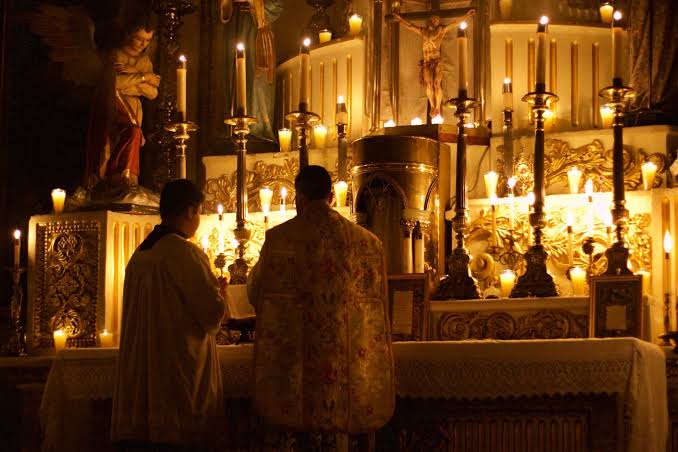
The Diocese of Pittsburgh has asked the faithful not to attend a new celebration of the Traditional Mass announced in a private chapel in Conway, Pennsylvania, noting that it lacks episcopal authorization and that, according to the diocese itself, it does not fulfill the Sunday precept. The warning comes just one month after Bishop Mark Eckman allowed the permission for the last Mass according to the 1962 Missal celebrated by diocesan priests to expire.
In a statement released this Tuesday, October 6, the diocese said it had become aware of several announcements regarding the celebration of the Vetus Ordo in a private property presented under the name Immaculate Heart of Mary Chapel, in the town of Conway.
“The announced celebration has not been submitted to Bishop Mark Eckman for his review or approval,” the diocese stated, adding that “neither the chapel nor the announced liturgical celebrations have received authorization from the Diocese of Pittsburgh.”
For this reason, it asked the faithful not to attend and maintained that these celebrations “do not fulfill the Sunday obligation.”
A weekly Mass announced on private property
According to The Catholic Herald, the announcement began circulating on social media around September 30 and indicated that an unidentified priest, belonging to a community within the Ecclesia Dei sphere, would celebrate the Traditional Mass weekly at the so-called Immaculate Heart of Mary Chapel. The post was later removed.
The Latin Mass Directory, which compiles places where the liturgy according to the 1962 Missal is celebrated, added the chapel on October 1 and updated the listing three days later. It currently warns that the planned celebrations there do not have the approval of the local bishop.
The Catholic Herald also notes that the address provided by the directory, at 913 2nd Avenue in Conway, corresponds to the former site of New Life Assembly of God Church, a Protestant church sold in June 2024 for $60,000. A post shared at the time on Facebook claimed that the property had been acquired by “a Catholic organization.”
The controversy has also sparked discussion about the private nature of these celebrations. Traditionis custodes regulates public celebrations according to the liturgical books prior to the reform, while some commentators have questioned whether a Mass publicly announced and intended to receive the faithful can simply be considered a private celebration.
The diocese directs the faithful to the Institute of Christ the King
The warning from Pittsburgh does not imply the disappearance of the Traditional Mass within the diocese.
The statement expressly encourages those who wish to attend the Vetus Ordo to go to Most Precious Blood of Jesus Parish, in Pittsburgh, where priests of the Institute of Christ the King Sovereign Priest celebrate daily according to the 1962 Roman Missal.
The parish, entrusted to the Institute, currently constitutes the main stable presence of the traditional liturgy recognized by the diocese.
“Bishop Eckman appreciates the faith and devotion of those who cherish the Traditional Mass and remains committed to their spiritual care and to growing together in unity as one Church,” the statement concludes.
One month after the end of the last diocesan Mass
The episode comes just weeks after Eckman decided not to request a new authorization for the last Traditional Mass served directly by diocesan priests.
In August, the bishop announced that he would allow the permission granted for celebrations according to the 1962 Missal at Saint Titus Church, part of the Mary, Queen of Saints parish, to expire.
The authorization had been extended for two years in September 2024, but Eckman chose not to request its renewal in Rome. The last diocesan Traditional Mass was celebrated on September 4.
In the letter communicating that decision, the prelate acknowledged that the measure would be “difficult” for some faithful who had found spiritual nourishment in those celebrations and expressed his gratitude for their “love of the Eucharist,” their “devotion to the Church,” and their desire to “worship God faithfully.”
The disappearance of that celebration did not, therefore, leave the diocese completely without Masses according to the traditional rite, but it did concentrate its ordinary celebration in the community served by the Institute of Christ the King.