


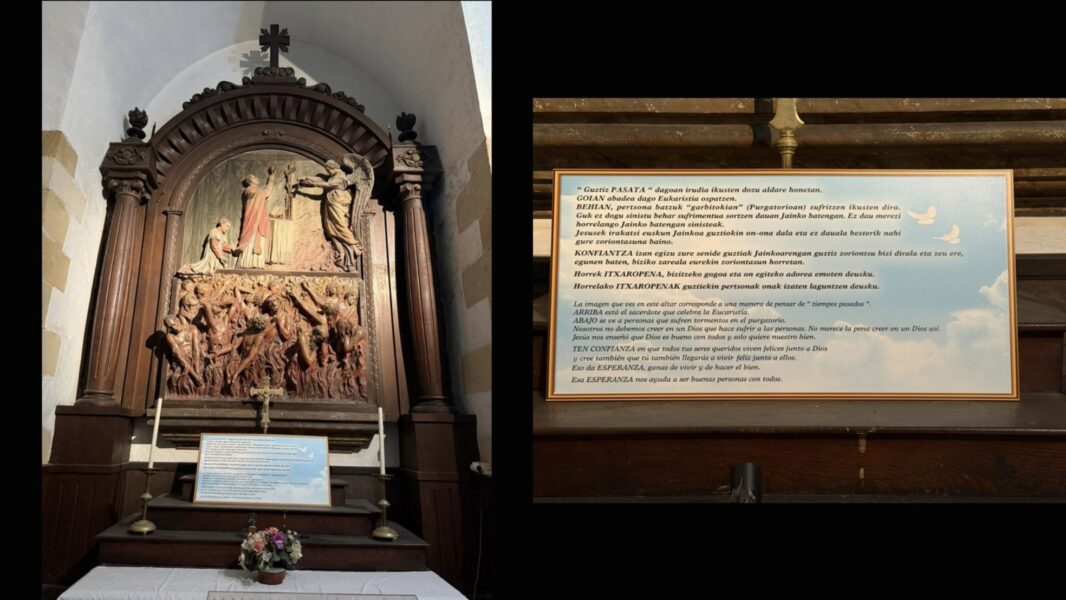
A text placed before the altarpiece of the Holy Souls in the parish of Santa María de Bermeo states that one should not believe in “a God who makes people suffer” and encourages the visitor to trust that all their loved ones “live happily with God.” The statements clash directly with what the Catechism teaches about purgatory, mortal sin, judgment, and the need for conversion.
A photograph shared on social media by the user @Markelpi_ has drawn attention to an unusual sign placed before an altar dedicated to the Souls in Purgatory in a church in Bermeo, Biscay.
Everything points to the parish of the Assumption of Our Lady, popularly known as Santa María, in Bermeo, belonging to the Diocese of Bilbao. Heritage sources document in this church an altarpiece of the Holy Souls, in addition to those dedicated to Saint John the Baptist, the Rosary, the Immaculate Conception, or Saint Joseph.
The identification is especially significant because devotion to the souls in purgatory has deep historical roots in the town. The Diocese of Bilbao itself has reported that its Historical Ecclesiastical Archive preserves the statutes and documents of the Confraternity of the Blessed Souls in Purgatory of the parish of Santa María de Bermeo, dated 1846 and at that time also explained to the faithful in the Basque language.
A historical study specifically dedicated to this documentation also records earlier antecedents of the confraternity in the former Santa María de la Atalaya of Bermeo and mentions the celebration of suffrages and the indulgences linked to devotion to the souls.
However, in front of the current altarpiece one can now see a bilingual sign, in Basque and Spanish, that seeks to reinterpret its meaning.
“A way of thinking from past times”
In its Spanish section, the sign literally reads:
“The image you see on this altar corresponds to a way of thinking from ‘past times.’
ABOVE is the priest celebrating the Eucharist.
BELOW one sees people suffering torments in purgatory.
We should not believe in a God who makes people suffer. It is not worth believing in such a God.
Jesus taught us that God is good to all and only wants our good.
TRUST that all your loved ones live happily with God and also believe that you too will come to live happily with them.
That gives HOPE, the desire to live and to do good.
That HOPE helps us to be good people to everyone.”
The Basque text conveys substantially the same message.
The problem does not lie, of course, in recalling the goodness and mercy of God, which are an essential part of the Christian faith. Nor does Catholic doctrine require one to understand the flames depicted by artists as a material fire identical to earthly fire. The problem arises when, in order to affirm that mercy, purgatory and purifying suffering are presented as an outdated religious conception, and it is offered practically as a certainty that all the deceased are already enjoying God.
That is not what the Church teaches.
The Catechism: those who die imperfectly purified “suffer a purification”
The Catechism of the Catholic Church expressly states in number 1030:
“All who die in God’s grace and friendship, but still imperfectly purified […] undergo purification after death.”
It adds that the Church calls purgatory that “final purification of the elect,” a doctrine formulated particularly in the Councils of Florence and Trent. Christian tradition even speaks, following certain scriptural texts, of a “purifying fire.”
Therefore, presenting before an altarpiece of the Holy Souls the reality it represents as a mere mentality of “past times” is, at the very least, incompatible with the currently valid formulation of the Catechism.
There is also an irony that is hard to overlook: the upper scene of the altarpiece itself depicts a priest celebrating the Eucharist precisely because the Mass offered for the deceased is one of the principal suffrages for the souls in purgatory. The Catechism teaches that from the earliest times the Church has offered for the dead “in particular the eucharistic sacrifice” so that, once purified, they may attain the vision of God.
What the sign seems to present as an uncomfortable relic of the past is, in reality, a practice that the Church continues to recommend today.
God is merciful, but that does not mean salvation is automatic
More serious is the invitation to believe that “all your loved ones live happily with God” and that the reader will necessarily be reunited with them.
A Catholic can and must hope for the salvation of his or her deceased, entrust them to divine mercy, and pray for them. What one cannot do is turn that hope into the assertion that each person’s salvation is automatic and independent of their response to God.
The Catechism affirms that dying in mortal sin without repentance means remaining separated from God forever and recalls that the existence of hell constitutes precisely “an urgent call to conversion.” God does not predestine anyone to damnation, but the possibility of definitively rejecting his grace is part of Catholic doctrine.
Equally clear is the teaching on the state of grace: mortal sin entails “the loss of charity and the privation of sanctifying grace” and, when not followed by repentance and forgiveness, can lead to definitive exclusion from the Kingdom.
That is why the Church has never presented the mercy and justice of God as contradictory realities.
Confusing hope with presumption
Precisely the Catechism warns against a distortion of Christian hope that it calls presumption: expecting to obtain forgiveness “without conversion” and to attain glory while disregarding the conditions that God himself has established.
The sign in Bermeo may be pastorally problematic precisely for this reason. A visitor unfamiliar with Catholic doctrine could leave a church convinced that the state of grace, conversion, confession, prayer for the dead, or the very existence of purgatory lack real importance, since the final salvation of all would be presented practically as an accomplished fact.
And that would not only empty of meaning the very altarpiece before which the sign has been placed. It would also empty of meaning centuries of the Church’s prayer for the dead.
The Catechism further explains that every sin carries consequences that require purification. At the same time, it clarifies that those penalties should not be imagined as a capricious revenge of God, but as consequences derived from the very nature of sin. In this way, authentic Catholic doctrine simultaneously avoids the caricature of a cruel God and the reduction of mercy to automatic salvation.
A heritage built precisely to teach the opposite
The case is even more striking because of Bermeo’s religious history. We are not dealing with an accidental representation or a decorative piece whose meaning has been lost.
The preserved documentation attests in Bermeo to the existence and activity of a Confraternity of the Blessed Souls in Purgatory, while the heritage sources of the church itself identify among its assets an altarpiece dedicated to the Holy Souls.
That is to say: generations of Catholics raised, preserved, and prayed before that altar precisely to remember the need to offer suffrages for those who had died in friendship with God but still needed to be purified.
Now, before the same work, a sign explains to the visitor that it corresponds to a way of thinking from “past times.”
Who is in charge of the parish?
According to the official guide currently published by the Diocese of Bilbao, the parish priest of the Assumption of Our Lady of Bermeo is José María Cortázar Uriarte. The same guide also identifies him as parish priest of Santa Eufemia. In the list of assignments for the 2025-2026 academic year, the Bishopric likewise announced Cortázar as the presbyter assigned to the Bermeo Pastoral Sector.
The diocese is governed by Msgr. Joseba Segura Etxezarraga, Bishop of Bilbao.
It is not known, for the moment, who wrote the sign or who ordered its placement. Nor have we found public documentation that would allow its content to be personally attributed to the parish priest.
What any faithful person can verify is that the explanation displayed before the altar does not adequately reflect what the Catholic Church continues to teach about purgatory, the need for conversion, suffrages for the dead, and the eternal destiny of man.