


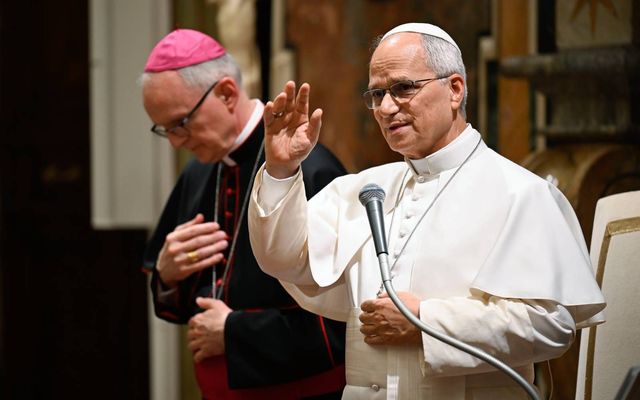
Pope Leo XIV received representatives of the Vatican Association of Lay Employees (ADLV) on Monday in a meeting held just weeks after the organization requested compensation for years of wage restraint and called for greater worker participation in decisions affecting their working conditions.
During the audience, which also included representatives of the Donne in Vaticano Association, the Pope did not address the specific economic demands recently raised by the employees. He did, however, discuss the relationship between workers and the institutions of the Holy See, highlighting dialogue as the path to finding “appropriate solutions to the problems we must face together.”
The context gives particular meaning to those words. Last September, the ADLV had called for a “new stage of sincere, constructive, and attentive dialogue,” after lamenting that workers had not been consulted on decisions that directly affected their economic conditions.
Pope Leo XIV advocates for dialogue
In his address to representatives of both associations, Pope Leo XIV began by thanking the “dedication” and “spirit of service” with which employees carry out their daily work in the various bodies of the Apostolic See, thereby collaborating in the Pope’s pastoral ministry.
The Pontiff emphasized the “irreplaceable centrality of the human person” and the “inalienable dignity of work,” and recalled that those who serve in the Vatican form, beyond their different roles, an “ecclesial community.”
Addressing specifically the role of workers’ associations, Pope Leo XIV recalled words spoken by Saint John Paul II in 1982. The Polish Pope at that time recognized that organizations like the ADLV could perform “a valid task of collaboration,” but warned that “it is not in line with the Church’s social doctrine to shift such organizations into the realm of conflict or struggle.”
It is, therefore, Saint John Paul II who uses the term “conflict”, while Pope Leo XIV, immediately after quoting him, offers his own exhortation: “The path of dialogue, therefore, remains the principal way by which I too urge you always to walk, with trust and creativity, in the common search for appropriate solutions to the problems we must face together.”
The Pope also called for “reviving dialogue” at all levels and recalled that the ADLV’s own regulatory framework defines the association as a “structure of dialogue” between its members and the Labor Office of the Apostolic See.
These words come after several months in which employee representatives have called precisely for greater engagement with Vatican authorities.
Economic demands remain pending
The immediate context of the audience is marked by the repeal, on September 14, of the wage restraint measures approved by Francis in 2021. That regime had included reductions in certain remunerations and the temporary suspension of biennial seniority increases for part of the staff.
The repeal took effect from September 1, but maintained the economic effects produced while the restrictions were in force. Employees, therefore, did not recover the seniority increases that ceased to accrue during those years.
The ADLV then raised the need to find some formula to compensate for the accumulated losses. The association proposed studying an extraordinary payment or another solution if it were not possible to fully restore the amounts not received, and also asked to examine the possible consequences for future pensions and end-of-service indemnities.
Alongside the economic issues, worker representatives insisted on the need to participate more fully in decisions that directly affect their working conditions.
In a statement published by the ADLV when the repeal of the 2021 measures was announced, the association lamented that employees had not been involved in drafting the new provisions, “not even through consultation activities with their representatives.”
The demands subsequently raised by the employees insisted on finding a solution for the economic effects accumulated during the years of wage restraint.
No concrete responses to wage demands
The speech delivered on Monday, however, did not offer a specific response to those requests. Pope Leo XIV did not announce economic compensation, changes to pensions, or measures to recover lost seniority increases. Nor did he make explicit reference to the ADLV’s latest demands.
His intervention remained fundamentally in the realm of the principles that, in the Pontiff’s view, should guide labor relations within the Holy See: dignity of work, collaboration, listening, and dialogue.
Nevertheless, in the final part of his speech, Pope Leo XIV offered a particularly significant consideration in the context of the workers’ demands. The Pope called for building “a working community where people are not used or sidelined,” where mutual assistance exists and “each person’s value and competence is recognized,” avoiding the generation of “dissatisfaction and resentment.”