


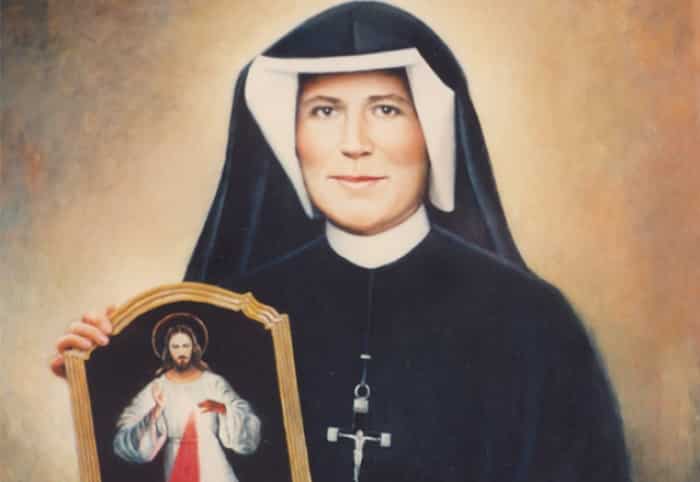
Every October 5, the Church celebrates the memory of Saint Faustina Kowalska, the Polish religious sister whose name became forever linked to devotion to Divine Mercy. She died in Kraków in 1938, at only 33 years of age, after a hidden life that hardly foreshadowed the extraordinary spread her writings and the forms of piety born from them would achieve.
Today, the image of Christ with rays streaming from His chest can be found in churches throughout the world. Millions of Catholics pray the Chaplet of Divine Mercy, and the ejaculation “Jesus, I trust in You” has become part of the everyday language of Catholic piety.
Yet the very popularity of this devotion can obscure something essential: the mercy of which Saint Faustina speaks is not an abstract idea about God’s goodness, but the mercy that flows from Christ’s sacrifice on Calvary.
That is the heart of her message.
From Christ’s Open Side
When Saint John Paul II canonized Faustina on April 30, 2000, he wished to explain her mission from the Gospel of that Sunday. The risen Christ enters the Upper Room, shows the Apostles the wounds in His hands and side, and then entrusts them with the power to forgive sins: “Receive the Holy Spirit; whose sins you forgive are forgiven them.”
For the Polish Pope, the two realities were intimately united. Christ’s wounds and the forgiveness of sins belong to the same mystery. Mercy does not appear apart from the Passion; it reaches humanity precisely through the redemptive sacrifice of the Son of God.
This also explains the image Saint Faustina was instructed to have painted. From Christ’s chest flow two rays, one pale and one red. According to the Diary, the Lord Himself explained that they represent the water and blood that flowed from His open Heart.
John Paul II repeatedly returned to this symbolism. The blood recalls the sacrifice of the Cross and the Eucharistic gift; the water points to Baptism and the life-giving action of the Holy Spirit.
Divine Mercy thus leads to the very center of the Catholic faith: Calvary, the sacraments, and the pierced Heart of the Redeemer.
A Mercy for Sinners
This is also why sin occupies such an important place in Faustina’s writings. Not because the saint was dominated by a gloomy vision of Christian life, but because only those who grasp the gravity of sin can grasp the greatness of forgiveness.
Christ does not come merely to reassure man. He comes to save him.
And to save him means to rescue him from what separates him from God.
Faustina’s mission was marked from the beginning by prayer for sinners, especially those farthest from God. The Chaplet itself retains this dimension of intercession when it asks the Father for mercy “for us and for the whole world.”
Saint John Paul II singled out those who bear the weight of their own sins to the point of feeling unable to return to God. For them, he said during the Polish nun’s canonization, the face of the merciful Christ is an invitation to regain trust.
There is something profoundly Catholic in this. The Church has never taught the sinner that his sin is unimportant; she has taught him something infinitely more consoling: that he can repent, confess, and begin again.
Mercy does not consist in making conversion unnecessary. It consists precisely in making it possible.
The Confessional and the Eucharist
It is no coincidence that the message entrusted to Faustina is so closely linked to the sacraments.
The Gospel scene chosen by John Paul II to explain Divine Mercy culminates in the words by which Christ gives His Apostles the power to forgive sins. Trust in divine mercy thus finds concrete expression in the sacrament of Penance.
For a Catholic, trusting that God forgives is not a vague interior disposition. Christ willed to leave His Church a sacrament in which the repentant sinner could truly hear the words of absolution.
And alongside the confessional appears the Eucharist.
The blood that Saint Faustina sees flowing from Christ’s Heart refers, as John Paul II explained, both to the sacrifice of Calvary and to the Eucharistic gift. The same Christ who offers His life for sinners remains in the midst of His Church under the sacramental species.
Thus, the spirituality of Divine Mercy, rightly understood, does not lead to a sentimental or purely private religiosity. It returns the soul to Christ, to Confession, to the Eucharist, and to the life of grace.
Mercy and Conversion
A superficial reading might present mercy and the commandments as if they belonged to two different ways of understanding Christianity: one based on welcome and the other on moral demand.
This was not the case for Saint Faustina, nor for John Paul II.
In his canonization homily, the Pope recalled the words of Saint John: “In this we know that we love the children of God: if we love God and keep His commandments.” And he added that the commandments themselves constitute “the measure and the criterion” of love.
God’s mercy, therefore, does not lower the Christian vocation to holiness. It makes it possible for weak men who fall, repent, receive forgiveness, and rise again.
This experience also transforms the way one looks at one’s neighbor. Whoever knows how much has been forgiven him learns to forgive; whoever knows his own misery has less reason to despise another’s. That is why devotion to Divine Mercy was never reduced in Faustina to certain prayers. It also demanded concrete works of mercy.
The Sacred Heart and Divine Mercy
There is, moreover, a continuity worth recalling. The spirituality of Saint Faustina did not appear as a break with the great devotions that had nourished the life of the Church for centuries.
Its center is once again the Heart of Christ.
Celebrating Divine Mercy Sunday in 2001, John Paul II expressed this with particular clarity while contemplating the two rays of the image entrusted to Faustina: “The Heart of Christ! His ‘Sacred Heart’ has given everything to men: redemption, salvation, and sanctification.”
The Heart that Saint Margaret Mary Alacoque had shown the world burning with love for men is the same Heart that Faustina contemplates opened, pouring forth blood and water.
Christian mercy, therefore, has a concrete face.
It is that of Jesus Christ.
A Saint Between Two Wars
Faustina was born in 1905. She was nine when the First World War began and died only a year before the invasion of Poland triggered the Second.
Most of her life, therefore, unfolded in a Europe that had known a devastating war and was unknowingly heading toward another, even worse.
John Paul II saw something providential in the fact that the message of Divine Mercy had been entrusted at precisely that time to a humble Polish religious sister.
Faustina never saw the extermination camps or the destruction her homeland would suffer. Nor did she witness the totalitarian regimes unleash their full capacity to turn man into an instrument of the State. But the message she left behind would traverse precisely that wounded world.
Decades later, John Paul II would speak of the twentieth century as a time marked by the mysterium iniquitatis, the mystery of iniquity, and would point to divine mercy as one of the great Christian responses to evil.
Not because evil had ceased to be evil, but because evil never has the last word as long as man can return to God.
“Jesus, I Trust in You”
The entire message of Saint Faustina was ultimately condensed into an extraordinarily simple phrase.
“Jesus, I trust in You.”
These are words that can be fully understood only before the image that accompanies them: the risen Christ still bears the wounds of the Passion, and from His chest flow blood and water.
Christian trust does not rest on the idea that sin is irrelevant, nor on the assurance that God will grant man everything he desires. It rests on a Person: Jesus Christ, who died and rose for our salvation.
That is why they can be spoken by the just person who wishes to persevere and also by the sinner who returns ashamed after having fallen. They can be repeated by one who has just received a grace and by one who is passing through a night in which he can scarcely grasp God’s designs.
And they can be spoken, above all, by one who discovers that he no longer has anything of his own on which to lean.
Faustina died on October 5, 1938. She was 33 years old and had spent much of her brief life performing the simplest tasks within her congregation.
What she left to the Church was an invitation that remains the same for every generation: to look upon the wounds of the Redeemer, to turn to His mercy, to abandon sin, and to trust.
Jesus, I trust in You.