


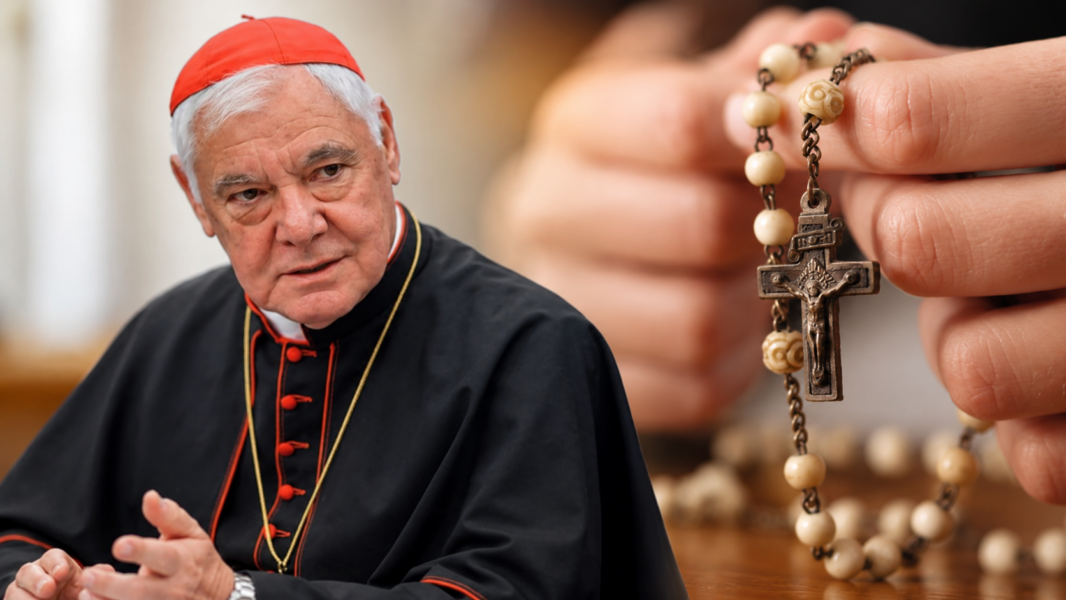
Cardinal Gerhard Ludwig Müller, Prefect Emeritus of the Congregation for the Doctrine of the Faith, presided on October 4 in Lublin (Poland) at a celebration marking the patronal feast of the Church of Our Lady of the Rosary.
In his homily, Müller recalled the Battle of Lepanto and the origin of the feast of Our Lady of the Rosary, reflected on the place of the Virgin Mary in the history of salvation, and encouraged the faithful to recover the daily recitation of the rosary.
“The rosary should not be forgotten at the bottom of a drawer,” the cardinal stated, recommending that people carry it with them and turn to this prayer throughout the day: “During a journey, while walking, or in the quiet weariness of the evening.”
Homily of Cardinal Gerhard Müller
Most Reverend Archbishop Stanisław, dear Pastor Marek, dear brother priests, dear religious sisters, dear brothers and sisters in Christ the Lord:
I am very pleased to be able to preside here in Lublin at the celebration in honor of Our Lady of the Rosary.
To fully understand the power of the rosary, we must go back to the year 1571, more precisely to October 7, when the destiny of our faith and our freedom was decided in the waters of the Gulf of Corinth, in the naval Battle of Lepanto.
The situation was dramatic. The Christian fleet, the so-called Holy League, was greatly outnumbered, poorly armed, and seemed doomed to defeat. Humanly speaking, there was no prospect of victory.
Then the Pope at that time, St. Pius V, did something that, from the point of view of military strategists, might have seemed madness. Instead of seeking only earthly allies, he called all of Europe to a spiritual mobilization. He asked every cardinal, every priest, every mother, every father, and every child to take up the rosary.
On the day of the battle, the streets of Rome and other cities were filled with people who, on their knees, implored Mary for salvation. Pope Pius V himself remained in prayer in his apartments in the Vatican.
And then a miracle occurred that historians continue to describe to this day: a sudden change in the wind. At the decisive moment of the battle, the wind, which until then had favored the sails of the invaders and driven the Christian ships away, suddenly changed direction completely.
At the same time, in Rome, Pope Pius V interrupted his work, approached the window, and his face lit up. He turned to his secretaries and said: “Our Lord has granted us a great victory. Let us give thanks to God.”
The news of the naval victory did not reach Rome until several days later and confirmed the Pope’s words with exact precision.
As thanksgiving for that extraordinary deliverance, the Pope established October 7 as the feast of Our Lady of Victory. Two years later, his successor, Pope Gregory XIII, changed the name of this day to the feast of Our Lady of the Rosary, which we continue to celebrate to this day.
The victory of Lepanto was not due to brilliant generals or better cannons. It was due to prayer to the Mother of God.
Because Mary is, after Jesus, the Son of God and the only Redeemer of the world, the most important person in the history of salvation.
Through her “yes,” in response to the angel’s announcement, she became, with faithful availability, the Mother of the eternal Son of God: “Behold the handmaid of the Lord; let it be done to me according to your word” (Lk 1:38).
From Mary the eternal Word took our human nature, who with the Father and the Holy Spirit is one God.
Mary is a historical figure, a real person, a daughter of Israel. But who she is for Jesus and what she means for us, his Church, cannot be interpreted solely through mythological metaphors or timeless existential truths.
What is decisive is to understand her role in the horizon of the divine plan of salvation, which God has historically accomplished in Jesus Christ.
In the womb of the Mother of God, the eternal Son of God takes our flesh and dwells for nine months in her body; she carries him beneath her heart.
Jesus Christ, the God-man, remains present in the midst of his people and of all peoples who are incorporated into his Church to form one single family of God.
Mary is, moreover, the original model of the Church. She is the eminent and exemplary disciple of her Son. For us she constitutes a luminous example of love for God above all things and of love for neighbor as oneself.
On the day of Pentecost, after the risen Lord had taken his seat at the right hand of the Father, God sent the Holy Spirit upon the apostles, who had prepared themselves for this event, at the beginning of the history of the Church, together with Mary, the Mother of Jesus.
The Fathers of the Second Vatican Council summarize the mission of Mary in the history of salvation with these words:
“Finally, the Immaculate Virgin, preserved immune from all stain of original sin, when the course of her earthly life was finished, was taken up body and soul into heavenly glory and exalted by the Lord as Queen of the universe, so that she might be the more fully conformed to her Son, the Lord of lords and conqueror of sin and death” (Lumen gentium, 59).
Therefore, as members of the Body of Christ who are pilgrims toward the heavenly Jerusalem, we can direct our petitions to her.
Because she is with Christ in heaven. At the head of the communion of all the saints, she unites her prayers with ours.
Thus she entrusts us, our families, our people, all peoples, and the whole Church to God the Father through her Son in the Holy Spirit.
The liturgical and private veneration of Mary, from whose womb the salvation of the world was born to us, clearly shows us that there is no relationship with God outside the visible Church, the Body of Christ.
“No one can have God as Father who does not have the Church as Mother” (De unitate Ecclesiae, 6).
Thus formulated the holy bishop Cyprian of Carthage in the face of all those who separate themselves from the Church, their Mother, whether out of pride or even out of disappointment at the human weaknesses of her representatives.
As Bride and Body of Christ, as well as temple of the Holy Spirit, the Church is the sacramental presence of the Word of God, who took our flesh from Mary and dwelt among us.
Here takes place the greatest union in all of history.
Mary is the true image and the eternal model of the fulfillment of the will of God, who always desires our salvation and our happiness.
Dear brothers: therefore the rosary should not be forgotten at the bottom of a drawer.
It should have its place in our pocket, in our purse, or beside the bed.
Let us take it up throughout the day: during a journey, while walking, or in the quiet weariness of the evening.
Our Lady of the Rosary awaits our small “Hail Mary.”
Let us entrust to her, with each bead we pass between our fingers, our cares, our families, and our future.
Amen.