


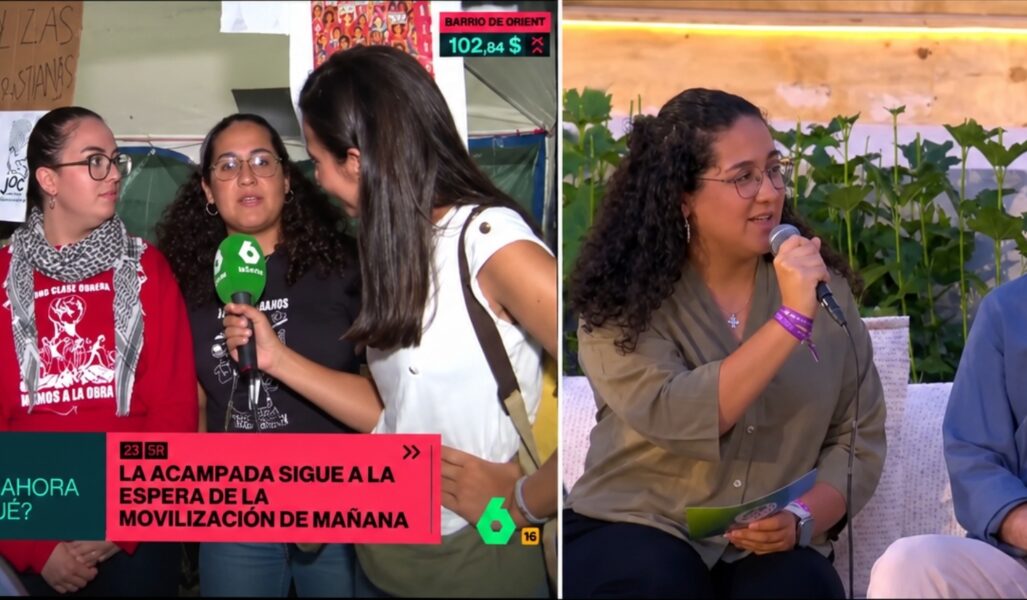
The Puerta del Sol, with the induction and complacency of the Ministry of the Interior, has recovered the aesthetics of its worst times: tents, banners against “rentism” and assemblies that deliberate until dawn over the order of the next batucada. The cast is the usual one of Madrid’s far left, with its entourage of perroflautas and its special on La Sexta to certify that everything has been very spontaneous. Among the tents, with the card of the Juventud Obrera Cristiana in her pocket, appears the young woman whom the Archdiocese of Madrid chose four months ago to speak with the Pope.
A very timely scarecrow
Pedro Sánchez has spent eight years in La Moncloa dictating housing laws, rent caps and stressed zones. If renting is today a calamity, the person responsible has a name and a parliamentary majority. It is prodigious that youthful indignation has taken exactly eight years to awaken and has done so just when Ceuta has spent two months turned into an open-air camp, with 72,000 people entering from Morocco in two days, with an entire local population terrified. The Government needed another photograph and the left has manufactured it for them at kilometer zero. In Sol there is not a single slogan against the tenant of La Moncloa.
Nor is there one against the variable they omit. Spain has received several million immigrants in just a few years, the Government has regularized a million and a half with a single stroke and the demand for flats is growing at a pace no development can match. More people competing for the same houses means higher prices; it is the oldest law of economics and the only one the camp has decided to repeal. It is more comfortable to point at the pensioner who rents out his mother’s flat than to admit that the Government’s migration policy is the first driver of scarcity.
Protesting to own nothing
No generation had ever camped before to demand the right never to own a home. In Sol no one is calling for buying, saving or leaving something to their children. They are asking for indefinite leases, prices by decree and an owner reduced to a figurehead of a contract that no longer belongs to him. A JOC leader summed it up right there: landlords “extract rents from their tenants.” Whoever describes renting as exploitation has already decided the recipe: that the State take the place of the owner. The result is a landlord with a BOE, much harder to evict than the previous one and from whom it is impossible to move.
The Church taught exactly the opposite for a century and a half. Leo XIII wanted worker-owners; Pius XI and John Paul II wanted to spread ownership among the greatest number of families. A society of owners distributes power; one of perpetual tenants concentrates it in whoever regulates. What is happening in Sol is the anthropology of the grateful serf, translated into evangelical language by a movement that defines itself as questioning the “capitalist system.”
A movement with an episcopal seal
The JOC is not a marginal collective that sneaks into Church events through the back door. It is part of Specialized Catholic Action, has chaplains appointed by the bishops, appears in the youth ministry charts of the dioceses and sits on the youth councils of the Episcopal Conference. Its campaigns are presented in ecclesiastical venues, its militants access official stages and the affiliated Catholic media publish its communiqués as if they were pastoral letters. That institutional backing, which other Catholic sensibilities are denied with notarial zeal, is what turns a political militancy into a representation of “Catholic youth.”
From Plaza de Lima to the tent
On June 6, more than half a million young people packed the Castellana for the vigil with Leo XIV. After two hours of music, rosary and testimonies, the Pope took the stage at Plaza de Lima accompanied by Cardinal Cobo and seven young people from the three Madrid dioceses, chosen by the organization to raise their concerns with him on behalf of everyone. One spoke about marriage and received that “do not be afraid to form a family” that went around Spain. María Azargui, a JOC militant, was given the lot of artificial intelligence, precariousness, housing and polarization. She herself later explained that the diocese wanted to reflect “the diversity of Madrid’s youth” and that she had been considered suitable to represent it.
This week she was sleeping in Sol, posing with Ana Pastor and calling for the protest to descend into the neighborhoods by organizing “rage” and “frustration.” From the dialogue with the Successor of Peter to the pedagogy of rage in a single summer.
The diocese of Fusara
The person who chose her presides, by delegation, over the board of Fusara, the foundation that in 2019 sold for 74 million euros a package of buildings in central Madrid with two hundred families inside and that in 2025 agreed to raise the price to 99. While the young woman chosen by Cobo asked the Pope about decent housing, some of those neighbors were asking the same Pope to help them not lose theirs. For the Fusara neighbors, lawyers and statements about the legal nature of the foundation; for the Tenants’ Union, a representative presented to the Pope and blessed by the affiliated Catholic media. The operation is impeccable if one understands that the objective was never housing but the photograph.