


By Stephen P. White
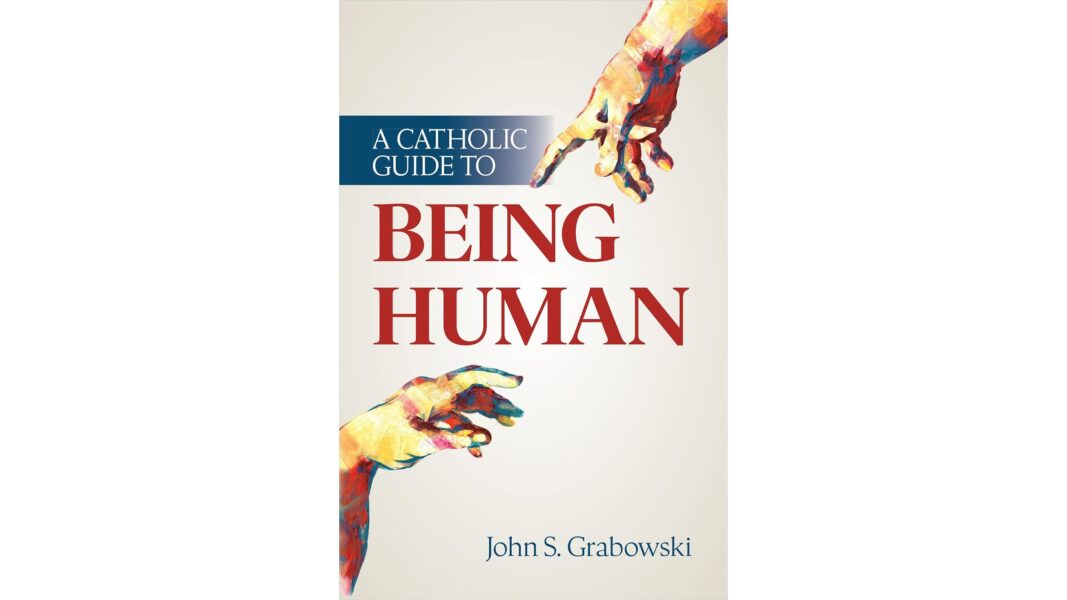
In his new book, A Catholic Guide to Being Human, Dr. John Grabowski offers a reminder that the term “person” is more laden with theological implications than we often realize. Identifying and unraveling those implications is the first step toward answering what is perhaps the great question of our age: what does it mean to be human?
The Christian West once had a confident answer to that question, firmly rooted in the mystery of the Incarnation. The strength of that confidence served as the foundation for a great human civilization. That does not mean a civilization without sin, but one in which even the most glaring failures confirm the norm of its underlying humanity.
Understanding the human person correctly requires that we think carefully about man both as a “what” and as a “who.”
Today it seems we have lost confidence in our answers to the great question. As a result, having lost sight of both God and man, our world has become less human, even as we have grown in power and technological mastery. Our idea of ourselves and our place in the world is distorted. We run the danger of becoming, as Grabowski puts it, “technological giants and moral pygmies.”
As Pope Leo XIV made clear in Magnifica Humanitas, one of the great temptations of our technological age is, in fact, a very ancient temptation: the temptation to build for ourselves, in all our pride, a new Tower of Babel. A world “conceived without reference to God” must necessarily also be a world built without reference to man: a world that is, literally, inhuman.
The changing rhythms and patterns of our way of life shape the way we understand ourselves. Sometimes threats to our self-understanding arise suddenly—as in the case of the appearance of nuclear weapons or, today, the rise of AI—and therefore provoke a great deal of self-reflection. Sometimes the change is much more subtle and, particularly when perceived as benign or beneficial, advances almost unnoticed.
However deeply our environment and circumstances shape us (and they do!), we are never merely the product of our circumstances. Human nature itself guarantees that, as Pope John Paul II insisted:
“[I]t cannot be forgotten that the way in which the individual exercises his freedom is conditioned in countless ways. While these certainly have an influence on freedom, they do not determine it; they make the exercise of freedom more difficult or less difficult, but they cannot destroy it.”
Even fervent Christians sometimes need a reminder that our self-understanding is conditioned by the world around us, often in ways that are not easy to perceive. And fervent Christians also sometimes need to be reminded that the threats and challenges we do perceive—however clear and present they may be—are only part of the story, and perhaps not the greatest part.
In short, when it comes to understanding ourselves and our place in the world, we must take care to ensure that we see both the forest and the trees. And this is where Professor Grabowski’s new book truly shines.
“Some of the Church Fathers,” Grabowski writes in his introduction, “saw man as a microcosm of the macrocosm: a miniature version of the universe as a whole. Human beings are at once material (like the physical world and the animals) and rational and spiritual (like the angels and God himself). In this way, the human person stands as a summation of creation and at the center of the history of salvation.”
It takes mastery of many subjects to write intelligently about so vast a topic. Yet here Grabowski displays his long years of experience as a teacher and his command of the material. He clarifies without oversimplifying; he condenses without distorting; he writes with precision without resorting to jargon or overly technical terms. The result is a compelling account of Christian anthropology that is at once eminently accessible and readable, without any dilution.
Perhaps the most delightful thing about this book is what we might call its sense of proportion. Grabowski is a moral theologian, and he clearly shares many concerns about the urgent challenges of our day. And he writes an entire chapter on what he calls the “Deviations, Distortions, and Deceptions” of the human person that we see around us today. He is very much aware, so to speak, of the trees that stand before us in the forest.
But he never allows these urgent moral challenges of our day to obscure the broader horizon. They are presented in the vast context of the entire history of Creation, the Fall, and Redemption. It is precisely in this context, and against the backdrop of Scripture, Tradition, and the sacramental life of the Church, that challenges such as AI, genetic engineering, and artificial contraception (to cite just a trio of examples from the book) acquire their proper meaning and proportion.
These deviations, distortions, and deceptions seem relatively small when compared with the whole sweep of salvation history. And yet it is precisely by understanding that entire history—the story of the dignity man receives from his Creator, the heights to which man is called, the price of his disobedience, and the inestimable love and mercy of God who assumes human nature to redeem us and make us his adopted sons and daughters—that we see how precious our humanity is and how perverse it is to disfigure and distort what God has made in his own image and likeness.
A Catholic Guide to Being Human is well worth reading for Catholic readers (and those curious about Catholicism) from adolescence onward. As someone who reads and writes about Christian anthropology all the time, I am grateful for (and perhaps just a little envious of) Dr. Grabowski’s ability to navigate with such clarity both the forest and the trees.
About the author
Stephen P. White is executive director of the Saint John Paul II National Shrine and a fellow in Catholic Studies at the Ethics and Public Policy Center.