


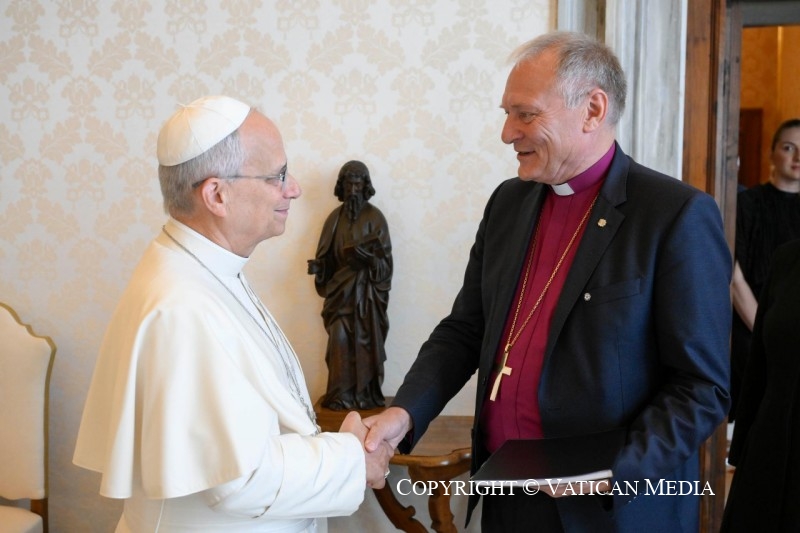
Pope Leo XIV has proposed recovering, ahead of the year 2030, the “pre-confessional ecumenical potential” of the Augsburg Confession, one of the foundational texts of Lutheranism, during an audience granted this Thursday to representatives of the Lutheran World Federation.
According to the address published by the Holy See Press Office, the Pontiff highlighted the progress made in recent decades in relations between Catholics and Lutherans and pointed to the fifth centenary of the Confessio Augustana, to be celebrated in 2030, as an opportunity to advance the path toward “full and visible unity.”
Leo XIV specified that the goal of the ecumenical journey is to achieve a “renewed communion in the apostolic faith, in the sacraments and in the ministries,” and recalled as one of its principal milestones the Joint Declaration on the Doctrine of Justification.
The Augsburg Confession on the eve of its fifth centenary
A large part of the address was devoted to the Augsburg Confession, presented on 25 June 1530 before Emperor Charles V and later becoming one of the principal confessional documents of Lutheranism.
Leo XIV stated that, when the text was presented, “the unity of the Western Church was threatened, but had not yet been broken.” To explain the context of its composition, he recalled words spoken by Saint John Paul II in 1980, on the occasion of the 450th anniversary of the Confession, according to which its authors intended to bear witness to their faith “in the one, holy, catholic and apostolic Church.”
The Pope maintained that the Augsburg Confession “originally intended to be a document of reconciliation within the Church” and that “only later did it come to be understood as a text of divisive confessionalization.”
On the basis of this interpretation, he set out the horizon for 2030: “It would be good if we could once again affirm together the pre-confessional ecumenical potential of the Confessio Augustana.”
A line the Vatican has been preparing for 2030
The proposal now made by Leo XIV is not appearing for the first time in the ecumenical debate of recent months.
Last January, the Secretary of the Dicastery for Promoting Christian Unity, Msgr. Flavio Pace, also referred to the Augsburg Confession as a text on which to work in view of 2030.
Pace then noted that, after the crisis provoked by Martin Luther, an attempt had been made to find “a meeting point, a shared profession of faith,” and he defended the importance of commemorating the Confessio Augustana in order to “rediscover a common foundation.”
This interpretation also has an immediate papal precedent. Francis, during an audience with the Lutheran World Federation in June 2021, had already presented the Augsburg Confession as an attempt to prevent the rupture of Western Christendom and had expressed his desire that joint reflection on the document in view of 2030 would favor the ecumenical path.
Leo XIV now continues that line and expressly calls for recovering the “ecumenical potential” of the document.
A text that also contains the doctrinal differences of the Reformation
Considering the Augsburg Confession as a possible point of encounter does not, however, eliminate the confessional character the document acquired nor the doctrinal controversies it aroused.
Drafted principally by Philip Melanchthon, the Confessio Augustana set before Charles V the positions of Luther’s followers and addressed issues that ultimately stood at the center of the religious rupture of the sixteenth century.
Among them were differences concerning the Mass, penance and confession, ecclesiastical ministry, clerical celibacy and other matters of doctrine and discipline.
The Catholic response came that same year in the Confutatio Augustana, prepared by Catholic theologians to reply to the articles of the Confession. The doctrinal controversies opened by the Reformation would later be addressed more fully by the Council of Trent.
This background allows us to situate the scope of the proposal the Vatican has been preparing for 2030: it is not a historically neutral document, but one of the texts that ultimately defined Lutheran confessional identity vis-à-vis the Catholic Church.
Leo XIV calls for a return to the primitive Church and the Fathers
In his address this Thursday, Leo XIV linked his proposal to a return to the common sources prior to the divisions of the sixteenth century.
“Let us return, with deep devotion, to our common roots, to the faith of the primitive Church and of the Fathers of the Church,” the Pontiff urged, calling for the rediscovery of “the apostolic and pre-confessional heritage” that unites Catholics and Lutherans.
The Pope addressed this invitation particularly to theologians, asking them to focus their attention on Christ and the Gospel.
He also recalled the Joint Declaration on the Doctrine of Justification as “a milestone on the ecumenical journey” and mentioned the documents produced over decades of dialogue on the Eucharist, ministry in the Church and paths toward communion.
Looking toward 2030, Leo XIV expressed his desire that the fifth centenary of the Augsburg Confession become “a profound ecumenical experience” capable of giving new impetus to the path toward full visible unity.
“Christ must not become a ‘foreign word’ in our world,” the Pope affirmed before concluding the meeting by inviting the representatives of the Lutheran World Federation to pray the Our Father together.
ADDRESS OF HIS HOLINESS POPE LEO XIV TO THE DELEGATION OF THE LUTHERAN WORLD FEDERATION
The grace of our Lord Jesus Christ, the love of God and the communion of the Holy Spirit be with all of you (2 Cor 13:13).
Dear brothers and sisters in Christ:
I extend a warm welcome to you, representatives of the Lutheran World Federation. I offer a special greeting to the President of the Lutheran World Federation. Thank you for your kind words and for this symbolic and beautiful gift. I also greet the General Secretary, the Reverend Burghardt, who is present here. I renew my gratitude for your presence at my inauguration last year.
I am pleased that Lutheran-Catholic relations have matured both spiritually and theologically over the decades. The international dialogue, now in its sixth phase, has yielded important fruits. A milestone on the ecumenical journey was, without doubt, the Joint Declaration on the Doctrine of Justification. However, the texts jointly produced in previous years also deserve to be remembered and received ever more deeply, especially The Eucharist, Ministry in the Church and Paths to Communion.
Five years ago, in his address to the Lutheran World Federation during a private audience, my predecessor, Pope Francis, beautifully described the meaning of ecumenism: “Ecumenism is not an exercise in ecclesiastical diplomacy, but a journey of grace. It does not depend on human negotiations and agreements, but on the grace of God, who purifies memories and hearts, overcomes attitudes of rigidity and leads toward a renewed communion” (Address to the delegation of the Lutheran World Federation, 25 June 2021).
Renewed communion in the apostolic faith, in the sacraments and in the ministries is the goal of our ecumenical journey of grace, which we walk together guided by the Gospel. On our common path from conflict to communion there are special moments. As you have mentioned, the year 2030, marking the 500th anniversary of the Augsburg Confession, can become one of those shared moments: a profound ecumenical experience that can give new energy and joy to the steps we will take toward full and visible unity.
When the Confessio Augustana was read in Augsburg on 25 June 1530, the unity of the Western Church was threatened, but had not yet been broken. The authors of the Augsburg Confession—as my predecessor Saint John Paul II affirmed—had the “intention of bearing witness to their faith in the one, holy, catholic and apostolic Church” (Address on the occasion of the 450th anniversary of the Confessio Augustana, 25 June 1980). The Augsburg Confession originally intended to be a document of reconciliation within the Church. Only later did it come to be understood as a text of divisive confessionalization.
In view of 2030, it would be good if we could once again affirm together the pre-confessional ecumenical potential of the Confessio Augustana. I make an earnest appeal to all believers, and especially to theologians, to fix their gaze on Christ and his Gospel. Let us return, with deep devotion, to our common roots, to the faith of the primitive Church and of the Fathers of the Church, in order to rediscover the apostolic and pre-confessional heritage that truly unites us as brothers and sisters, brothers and sisters in Christ.
Christ must not become a “foreign word” in our world. Our world needs ecumenical witnesses of Christ who make him known through their lives and actions, because only Christ is the living source capable of fulfilling humanity’s deepest longings.
Dear brothers and sisters, united in this common ecumenical and missionary task, I would like to thank you once again for your visit. Let us renew our commitment to unity by praying together now as the Lord taught us.
Our Father (prayed together).