


Brazilian businesswoman and communicator analyzes the weight of Catholics and evangelicals in an election marked by the hoax about Our Lady of Aparecida and by Lula’s attacks on priestly celibacy.
Brazil goes to the polls this Sunday, October 4, and faith has become one of the main battlegrounds of the campaign. More than 158 million Brazilians are called to vote in the country with the most Catholics in the world. But Catholicism is in retreat: according to the 2022 Census, published by the IBGE in 2025, only 56.7 % of the population identifies as Catholic, the lowest percentage since 1872.
Against that backdrop, La Sacristía de la Vendée once again welcomed Sandra Bronzina, a Brazilian businesswoman, writer and communicator who had already appeared on the counter-revolutionary priestly talk show. This time she speaks from within: Bronzina is personally involved in a campaign that is entering its final days.
Born in Brazil and based in Argentina, Bronzina creates daily content for the television channel of Flávio Bolsonaro, the presidential candidate of the Liberal Party. She had planned to discuss economics and security, she explained to Father Francisco José Delgado, the program’s host, but the campaign took her elsewhere: “The most striking thing about this campaign is how the left is using faith in a dirty way.” Something that, in her view, “had never happened in any other election in Brazil.”
“The priest gives up everything”
The trigger was Lula da Silva. On September 16, at a meeting in the Planalto Palace with the Evangelical Front for the Rule of Law, the president and PT candidate claimed that the Catholic Church would continue to face difficulties until it ended celibacy and allowed women to become priests and bishops. He even said he had told Pope Francis as much. Bronzina interprets this as an attempt to woo the evangelical electorate, 70 % of whom, according to her data, would support Flávio Bolsonaro.
The Brazilian also maintains that, in the same speech, Lula compared the red of the PT flag to the blood of Christ. The Brazilian press reported that the president presented the party’s star and his own beard as Christian references. “That is blasphemy,” Bronzina thought, and she returned to Brazil determined to respond.
She did so on Flávio Bolsonaro’s channel. “A politician accustomed to power, fame, prestige and pleasures will never understand what a priest’s life is like,” she explained on La Sacristía de la Vendée. “Celibacy is not the main renunciation. The priest gives up everything: he gives up wealth, status, power, to donate his life to others.” Regarding the ordination of women, she recalled that Catholic women seek to follow the example of Mary.
Her response video, which ended with a “Long live Christ the King!”, is approaching 500,000 views. In it she told the president that the Church does not weaken by remaining faithful to its tradition: “The only thing weakening is the ideology you defend.” She says even a Protestant theologian wrote to her to agree.
For Bronzina, a head of state pressing for “the modernization and secularization of the Church” should concern any Catholic. Several Brazilian bishops reacted by reminding Lula that his task is to govern the country, not to reform the Church, and the Catholic Parliamentary Front in the Chamber issued a statement of repudiation. It is not a matter of opinion: St. John Paul II settled the question in Ordinatio sacerdotalis (1994), stating that the Church has no authority whatsoever to confer priestly ordination on women.
Aparecida at the center of the battle
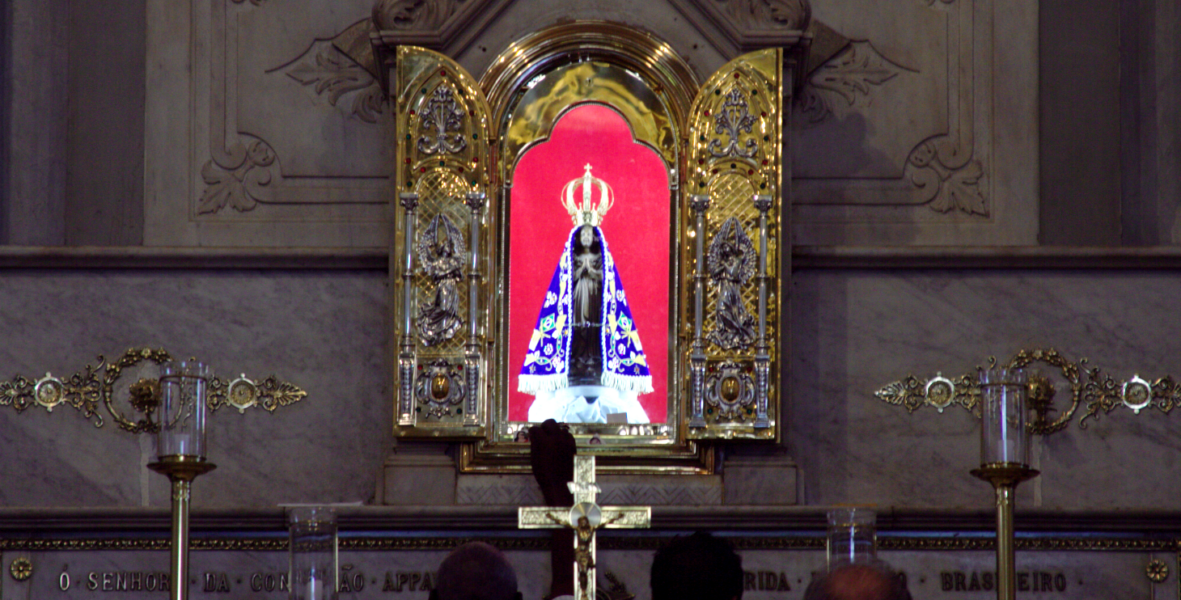
To understand why a rumor about Our Lady of Aparecida can shake a presidential campaign, it helps to recall what the Virgin means to Brazil. In October 1717, three fishermen pulled a small clay statue of the Immaculate Conception, barely 37 centimeters tall, from the waters of the Paraíba do Sul River. In 1930, at the bishops’ request, Pius XI proclaimed her the principal patroness of the country, and since 1980 her feast day, October 12, has been a national holiday. Her National Shrine, the largest Marian church in the world, has welcomed St. John Paul II, Benedict XVI and Francis.
That faith remains very much alive, Bronzina insists. Before her trip she attended daily Mass in Buenos Aires and found churches almost empty. In Brazil, on the first Monday, Mass was “packed, and full of young people.” According to her, when Lula realized he was losing the Catholic vote after his remarks on celibacy, the Virgin entered the scene.
The verified facts are these. On Thursday, September 24, on GloboNews Em Pauta, journalist Maria Cristina Fernandes spoke of an alleged evangelical-backed project to strip the Virgin of her title as patroness. On social media the project was attributed to Flávio Bolsonaro, who that same night denied it as “a big lie.” In the early hours of the 25th, GloboNews issued a correction and apologized: the bill, PL 2.623/2007 introduced by a former PMDB deputy, was rejected in committee and archived in 2008. It had nothing to do with Flávio, as confirmed by Gazeta do Povo and Terra.
Bronzina goes further and directly accuses Lula’s circle. According to her account, the hoax was launched by an employee of the Presidency’s Communications Secretariat, responsible for a well-known page aligned with Dilma Rousseff, and the PT’s digital machinery multiplied it in thousands of posts. Infovaticana has not been able to verify that accusation. Regarding GloboNews’s correction, she complains that it was issued by another journalist “at a time when nobody is watching.” “The lie prevailed over the truth,” she laments, “and what hurts me most is that it was a lie involving the Blessed Virgin.”
Bronzina also accuses of hypocrisy those who now display the image of Aparecida in the campaign. She recalls that Jair Bolsonaro, a Catholic, consecrated the country to the Virgin during his term, and claims the current government removed that record from the official website. “This is not about right or left,” she stresses. “It is about them using something sacred.”
Even so, she sees a positive side. “In the end, the Virgin is the one leading the presidential debate in Brazil.” On the channel of the evangelical Flávio Bolsonaro she had an hour and a half to speak about Mary with a priest. Later she took part in a program with an evangelical pastor, an Anglican priest, an Orthodox and a Catholic, among others, in which everyone ended up talking about the Virgin. “It is impossible for anyone to speak ill of Mary,” she summarizes.
A silence and a threat
Delgado raised the most delicate question. Some try to portray the controversy as a clash between the evangelical Flávio Bolsonaro and the Brazilian episcopate, when some bishops had already leaned toward Lula in previous elections. Bronzina did not mince words: the National Conference of Brazilian Bishops (CNBB) “kept silent in the face of the lie.” “If you stay silent when they are creating a calumny against the patroness of Brazil, you are at least complicit.” In her view, the bishops only admitted it was a hoax when Flávio challenged them. “If someone spreads a calumny against my mother, how could I not defend her?”
The Brazilian spoke openly about Marxist infiltration in the Church and recalled that the Holy See had already condemned Marxist-inspired liberation theologies in the 1980s. “The Church has existed for 2,000 years and for 2,000 years has built hospitals, orphanages, homes to welcome vulnerable people,” she said. “Looking at the poor is different from using them.”
Her commitment comes at a price. Bronzina recounted receiving a direct message on Instagram with a death threat: “Either you shut up or I’ll kill you.” When she checked the sender’s profile, she saw that he followed several bishops, priests and the CNBB itself. “I talk about politics in Mexico, I speak out against the narco and I don’t receive threats. And I receive one in Brazil for defending the truth of the Church.” For her, it is also “a spiritual battle.”
Does a Catholic vote exist?
The underlying question was posed by Delgado: there is no perfect political program, so the issue is in what scenario a Catholic can act freely and do good. Bronzina acknowledges there is no ideal candidate. “I would love to have a perfect Catholic candidate, but I think there is almost none in any country today.” Flávio Bolsonaro, however, is in her view a conservative who defends the family, opposes the woke agenda and is “completely in favor of life and against abortion.”
By contrast, Lula declares himself personally opposed to abortion but has framed it as a public-health issue. “If you have a pro-life candidate and a candidate in favor of abortion, the choice is more than clear,” Bronzina concluded.
Delgado insisted on distinguishing what is debatable from what is non-negotiable. On economic policy or on Israel, Catholics may legitimately disagree. On the evil of abortion or the nature of the family, they may not. And he lamented that debatable issues are displacing the essential ones in public debate. His criterion for choosing between evils was blunt: “If I have to choose between the gulag and evil exploitative companies, I’ll go with the companies,” because “at least they don’t want to kill me” and they leave a space of freedom that Catholics must take advantage of.
Bronzina agreed and drew a clear line: “I can sit at the table with an evangelical, with a Protestant, and we will have thousands of topics. I cannot sit with a communist.” With Protestants, she explained, she shares the defense of life, religious freedom and private property. That is why she urged Catholics not to stay on the sidelines because of reservations about an evangelical candidate: “We have to occupy our spaces, give witness and make our principles clear, wherever we are.”
These are questions that also challenge Spanish Catholics. The Church’s social doctrine does not impose a party, but neither does it leave the faithful without criteria: life, family and religious freedom are non-negotiable.
Discernment versus polarization
The nearly hour-and-forty-minute conversation also touched on Javier Milei’s Argentina, the debate on Zionism in Catholic networks and Russian influence in Latin America. Bronzina maintained that everything that divides Christians benefits authoritarian regimes. Delgado, for his part, flatly rejected proposals for an alliance between Catholics and Marxists that arose amid images of Lula with the Virgin of Aparecida: “This has happened before and we know where it leads.”
Bronzina closed with a reflection on the Christian’s political life: “The hardest thing in politics is to discern.” That is why, she explained, she asks the Holy Spirit daily for the fruits of peace, love and joy. “If you are speaking with anger, if you are mistreating a brother over an idea, something is wrong.”
The program ended with a prayer for Brazil, that its faithful may remain united with the Virgin of Aparecida, and with the priest’s final blessing. It can be watched in full on the YouTube channel of La Sacristía de la Vendée.