


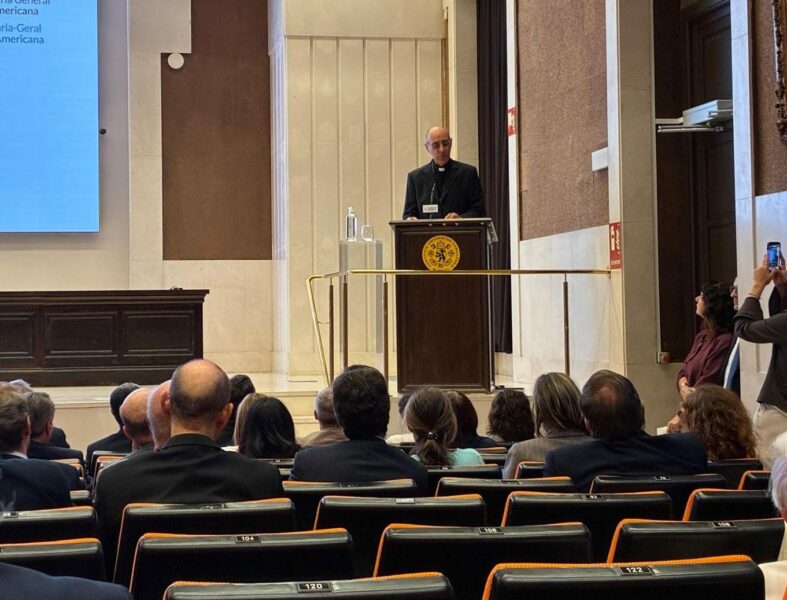
The Cardinal Víctor Manuel Fernández, prefecto of the Dicastery for the Doctrine of the Faith, participated this Wednesday in Madrid in an academic day dedicated to Magnifica humanitas, the first encyclical of Leo XIV, held in the Aula Magna of the Pontifical University Comillas.
The meeting, organized under the title “The Lessons of the Encyclical Letter Magnifica humanitas. An AI Centered on Persons,” also counted on the presence of Cardinal José Cobo, Archbishop of Madrid; of the Apostolic Nuncio in Spain, Monsignor Piero Pioppo, and of the Rector of the Pontifical University Comillas, Antonio Allende.
Before them, Fernández presented the encyclical as “a dialogue of the Church with society and culture” and placed the development of artificial intelligence within a broader question. In his view, behind the technological questions of our time lies an essentially human problem: “The underlying question is the care of humanity.”
“Prudence, rigorous controls and even slowdown”
From that premise, the prefect of the Doctrine of the Faith addressed the limits that should accompany technological development. Without denying the possibilities offered by artificial intelligence—particularly in fields such as medicine—he defended the need to establish clear responsibilities and control mechanisms that prevent turning technical progress into an end independent of its consequences for man.
Hence he called for “prudence, rigorous controls and even slowdown” in the face of certain developments in artificial intelligence. Slowing down, he clarified, does not mean opposing technology, but preventing its advance from imposing itself on its own, apart from any ethical consideration.
The reflection led Fernández to transhumanism and the currents that aspire to overcome the limits proper to the human condition. Against that conception, he maintained that “there is a fruitfulness in the limit” and that “humanity prospers through the limit.”
The prefect turned to love and suffering to explain that relationship. The attempt to eliminate any painful experience from existence, he pointed out, would end up affecting also that which allows one to love: “To suppress pain one would have to extinguish love and it is not a good deal.”
“From gestation to the last second of his life”
From that defense of the human condition, Fernández moved on to the question of dignity, which he linked to the protection of every person “from gestation to the last second of his life.”
That dignity, he affirmed, does not depend on social condition, origin or the particular circumstances of each individual. “It does not matter if he was born here or there, if he is Black, if he is in prison, it does not matter if he is gay or disabled,” he noted, also recovering the expression “infinite dignity” used during the pontificate of Francis.
The argument allowed him to dwell especially on those who may be left behind by economic and technological transformations. Fernández warned that the risks derived from those processes fall more easily on the poor, precisely because many times “they count for nothing,” and asked Catholics to remain “particularly attentive as humble sentinels to the consequences of the new developments of society for the life of the last.”
In that framework he also placed one of the purposes he attributed to Magnifica humanitas: “to reactivate the Social Doctrine of the Church.” Fernández also wanted to underline that this intervention of the Church in contemporary debates does not seek to hide its religious foundation. “The encyclical is a believing Christian text that drinks from Jesus Christ and his Gospel and does not seek to conceal it,” he assured.
From artificial intelligence to the “just war”
Fernández’s tour then broadened toward matters that exceeded the strictly technological debate. One of them was war. According to the prefect, Magnifica humanitas “invites us to overcome the theory of just war,” an affirmation he immediately qualified to distinguish it from legitimate defense understood in the strict sense.
His criticism, he explained, is directed mainly at the extension of that doctrine to justify “preventive wars full of collateral damage.” It was not the first time Fernández had raised the question in those terms: he had already defended a particularly restrictive interpretation of the conditions under which recourse to arms can be considered morally legitimate. Catholic doctrine recognizes the right to legitimate defense, although it subjects it to rigorous conditions.
Israel’s response, an “unbearable and unjustified massacre”
From the general reflection on war, Fernández moved to the conflict in the Holy Land. After recalling the terrorist attack of October 7, he described Israel’s subsequent response in Gaza as an “unbearable and unjustified massacre.”
Faced with the different manifestations of violence, the cardinal wanted to highlight what he considers historical expressions of that “magnificent humanity” to which the title of the encyclical alludes. He mentioned, among them, the abolition of slavery, the recognition of human rights, women’s suffrage and the suppression of the death penalty in various countries.
The same idea led him to cite such different figures as Mother Teresa of Calcutta, Dorothy Day, Martin Luther King and Marie Curie, along with cultural expressions such as Picasso’s Guernica, Beethoven’s Ninth Symphony or Schindler’s List.
But Fernández finally wanted to transfer that “magnificent humanity” from the great figures of history to ordinary life. He then spoke of the “martyrs of the everyday”: fathers and mothers of families, doctors and people dedicated to the care of the elderly, prisoners and the excluded. “Why not give them all a strong round of applause? That is the magnifica humanitas,” he affirmed.
Numerous empty seats in the Aula Magna
The expectation generated by the conference, however, was not up to the rank of the speaker nor of the ecclesiastical authorities who accompanied him. The presence of the prefect of the Dicastery for the Doctrine of the Faith, together with the Archbishop of Madrid and the Apostolic Nuncio, was not enough to fill the Aula Magna of Comillas, where during the intervention numerous empty seats could be observed.
The contrast is especially striking if one looks at the recent history of the dicastery that Fernández now heads. Joseph Ratzinger turned, during his years as prefect of the Congregation for the Doctrine of the Faith, his academic interventions into intellectual events capable of arousing considerable interest inside and outside strictly ecclesiastical circles. His lectures and meetings with the university world drew attention to theological, philosophical and cultural questions long before his election as Benedict XVI.
Nor is it solely a phenomenon linked to the figure of Ratzinger. In our days, Cardinal Robert Sarah, who has also headed a dicastery of the Roman Curia, continues to arouse notable expectation in his lectures and visits to universities, with aula magnas that bring together numerous students, professors and faithful interested in hearing his interventions.