


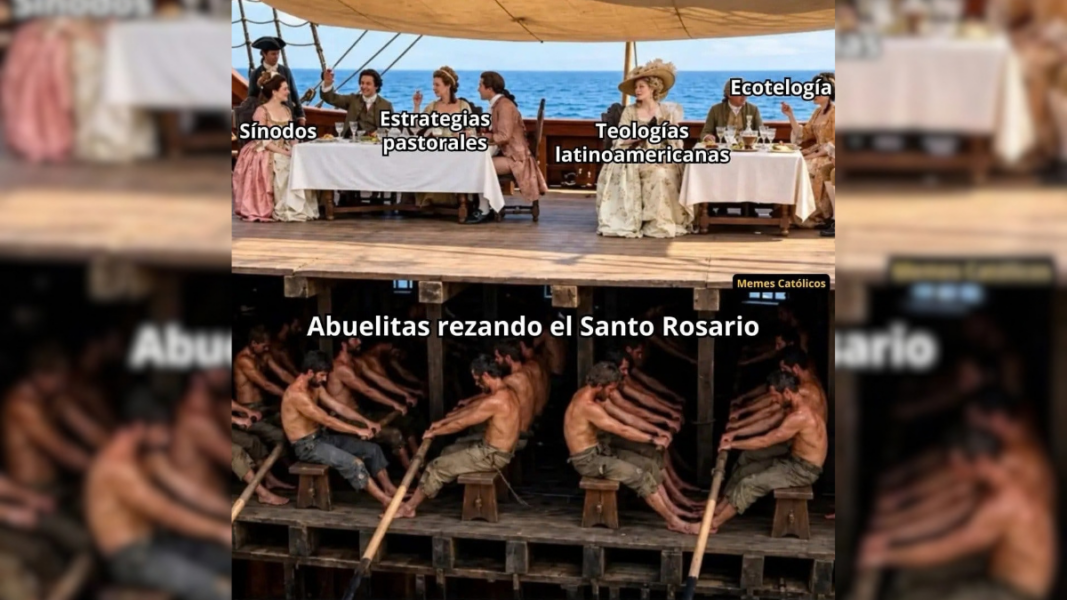
A meme is circulating (signed by a page called Catholic Memes) that explains the Church of these years better than the two instrumenta laboris of the last Synod combined. On the deck of a sailboat, eighteenth-century ladies and gentlemen toast on white tablecloths, each with their little sign: Synods, Pastoral Strategies, Latin American Theologies, Ecotheology. Below, in the hold, a row of shirtless rowers pull the oar, and there is only one label: Grandmothers praying the Holy Rosary.
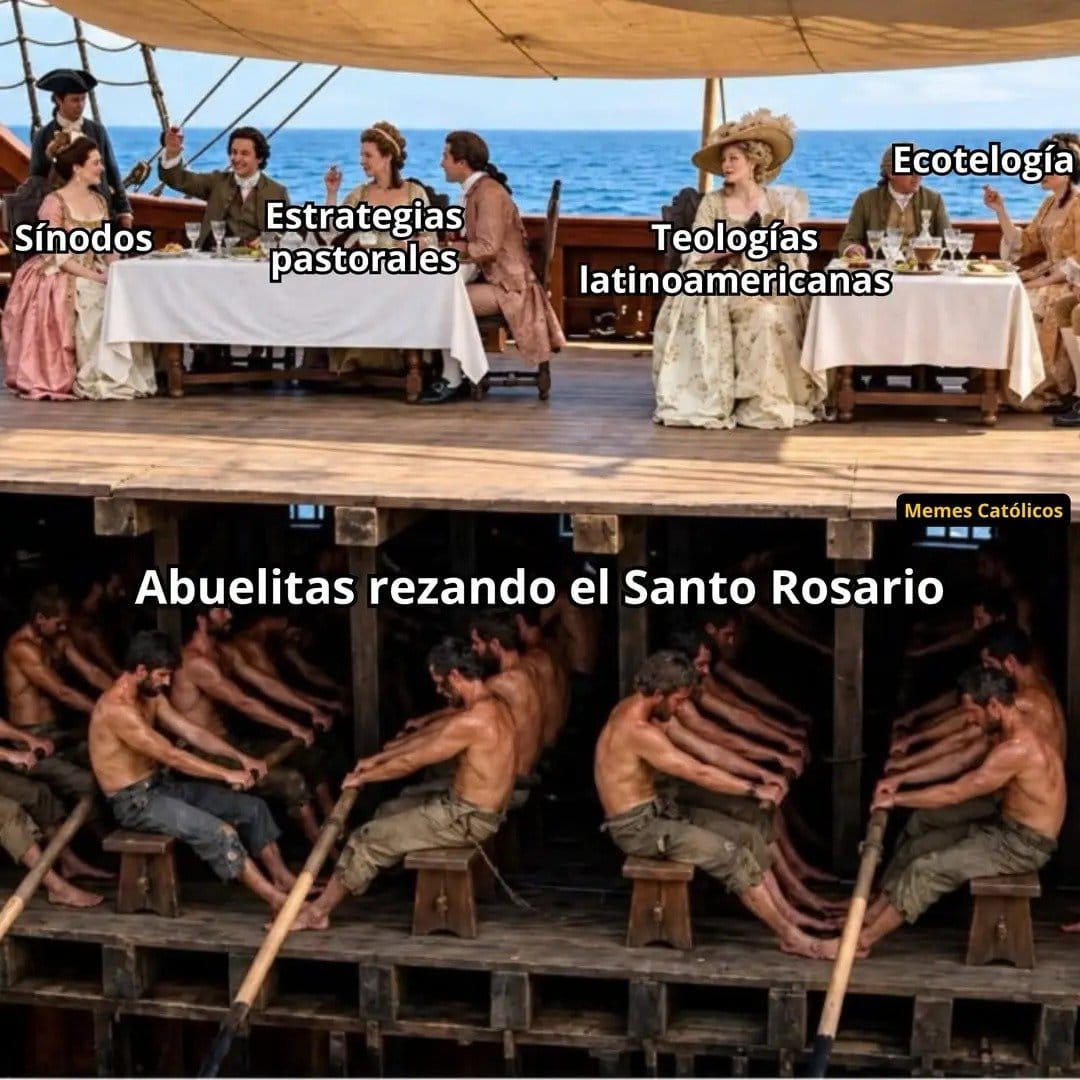
The meme takes care of the details. Synods got a pale pink dress; Latin American Theologies, a sun hat with more flowers than a May altar; Ecotheology, an olive-green jacket and a doctrinal typo (the label reads Ecotelogy, without the o of Theós, which is exactly what is reproached). In the hold there are no typos. One rower has been given more arms by the machine than nature provides, which are exactly what a grandmother needs.
The word for those below is chusma.
The Academy first defines it as rude and vulgar people, and only later as the group of galley slaves who served on the royal galleys, which is the reverse order of its etymology. Because chusma, before being a contempt, was a chant: it comes from the old Genoese ciüsma and this from the Greek kéleusma, the rhythmic chant with which the lead rower marked the movement of the oars (what in Ben-Hur was done with a drum).
In Argentina, Bolivia, Colombia, Cuba and Uruguay, the Academy adds, chusma was also the group of Indians in a community who did not make war, that is, women, children and the elderly. The grandmothers, exactly.
A parish rosary at seven in the evening is a textbook kéleusma: a lady intones the first half of the Hail Mary, the others respond with the second, and so on fifty times, evening after evening… They do not row blindly, of course, because each decade carries its mystery of the life of Christ. John Paul II opened the Rosarium Virginis Mariae with a rowing order, “put out into the deep,” the duc in altum that Christ gave to Peter. And there he defined the rosary as a Marian prayer with a Christological center, a kind of compendium of the Gospel. The hold carries the Gospel in its hand, ten beads at a time.
The meme, moreover, is more accurate than it knows. At Lepanto, the greatest occasion the centuries have seen, galleys fought, that is, chusmas, and Pius V had asked Christendom to accompany the battle with the rosary. It was won on October 7, 1571, and that day some twelve thousand Christian galley slaves were freed from the Turkish benches. One chusma prayed in Rome and another dropped the oar in the Gulf of Patras. The Dominican pope instituted the feast of Saint Mary of Victory, and Gregory XIII turned it in 1573 into that of the Rosary.
On deck, meanwhile, they do the math. The Synod on Synodality ended in 2024 and continues, with assemblies until October 2028 divided into four stages called Remembering, Interpreting, Orienting and Celebrating. The fourth is the one that appears in the meme.
And it was to the presidency of the CLAR, the Latin American religious (more or less, the table of the sun hat), that Francis told in June 2013, according to the notes of the attendees that the CLAR itself regretted seeing published, that upon being elected they had offered him 3,525 rosaries and that counting them sounded to him like a Pelagian current and like going back sixty years. A curious objection. The rosary, in Spanish, is made of beads.
But on Sunday, in Lourdes, Leo XIV leaned out over the hold. He asked the faithful and communities for the October rosary so that wars may cease, with “concrete acts of penance and mercy.” This October 1 he prays it with hundreds of children in the Lourdes grotto of the Vatican Gardens. The hold, it seems, has a future.
Above they will continue eating the thin soup, which originally was what the convents gave to the poor, and will attribute the ship’s progress to the breeze of their conversations. Below there is neither boatswain nor chain. On the galleys they called good will, from the Italian buonavoglia, those who rowed of their own will and for pay. The grandmothers row of their own will and, on top of that, pay the collection.
Read also