


Behind a tarpaulin, in Murcia’s Plaza de la Cruz, workers are these days chiseling the stone of the Cathedral. For more than eighty years, beside the Puerta de las Cadenas, one could read: “José Antonio Primo de Rivera. ¡Presente!” The Ministry of Democratic Memory listed the inscription in its catalogue of symbols to be removed, citing its location in a place of high symbolic value and particular visibility.
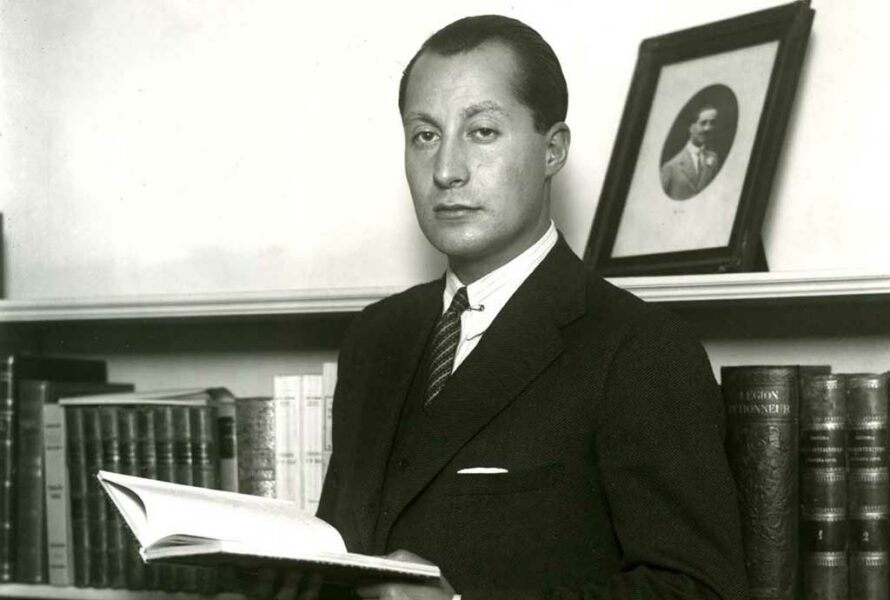
The man whose name is disappearing from the façade was shot in the courtyard of Alicante prison on 20 November 1936. He was thirty-three. A brilliant lawyer, an insatiable reader and an orator respected even by his opponents, he wrote a serene testament in his cell before dying, free of hatred, in which he forgave, asked forgiveness and expressed a wish that time would render especially bitter: that his blood be the last shed in civil discord among Spaniards.
Those who knew him often turned to poetry to speak of him. Rafael Sánchez Mazas, who helped shape the liturgy of the “presente” used to remember the fallen, saw in José Antonio a man who had sought to restore to politics a certain ancient gravity. Dionisio Ridruejo, who would eventually break with the Franco regime, never ceased to acknowledge the impression made on him by that blend of intelligence, modesty and courage. Agustín de Foxá turned him into literary material, almost an elegiac figure: the young prince whom death reaches before disillusionment. None of them was content merely to recount his biography; to speak of that destiny they needed something more than chronicle.
It is not surprising. José Antonio often repeated that peoples had never been moved by anything but poets. The phrase encapsulates much of his understanding of politics. Poetry was not, for him, an ornament or a matter of style; it was a form of knowledge, a way of approaching what endures.
Antonio Caponnetto developed this idea brilliantly in a lecture delivered in Salamanca in 1999, perhaps the finest ever devoted to José Antonio. It opens with a passage from Aristotle’s Poetics: poetry is truer than history, because history recounts what happened while poetry speaks of the universal, of what can or must happen. Menéndez Pelayo had insisted on the same point, presenting poetry as a graver, more doctrinal form, charged with moral and metaphysical truth. The poet, according to that tradition, does not merely record events; he seeks in them a measure, a model, something capable of surviving anecdote.
From this horizon the essence of José Antonio becomes clear. He conceived man as the bearer of eternal values; the fatherland as a unity of destiny in the universal; life as a militia. He renounced the comforts his name, position and profession assured him out of fidelity to an idea, and ultimately gave his very life for it.
The walls of Murcia Cathedral have stood for centuries and seem the very image of what endures. Yet stone belongs to the world of things that perish: an administrative order, a tarpaulin and a few chisels suffice for letters to vanish in a few days. Those who erase them fight their battle on the surface, and only there do they win it—vainly—against the immense memory of someone who left a unique moral legacy.