


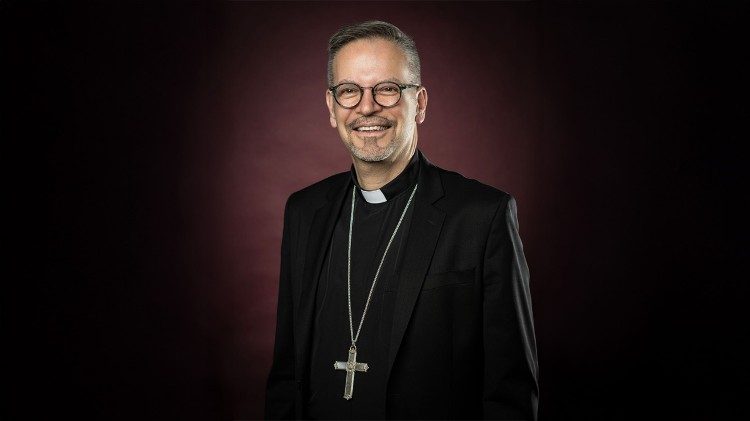
Pope Leo XIV has appointed Mons. Pierre Goudreault, current president of the Canadian Conference of Catholic Bishops (CCCB), as bishop of Trois-Rivières in the Canadian province of Quebec, transferring him from the diocese of Sainte-Anne-de-la-Pocatière.
The Holy See announced this Tuesday, September 29, the appointment of the 63-year-old prelate, who has presided over the Canadian episcopate since September 2025 and whose mandate at the head of the Conference extends until 2027. Goudreault will occupy a see that had remained vacant after Leo XIV transferred its previous bishop, Martin Laliberté, in February as coadjutor of Saint-Jean-Longueuil. Laliberté assumed that diocese definitively last July.
A pastoral theologian at the head of the Canadian episcopate
Pierre Goudreault was born on May 27, 1963, in Rouyn-Noranda, Quebec. After obtaining a certificate in Administration, he entered the Seminary of Saint Paul University in Ottawa and was ordained a priest on May 18, 1991.
He earned a doctorate in Theology from the same university and developed much of his ministry in parish work, seminary formation, and pastoral theology. He has published a dozen books and around thirty articles devoted mainly to ecclesiology and liturgy, in addition to having taught at the university level.
Francis appointed him bishop of Sainte-Anne-de-la-Pocatière on December 8, 2017. He received episcopal consecration on March 10, 2018. After progressively joining the governing bodies of the Episcopal Conference, he was elected vice-president in 2023 and president in September 2025 for a two-year term.
His pastoral motto in Sainte-Anne-de-la-Pocatière —“Proclaim the Gospel everywhere”— summarizes a trajectory especially linked to practical theology and the pastoral reorganization of communities in a deeply secularized Quebec.
Synodality among his priorities
As president of the Canadian bishops, Goudreault has placed the implementation of synodality among the priorities of the Church in Canada.
In the report he presented just a week ago at the opening of the CCCB Plenary Assembly in Montreal, he expressly highlighted “the ongoing implementation of synodality in the Church in Canada” among the main works carried out during the past year. The letter sent at that time to Leo XIV also included synodality among the issues on which the Canadian bishops continue their discernment.
His former diocese actively participated since 2021 in the consultations of the Synod on Synodality, both at the diocesan level and in the successive provincial, national, and continental phases.
There are no known public statements by Goudreault, however, defending some of the doctrinally controversial reforms that have been associated with certain sectors of the European synodal process. His public profile has focused more on the synodal method, evangelization, social justice, and the coordination of the Episcopal Conference.
A Canadian Church facing the expansion of euthanasia
Goudreault arrives in Trois-Rivières while the Canadian Church faces one of the most extensive euthanasia regimes in the world.
In June, on the tenth anniversary of the federal legalization of euthanasia and assisted suicide —legally termed “medical assistance in dying”— the Permanent Committee for the Family and Life of the Episcopal Conference urged Catholics to remain “firm in their opposition” to both practices and to accompany the sick and vulnerable persons.
The document was issued by the Conference presided over by Goudreault, not as a personal statement. For his part, in his own institutional interventions, the prelate has also insisted on the defense of “human life and the dignity of every person” as one of the areas sustained by the common action of the Canadian bishops.
The issue has acquired special relevance in Canada after even the Canadian Anglican Church developed liturgical forms to pastorally accompany situations of death caused through the MAiD system, a step that has raised concern over the “religious normalization” of euthanasia.
Religious freedom versus the Canadian Government
During his presidency, Goudreault has also intervened before the federal government in defense of religious freedom.
In December 2025, he signed a letter addressed to the Canadian prime minister in which the bishops expressed their concern over a legislative reform against hate crimes that could affect the legal protections of religious expressions.
The letter defended that it was possible to combat real hatred without undermining “the constitutional rights of millions of Canadians who draw moral and spiritual guidance from their religious traditions” and warned that the legislation should not inadvertently undermine fundamental freedoms.
The tension between secularization and religious freedom continues to be particularly visible in Canada. Last week, the Catholic Military Ordinariate denounced a regulation of the Armed Forces that prevents expressly mentioning God in certain official ceremonies.
Relationship with Leo XIV and indigenous peoples
Goudreault has already maintained direct and relevant contact with Leo XIV during the current pontificate.
In November 2025, he was received by the Pope together with Archbishop Richard Smith and the secretary general of the Canadian Episcopal Conference. During that audience, Leo XIV handed over to the bishops 62 pieces from the ethnological collections of the Vatican Museums for their transfer to indigenous organizations in Canada.
Goudreault then presented the gesture as a new step in the process of “reconciliation” between the Church and indigenous peoples, one of the great institutional priorities of the Canadian episcopate since Francis’s trip to the country in 2022.
The issue again occupied a prominent place in his presidential report of September 2026, where he mentioned both the return of the objects and the continuity of the process of “healing, reconciliation, and relationship-building” with indigenous communities.
Immigration and coordination of the Churches of North America
Another of the issues to which Goudreault has devoted attention during his presidency is immigration.
At the beginning of September, he participated in Cuernavaca in the first meeting of this kind between representatives of the Episcopal Conferences of Canada, the United States, and Mexico. There he described “human mobility” as one of the common challenges of the Churches of the continent and highlighted the role of families and priests who have come from other countries in the revitalization of some Canadian parishes.
A historic diocese in a de-Christianized Quebec
Trois-Rivières is one of the historic dioceses of Quebec and belongs to the ecclesiastical province of Quebec. According to statistics published by the Assembly of Catholic Bishops of Quebec corresponding to 2023, it has nearly 290,000 Catholics, 61 diocesan priests, 21 religious priests, and 29 permanent deacons, grouped into 14 parishes and missions.
The historical evolution, however, shows the magnitude of the religious transformation of Quebec. In 1966, Trois-Rivières had more than 400 priests, both diocesan and religious, and more than 1,700 religious sisters; the current figures are a fraction of those recorded before the Quiet Revolution and the subsequent process of secularization of the province.
The diocese also houses the National Shrine of Our Lady of the Cape, one of the main Marian centers in Canada.
Goudreault will thus assume a historically Catholic diocese but located in one of the Western societies where secularization has been most rapid, while simultaneously retaining the presidency of the Canadian episcopate. His appointment places in Trois-Rivières a prelate closely linked to the national structure of the bishops and to several of their current priorities: synodality, indigenous reconciliation, immigration, religious freedom, and the defense of human dignity.