


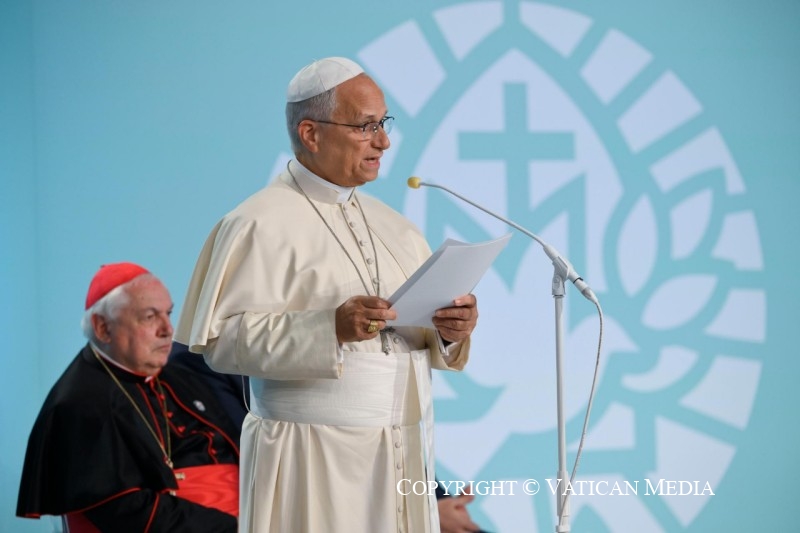
Pope Leo XIV has defended this Monday in Metz the sacred value of human life and has called on religions to remain alongside the most vulnerable “especially in trial, until the end.” In a meeting with representatives of different faiths, the Pope stated that “religions are guardians of life” and condemned as a profanation of God’s name any attempt to use it to legitimize violence or oppression.
The Pontiff arrived in Metz from Lourdes, where on Sunday he had devoted much of his addresses to the dignity of the sick, penance, and the defense of life in the face of illness and old age. After leaving the episcopal residence at 7:10, he took off from Tarbes-Lourdes-Pyrénées airport at 7:51 and landed at Metz-Nancy-Lorraine at 9:02. From there he proceeded to the Robert Schuman Congress Center for the first event of the final day of his apostolic journey to France.
“Religions are guardians of life”
The interreligious meeting began around 10:20 with a musical introduction and the reading of the Metz Appeal by representatives of the various faiths. Leo XIV placed his intervention in a city historically marked by borders and encounters between peoples, recalling the figure of Robert Schuman, one of the fathers of European construction and “a man of faith and convictions” who knew how to transform old fractures into possibilities for unity.
The most significant core of his speech was devoted to human life. The Pope affirmed that the fruitfulness of a religious tradition is manifested not only in its contribution to peace and fraternity, but also in its capacity to “protect, accompany, and serve life.”
“The greatness of a civilization is not measured by its material successes, but by the way it embraces, protects, and elevates the human person,” he stated.
Leo XIV was even more explicit in pointing out the responsibility of religions before fragility: “Religions are guardians of life: they affirm its sacred value.”
That recognition, he added, must translate into a concrete presence alongside the most vulnerable. “To serve life means to surround it with care, presence, and tenderness, especially in trial, until the end.”
The statement extends one of the axes that has run through Leo XIV’s journey to France. On Friday, before Emmanuel Macron, the Pope warned against euthanasia, surrogacy, and genetic manipulations. On Sunday, in Lourdes, he again defended the “beauty and sacredness of life” against currents that seek to redefine its value in the face of illness, suffering, or old age.
God’s name cannot legitimize violence
The second axis of the speech was the responsibility of religions before violence. Leo XIV maintained that dialogue does not require diluting one’s own convictions: “To dialogue does not diminish our identity, but expresses it with simplicity and truth, opening ourselves to the difference of the other.”
The Pontiff recalled Francis, for whom interreligious dialogue should not be reduced to “diplomacy, kindness, or tolerance,” but should aim to establish friendship and peace, and John Paul II, who considered it a requirement linked to human nature itself.
Faced with the use of religion as justification for conflicts, Leo XIV was categorical: “To invoke the name of God to legitimize violence or oppression is a profanation of that name.”
“Nothing that disfigures human dignity can be claimed as an authentic divine inspiration,” he added. Hence, religious discourse must contribute to “disarming hearts and words,” a responsibility the Pope directly attributed to those who guard the different religious traditions.
An identity that does not dissolve in order to dialogue
Leo XIV thus rejected a conception of dialogue built on the renunciation of one’s own identity. Openness to the other, he explained, stems precisely from convictions that can be expressed clearly and without aggression.
The issue connects with the interventions of previous days on the place of religion in a secularized society. Before the French bishops, the Pope had defended on Sunday that the Church has the right to evangelize, educate, publicly celebrate worship, and visibly exercise charity in the name of Jesus Christ.
In Metz, the Pontiff transferred that idea to the encounter between religions: recognizing the difference of the other does not require erasing one’s own belonging, but making it a starting point for friendship and the building of peace.
Leo XIV concluded by quoting his encyclical Magnifica humanitas: “The Church considers companions on the journey all those who sincerely seek truth, goodness, and beauty.” He then asked the religious representatives to become, wherever they live, “artisans of peace and witnesses of a hope that never ceases to grow in our world.”
After the meeting, the Pope moved to the auditorium of the same Robert Schuman Congress Center to participate in the event “At the Roots of Europe for Peace and Unity,” the next appointment of his final day in France.
ADDRESS OF THE HOLY FATHER LEO XIV
Dear brothers and sisters,
dear friends, representatives of the different religious traditions:
With great joy, but also with a deep sense of spiritual responsibility, I find myself today among you in Metz, a city of borders and crossroads, in the Congress Center named after Robert Schuman, one of the founding fathers of the European Union. This man of faith and convictions knew how to transform old lines of fracture into points of hope for all of Europe, and became a true ambassador of unity in diversity. Following his example, our common responsibility as religious women and men is to bear witness that, beyond borders, it is always possible to meet again, establish friendship, and build peace.
To dialogue does not diminish our identity, but expresses it with simplicity and truth, opening ourselves to the difference of the other. As my Predecessor, Pope Francis, said: “Dialogue between people of different religions is not carried out merely for diplomacy, kindness, or tolerance (…). The goal of dialogue is to establish friendship, peace” (Fratelli tutti, n. 271). Before him, Pope Saint John Paul II considered dialogue an intrinsic requirement of human nature itself (cf. Message for the World Day of Peace, 1 January 2001, n. 10). According to Paul Ricœur, it is the path by which we recognize otherness as a promise and not as a threat; it is the art of encounter, of which our world is greatly in need, at the antipodes of aggression and violence.
Indeed, to invoke the name of God to legitimize violence or oppression is a profanation of that name. Nothing that disfigures human dignity can be claimed as an authentic divine inspiration. Religious discourse must constantly appeal to disarming hearts and words. This entails the direct responsibility of each one of us, as guardians of our respective traditions.
Moreover, if the fruitfulness of religious traditions is manifested above all in their service to peace and fraternity, it is equally expressed in their capacity to protect, accompany, and serve life. The greatness of a civilization is not measured by its material successes, but by the way it embraces, protects, and elevates the human person. Religions are guardians of life: they affirm its sacred value. Their fruitfulness is demonstrated in their loving presence alongside the most vulnerable and fragile persons. To serve life means to surround it with care, presence, and tenderness, especially in trial, until the end. To us, who are open to transcendence, is entrusted the mission of offering solid points of reference, particularly to young people, to build a communion that respects and values the dignity of every human person.
Dear friends, “the Church considers companions on the journey all those who sincerely seek truth, goodness, and beauty” (Magnifica humanitas, n. 23). I thank you once again for your closeness and your presence. May the infinite goodness of God and his wisdom accompany us and teach us to live ever more as his children and as brothers and sisters among ourselves. May we also be, wherever we live, artisans of peace and witnesses of a hope that never ceases to grow in our world.
May God bless you!
I have kept the Spanish text you provided intact, limiting myself to integrating it into WordPress format; in the journalistic part I have removed the institutional bulletin tone and focused on life, identity, and the rejection of the religious use of violence.