


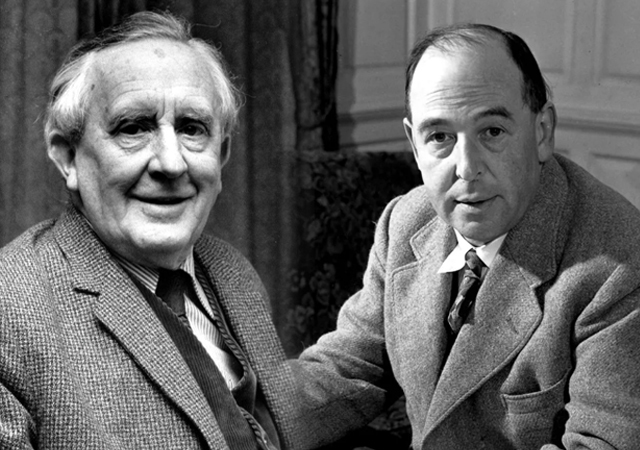
J. R. R. Tolkien, one of the most influential Catholic writers of the 20th century, will have a permanent monument in Poets’ Corner at Westminster Abbey in London, alongside that of his friend C. S. Lewis. The work will be unveiled in the spring of 2027 and will pay tribute to the author of The Lord of the Rings as a writer, artist, scholar and linguist. In announcing the initiative, the Anglican Dean of Westminster himself expressly highlighted the writer’s “Christian imagination.”
The Westminster Abbey announced the project on 21 September. The monument, designed by British artist Stephen Broadbent, will be presented to coincide with two anniversaries related to Tolkien’s work: the 90th anniversary of the publication of The Hobbit and the 50th anniversary of the posthumous appearance of The Silmarillion.
Tolkien and Lewis, together in Poets’ Corner
The location carries particular symbolic weight. Poets’ Corner, situated in the south transept of Westminster, gathers tombs and monuments dedicated to great figures of British literature, among them William Shakespeare, Charles Dickens, Jane Austen and the Brontë sisters.
Since 2013, C. S. Lewis has also been there, author of The Chronicles of Narnia and one of Tolkien’s closest friends. Both were members of the Inklings, the circle of Oxford writers and scholars who met to converse and share their literary works. Westminster has announced that the new monument will be placed beside the one dedicated to Lewis.
The Dean of Westminster, David Hoyle, has precisely highlighted Tolkien’s Christian dimension in explaining the decision.
“Here we will remember a master storyteller, a scholar, a man of Christian imagination and a writer who helped some of us understand that a life of virtue and commitment may demand sacrifice and courage,” he stated.
A work “fundamentally religious and Catholic”
The Dean’s reference takes on special meaning because of the faith Tolkien professed for virtually his entire life. Catholicism was not an accessory element of his biography, but a conviction the writer himself expressly linked to his literary creation.
His mother, Mabel Tolkien, converted to Catholicism in 1900, when Ronald was eight years old, and raised her children in the new faith despite the strong opposition her decision provoked within the family. After Mabel’s death in 1904, Tolkien and his brother Hilary came under the guardianship of the priest of the Birmingham Oratory, Francis Xavier Morgan, who continued to accompany and support them materially and spiritually. The Tolkien Estate itself recalls the decisive role the priest played in those years.
Decades later, Tolkien put in writing the extent to which that faith had permeated his work. In a letter dated 2 December 1953 and addressed to the Jesuit Robert Murray, he stated that The Lord of the Rings was “a fundamentally religious and Catholic work.” He explained that this dimension had initially been unconscious, but became conscious during the revision of the book, and that the religious element had been absorbed into the story and its symbolism rather than appearing through explicit religious practices.
The presence of Catholicism in Tolkien should not, therefore, be understood as a direct allegory in which each character or event represents a specific Christian reality. His conception of good and evil, sacrifice, mercy, freedom, the temptation of power, the fall and hope run through the narrative world from a vision the author himself recognised as Catholic.
Tolkien’s “Tree of Tales”
The monument will be inspired by the Tree of Tales, called by Tolkien the “Tree of Amalion.” The image of a tree within a forest will form the central element of a 2.5-metre-high composition that will be installed vertically on a stone column in the south transept.
The work will be made primarily with woods originating from the United Kingdom and will incorporate an element directly related to the writer’s life: a fragment of the famous black pine known as “Tolkien’s tree,” which stood for decades in the University of Oxford Botanic Garden until it had to be felled in 2014. It was one of the writer’s favourite trees during his years in Oxford.
Broadbent has conceived the monument as a window onto the author’s imaginative universe. As he explained, the viewer will have the sensation of contemplating another world, a “forest of stories” whose centre will be the tree conceived by Tolkien and through which a land situated beyond may be glimpsed.
The material realisation will be carried out by artisans from Silverlining Furniture and will combine traditional and innovative techniques of British craftsmanship. The original proposal to erect the monument came from Lord David Alton, a Catholic and president of the Christian Heritage Centre at Stonyhurst, and the project has counted on the support of the Tolkien Estate.
A Catholic in Westminster’s literary memory
John Ronald Reuel Tolkien (1892-1973) developed much of his academic career at the University of Oxford and achieved worldwide fame thanks to The Hobbit, The Lord of the Rings and, posthumously, The Silmarillion. His work as a philologist, his creation of languages and mythologies and the depth of his narrative universe made him one of the decisive figures of contemporary fantasy literature.
The tribute will also have a confessional singularity: Tolkien, a Catholic, will be permanently remembered in Westminster Abbey, one of the principal temples of the Church of England, and his monument will be placed beside that of C. S. Lewis, with whom he shared years of conversations about literature, myth and Christianity.
Ninety years after the publication of The Hobbit, Westminster will thus pay tribute not only to the creator of Middle-earth, but also to the writer who openly acknowledged that the Catholic faith had nourished his life and penetrated deeply into his work.