


Msgr. Alberto José González Chaves
Just as many films end when the word “The End” appears, others begin at that moment, because a scene, a gesture, a glance continue to work within the viewer long after the screen has gone dark. Twelve Angry Men belongs to the latter. For an hour and a half we have witnessed the almost suffocating confinement of twelve men in a deliberation room on a hot, oppressive, sticky afternoon, while a young man somewhere awaits the outcome of that discussion, for he stands accused of murder and, with it, the possibility of a death sentence. At first, almost everyone is certain of his guilt; then doubts begin to surface, certainties crack, testimonies no longer seem so incontestable, and in the end, when eleven men have already changed their vote, only one remains clinging to that “guilty” with a violence that grows increasingly strange.
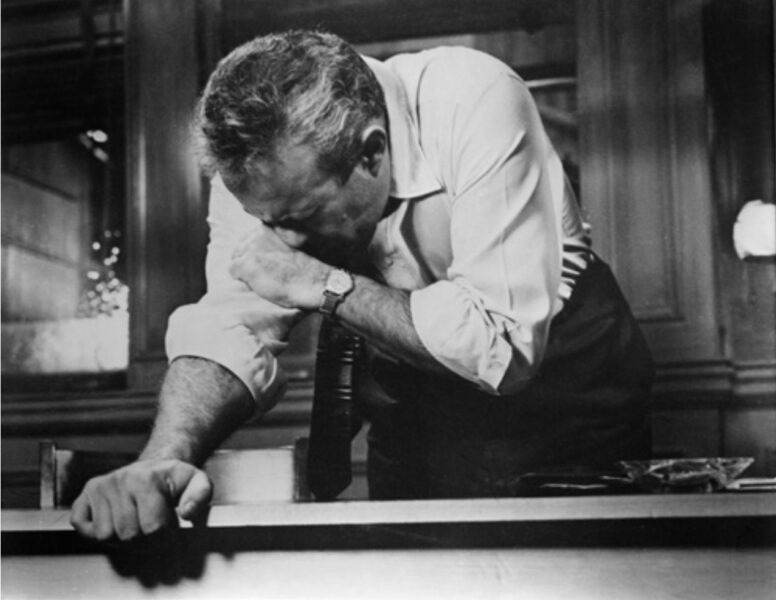
It is “Juror No. 3,” formidably portrayed by Lee J. Cobb, a burly, energetic, gruff man accustomed to imposing himself because he believes strength consists in never revealing one’s own weakness. For much of the film he seems simply the most convinced of the defendant’s guilt, yet gradually we notice something excessive in the way he defends it. As arguments slip from his grasp, his obstinacy increases; the less he has to prove, the more he needs to prove it. He is no longer arguing merely about a switchblade, a passing train, an old woman who claims to have seen something, or a man who says he heard something. There is too much passion for it to concern a stranger, and too much hatred for everything to be explained by the evidence of a trial. Until, almost at the end, a photograph appears—the photograph of his son—and then we understand that during the deliberation that man was not judging only the boy awaiting the verdict, but another, absent figure who had been painfully lodged within him for years.
There are wounds that end up taking the stand
We know from earlier confidences that his relationship with his son is broken. He himself recounts that he tried to raise him with toughness, to make a man of him, to teach him to defend himself, and he even recalls with a certain bitter satisfaction how, when the boy was small, he had tried to harden him. But the son grew up, confrontation came, and one day the rupture occurred. They have not spoken for years. The father presents it as ingratitude, as a filial betrayal that would confirm everything he thinks about youth, rebellion, and the loss of respect for parents; yet he carries with him the photograph of the very son he claims almost to have expelled from his life, and this detail belies all his apparent indifference. If he had truly ceased to love him, he would not keep in his pocket a portrait that reveals the love is still there—wounded, humiliated, turned into resentment because it has found no other way to survive.
And the terrible coincidence of life places before him another young man, also rebellious and at odds with his father, accused of nothing less than having murdered him. Without realizing it, “Juror No. 3” stops seeing the defendant as he is and begins to view him through the image of his own son. Over that unknown face another, all too familiar one is superimposed; onto the story he must judge he projects the one he has never managed to resolve. The psychological greatness of Twelve Angry Men lies in showing us that into that room have entered not only twelve intellects called to examine evidence, but twelve whole men, each accompanied by his prejudices and weariness, his frustrations and selfishness, his experiences and his wounds. No one appears completely stripped of himself before reality; therefore, judging justly demands far more than a keen intellect: it demands a heart sufficiently purified not to confuse what lies before it with what it carries within.
It is too much hatred for a stranger
When the fury of “Juror No. 3” no longer corresponds to the growing weakness of the evidence, something is revealed that can happen to all of us far more often than we are willing to admit. When we feel toward someone an irritation manifestly out of proportion to what that person has done, it is worth asking whether behind his face there might not be another: a father, a mother, a son, a brother, a superior, a friend who betrayed our trust, someone who humiliated us twenty years ago and whose debt we unconsciously seek to collect from another person. Sad mystery of the human heart: that we can end up making another pay the debts of the absent, punishing in the innocent what someone else once drove with blood into our memory. The defendant in the film possesses for “Juror No. 3” the youth, the rebellion, and the insolence of his son; it hardly matters anymore who he really is, because over his face “Juror No. 3” has already placed the mask he himself fashioned; hence the arguments of the other eleven barely reach him: they dismantle evidence, while he defends a wound; they speak of the trial, while he speaks of his own life. There are reasonings that do not penetrate because the problem is no longer in the intellect, but much deeper, where reasons mingle with affections and where an old passion disguises itself as moral certainty.
The photograph he still carried with him
The scene with the photograph is perhaps the most moving in the entire film: the man contemplates it and finally tears it, but it would be superficial to interpret that gesture as a final outburst of hatred against his son; it is rather the opposite: he tears it because he can no longer continue to sustain what that photograph represents for him. For years he has been able to repeat to himself that the son was ungrateful, that he had done his duty as a father, that all the blame belonged to the boy and that the rupture was proof of his rebellion. That inner construction had allowed him to live without asking himself the painful question, the only one that could shake all his security: “What if I, too, was to blame?”
When the photograph tears, what actually breaks is the armor, and that man who throughout the film has shouted, making aggression his form of personal affirmation, ends up weeping like a child. He weeps for his son, yes, but also for himself: for the father he failed to be, for the rigidity he mistook for firmness, for the shouted words he would have liked to take back and for those he never managed to say, for the embrace he did not give when there was still time, for the lost years and for the terrible realization that he still carries in his pocket the son he presumed to have expelled from his heart. Those tears, at last, restore the capacity for justice to the one who until then had turned pain into wrath: now, for the first time, wrath turns back into pain, the only path by which a wound can begin to heal.
When we defend an opinion in order to defend ourselves
Until that moment he needed the defendant to be guilty, because that confirmed an entire vision of life: rebellious and ungrateful sons who confront their fathers are capable of anything, and the outraged father has nothing to reproach himself for. But if that young man was innocent, something far more important than a verdict was tottering within him, because perhaps not all rebellious sons are monsters and not all suffering fathers are merely victims. Perhaps behind many ruptures there lie responsibilities that no one can cleanly distribute between innocents and guilty parties.
This is the penetrating intuition of the film: sometimes we cling to an opinion not because we have so many reasons to maintain it, but because we are too afraid to discover what would collapse within us if we abandoned it. There are endless discussions in which ideas apparently confront one another, when in reality scars are being defended; one begins by speaking of principles and ends by protecting one’s own pride, one’s own history, or a certain image of oneself that one is unwilling to submit to judgment. That is why it is so difficult to persuade someone when what seems an intellectual conviction is secretly linked to an affective need: to change one’s opinion one would first have to change the way one sees oneself.
“Nolite iudicare”
To view this film from a Christian perspective is to evoke the words of Jesus: “Nolite iudicare, ut non iudicemini” (Mt 7:1). Naturally, the Gospel does not forbid all moral discernment nor does it intend that justice should disappear; social life itself requires judging acts, establishing responsibilities, and distinguishing truth from error. The question so fashionable lately, “Who am I to judge?” is nonsense: you are no one to condemn, but to judge you are a person: rationalis naturae individua substantia. What Christ denounces is something far deeper: the temerity with which a man can set himself up as master of another’s interior while remaining strangely blind to his own. That is why he continues with that deliberately exaggerated image of the speck in the brother’s eye and the beam in one’s own: “Quid autem vides festucam in oculo fratris tui, et trabem in oculo tuo non vides?” (Mt 7:3). We are not reproached for seeing the speck, which may really be there; what is terrible is seeing it with a gaze deformed by a beam we refuse to acknowledge.
“Juror No. 3” saw real specks: the defendant was a difficult young man; he had argued violently with his father…; but this man had a beam running through his gaze, and that beam bore the face of his son. Until he discovers it, everything he sees remains deformed by it. Here the film acquires an almost ascetic depth, because self-knowledge is not psychological self-indulgence but the condition of justice and charity. Whoever does not know his passions runs the risk of baptizing them with virtuous names; he can call his anger zeal, his fear prudence, his rigidity strength, his antipathy discernment, and his desire for revenge justice. The human heart possesses a prodigious skill for supplying respectable reasons for what, in its origin, may be nothing more than a poorly healed wound.
Before looking at the speck…
Hence the Christian necessity of the examination of conscience, which does not consist merely in hastily compiling at the end of the day an inventory of faults committed, but in humbly placing oneself before God to ask from where one is living, loving, speaking, and judging. There is a particularly salutary question we might learn from this film: not only “Is what I think of this person true?” but “Why do I need so strongly for it to be true?” The first question examines the object of our judgment; the second examines the judge, and this opens the door to truth.
We can be right and still judge wrongly, because even a truth can be used to feed a twisted passion. We can notice a real defect and exaggerate it because that person reminds us of another; we can discover a genuine weakness and take pleasure in it because it allows us to feel superior; we can even defend a just cause with a violence that reveals we are no longer defending only the cause. The Christian purification of the gaze does not consist in closing one’s eyes to evil, but in cleansing them so as to see it in its true dimensions, without adding the sediment of our resentments, fears, and wounds. Only the heart that allows itself to be judged by God is capable of looking with justice upon man.
Mercy does not deny the truth
When the jury finally says “not guilty,” it is not affirming that the young man is good, exemplary, or innocent of all the mistakes of his life. Nor do we, when we forgive, affirm that what made us suffer never happened. Christian forgiveness does not consist in falsifying the past, but in refusing to turn it into a perpetual sentence. Mercy does not call evil good, but it resists identifying a man forever with the evil he did; precisely because God judges with truth He can also judge with mercy, whereas we, who scarcely know the surface of actions and almost nothing of the mystery of souls, should always approach judgment of others with trembling humility.
That is why the verdict “not guilty” seems to refer to more than one person. Legally it applies to the defendant, but it is impossible not to feel that that father also begins, amid tears, to withdraw an old sentence pronounced against his son and… against himself. We do not know who was to blame for that rupture or in what proportion, and director Sidney Lumet has the intelligence not to explain it. We only know that the father can no longer continue living installed in the comfortable certainty that all the blame belonged to his son. And when a man accepts the possibility that he, too, may have wounded, the path of reconciliation already begins, because he ceases to appear before life exclusively as accuser and accepts also occupying the defendant’s bench.
Tears that cleanse the eyes
We do not know what will happen afterward. The film does not show the father seeking his son, nor does it grant us a sentimental reconciliation, nor does it even assure us that such reconciliation will be possible. Perhaps the son does not wish to return, perhaps too many years have passed, perhaps there are wounds that cannot be entirely repaired in this life. But something decisive has already happened in that room: a man has ceased to turn his rage into accusation and has allowed the pain to hurt him again; and that, though it is not yet reconciliation, already contains its possibility.
From a Christian perspective there is something almost sacramental—understood, of course, in an analogous sense—in those final tears, because they remind us that conversion often begins when we stop justifying ourselves. St. Peter did not repair his triple denial with a speech, but, upon meeting Christ’s gaze, “flevit amare”, he wept bitterly (Lk 22:62). There are truths about ourselves that become bearable only when they are poured out in tears before a gaze that does not destroy us. Pride hardens because it needs to defend itself; contrition softens because it no longer needs to. And that man who has spent the entire film furiously claiming his own innocence while striving to prove another’s guilt begins to be set free only when he breaks into tears.
Perhaps we all carry, like him, some invisible photograph in our pocket: a face, a word, a humiliation, a disappointment, an abandonment, a person whose memory continues to condition the way we look at others who came afterward. The danger lies in inadvertently placing that old portrait over the face of the one now before us, ceasing to see him as he is, forcing him to play in our life a role that never belonged to him. Justice and charity together exhort us to allow each man to be himself before us, without turning him into an extension of our ghosts or making him pay debts contracted by others.
The last juror of Twelve Angry Men needed to tear a photograph to discover it. Perhaps we all need at some point to take certain old photographs out of our inner pocket, to look at them long before God, and to ask ourselves how much they still weigh upon our judgments, our antipathies, and our condemnations. “Nolite iudicare”. Not because evil ceases to be evil or truth becomes indifferent, but because before constituting ourselves judges of another’s heart we must allow God to illumine our own: then, yes, we may continue to see the speck that is in our brother’s eye, but in another way, because we will have begun to discover the beam that ran through our own.
Here lies the teaching of that torn photograph: there are tears that do not cloud the eyes but wash them, and only after having wept over some of our old certainties can we look cleanly upon the man before us and discover, with that humility which is “walking in truth,” that perhaps it was never he against whom we had been struggling for so many years.