


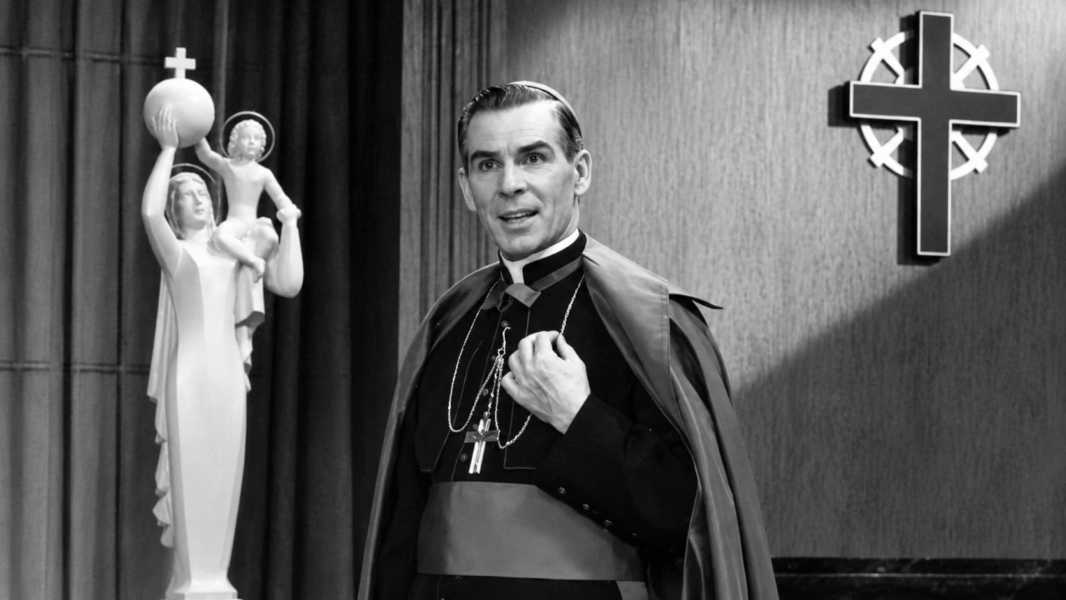
Fulton J. Sheen will be beatified today in St. Louis, Missouri. On the eve of the ceremony, Msgr. John O. Barres, bishop of Rockville Centre, wished to revisit three dimensions that marked the life of the celebrated American preacher and that he considers especially relevant for the Church today: the eucharistic contemplation, the Cross, and the mission.
Barres also has an uncommon personal connection with the new blessed. It was Sheen himself who baptized him on October 2, 1960, at St. Augustine Church in Larchmont, New York. Now, more than six decades later, he has dedicated to the one who administered his first sacrament an extensive pastoral letter titled The Beatification of Archbishop Fulton J. Sheen and the Mission of the Catholic Church in the 21st Century. From its opening pages, he presents the beatification as an opportunity to rediscover “the missionary nature of the Church and the beauty of the Catholic priesthood.”
The Holy Hour that sustained his apostolate
Behind the Fulton Sheen who reached millions through radio and television lay an intense life of prayer. Barres especially recalls the new blessed’s commitment to a daily Holy Hour before the Blessed Sacrament, a practice about which Sheen himself wrote in his autobiography Treasure in Clay. For him, contemplation and apostolate were not separate paths: prayer was meant to purify, guide, and intensify the mission.
This eucharistic root helps explain Sheen’s extraordinary public activity. From 1930 he became known through the radio program The Catholic Hour, and with the arrival of television, Life Is Worth Living reached audiences of up to ten million viewers. “Whether speaking from a radio studio, before a television camera, teaching in a university classroom, or preaching from a pulpit, Archbishop Sheen’s message remained the same: Jesus Christ,” Barres summarizes.
Sheen understood that the Church had to enter the new media without diminishing what it proclaimed. Barres emphasizes that he did not dilute the Gospel to fit the demands of modern media, but rather brought to them “the fullness of the Gospel” with clarity, beauty, conviction, and humor.
For this reason, looking toward the 21st century, the bishop of Rockville Centre believes Sheen would also have used new technologies, including artificial intelligence, when they could ethically serve evangelization, but without allowing the instrument to eclipse the person.
The Cross at the heart of the priesthood
The second major axis of Barres’s reflection is the Cross. To explain it, he turns to The Priest Is Not His Own, Those Mysterious Priests, and Treasure in Clay, works in which Sheen developed his vision of priestly identity.
The future blessed did not present an idealized image of the priest. He openly acknowledged his own weaknesses, resentments, and inner struggles. Barres finds in that acknowledgment a consoling lesson: “It is good to know that a bishop and priest soon to be beatified struggled with what priests and bishops struggle with every day. It reminds us that holiness is possible.”
But Sheen’s reflection goes further. At the center of his priestly spirituality stands the figure of the priest-victim, united to Christ the victim on the Cross. The priest is not only a shepherd but also a lamb who offers himself alongside Christ. “Our priesthood is best illumined in the fires of victimhood,” Sheen wrote.
This identification finds particular expression in the Holy Mass. Sheen contemplated the priest sacramentally united to Christ’s sacrifice and understood the Cross as indispensable for fully living the identity received in ordination. Barres draws on this teaching to recall that priestly sacrifice is not merely a burden to bear, but a profound expression of one’s own vocation.
On the eve of the beatification, Barres therefore invites priests to rediscover Sheen’s vision: to be united to Christ “not only as Shepherd, but also as the Lamb who offers himself for the life of the flock.” In an age he describes as tempted by “comfort and self-preservation,” he presents the new blessed as a model of the “liberating joy of the Cross.”
A life given to the mission
Contemplation and the Cross led Sheen to mission. Between 1950 and 1966 he directed the Society for the Propagation of the Faith in the United States, from which he made known the needs of the Church in many parts of the world and raised millions of dollars to support evangelization.
Barres insists that this impulse cannot be separated from the content of the faith Sheen proclaimed. “Jesus Christ is the only Redeemer of the world. He is the Alpha and the Omega, the Way, the Truth, and the Life for all peoples, cultures, geographies, and moments of history,” he writes in summarizing the principles of Catholic mission. The Church is, by its very nature, missionary, and all the baptized share in that call.
Evangelization, he adds, requires “fidelity to all dimensions of the Church’s teaching.” Barres explicitly mentions Trinitarian theology, Christology, sacramental and moral theology, the defense of human life, anthropology, and eschatology. He also maintains that true ecumenical and interreligious progress requires the Church to be willing to share “the liberating and objective truths of its teaching” with charity, humility, and mercy.
The bishop whom Sheen baptized
For Barres, the reflection has an inevitably personal dimension. When Sheen baptized him in 1960, his father, Oliver Barres, worked for him as a writer for the Society for the Propagation of the Faith. His parents, Oliver and Marjorie, had been Congregationalist Protestant ministers trained at Yale Divinity School before converting to Catholicism in 1955.
Three years after the baptism, Sheen gave the couple a copy of The Priest Is Not His Own and wrote by hand a dedication addressed to their two sons, John Oliver and William Michael.
More than six decades later, Barres interprets that baptism in light of his own vocation: “Providentially, Archbishop Sheen was not only baptizing me, but in a certain sense was sending me as a future successor of the Apostles and diocesan bishop into the worldwide Catholic mission.”
On the day Fulton Sheen is raised to the altars, Barres returns finally to the point from which all his reflection begins: the contemplation that leads to mission. He asks that priests rediscover the Holy Hour as a “privileged school of priestly identity, holiness, and pastoral charity,” and that the intercession of the new blessed may stir “a new and creative Pentecost in Catholic missionary communications.”
The final lesson Barres draws from Sheen’s life condenses the three great axes of the letter—the Eucharist, the Cross, and the proclamation of Christ—into a single phrase: “holiness and mission are inseparable.”