


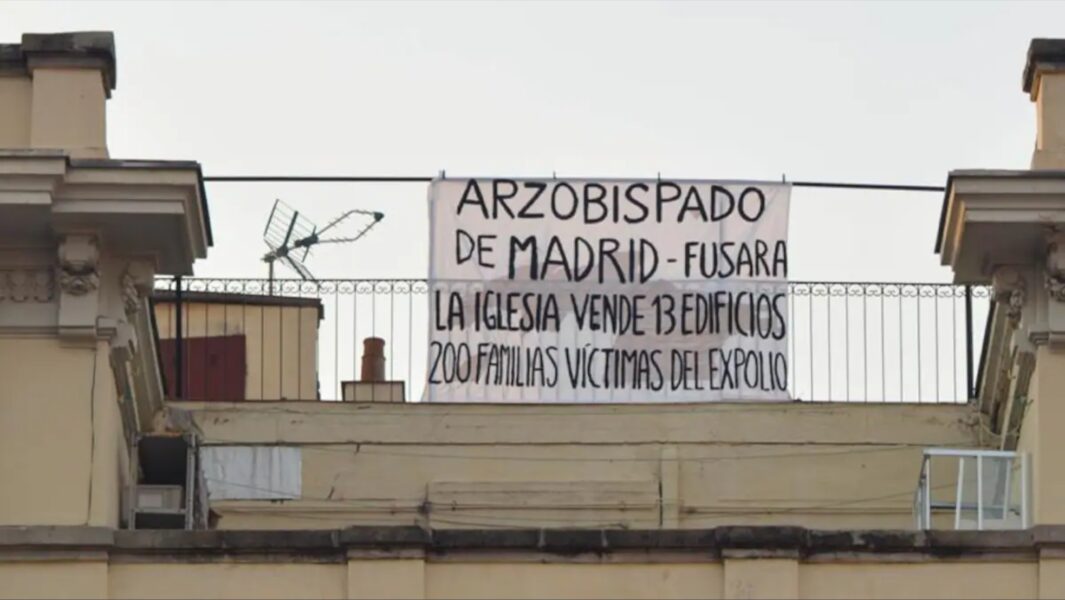
The eviction of Maricarmen, an 87-year-old neighbor from the Retiro district with an old-rent contract, has sparked intense neighborhood mobilization and a high-level political offensive. At the Archbishopric of Madrid, with the Fusara case still open in the courts and two hundred tenant families in the buildings sold by its foundation, the controversy is being followed with evident unease.
An eviction on a stretcher after seventy-one years
María del Carmen Abascal was evicted last Wednesday, September 23, from the apartment on Calle Alcalde Sainz de Baranda where she had lived since 1956, when she moved in at just seventeen years old with her parents. The judicial commission carried out the eviction on the fourth attempt, the first against which no further appeal was possible. The National Police dispersed from early morning the encampment of some four hundred people called by the Tenants’ Union in front of the entrance, and the elderly woman, who uses a wheelchair, had half an hour to gather her essential belongings before being transferred on a stretcher to an ambulance.
The conflict stems from the contract her father signed seventy years ago. Upon his death it passed to her mother, and when she died in 2005, to Maricarmen, who kept the same conditions and a rent of around 500 euros per month. In 2018 the building was acquired by Renta Corporación, which offered to sell her the apartment for about 250,000 euros, an amount unreachable for a pensioner. In 2020 ownership passed to Urbagestión Desarrollo e Inversión, which demanded a rent of 2,650 euros.
The legal knot lies in the second transitional provision of the 1994 Urban Leases Law, which limits the second subrogation of contracts prior to May 1985 to two years, unless the cohabiting child proves a disability of 65% or higher. Maricarmen has a recognized 50%. She won in the first instance, but the Provincial Court and, in March, the Supreme Court ruled in favor of the owner. Hours before the eviction, Urbagestión rejected the offer of a well-known writer, who asked to remain anonymous, willing to pay for life the difference between the old rent and the one demanded.
The left’s offensive
The scene has quickly been turned into a political banner. MEP Irene Montero confronted the officers deployed at the eviction, and the protesters later moved to Chamberí chanting “Ayuso’s penthouse for Maricarmen!”, in reference to the controversial purchase of a penthouse by a public agency of the Community of Madrid.
The narrative, however, has some uncomfortable edges for those who brandish it. The rule applied by the Supreme Court is the 1994 law, passed under Felipe González’s government, and the forced extension for new contracts was abolished in 1985 by Miguel Boyer’s decree. The protective regime now so fervently claimed comes from the 1964 Urban Leases Law, in the middle of the Franco era. It is striking to see a left that has made historical memory a hallmark of identity nostalgically defending Franco’s frozen rents.
Even more striking is that the protest comes from those who have been in government for eight years. The purchase of entire buildings with long-standing tenants by investment companies, waiting for contracts to expire so each home can be turned into a speculative asset, is a structural problem the legislator has the power to correct. The Government has the Official State Gazette and a parliamentary majority with which it could address it.
The uncomfortable Fusara precedent
The controversy comes at an especially delicate moment for the Diocese of Madrid, which carries its own real-estate file with families inside. The Santamarca and San Ramón y San Antonio Foundation (Fusara), whose presidency belongs to the Archbishop of Madrid, administered buildings in the city center that came from the legacy of two widows who destined them for people in situations of social exclusion.
In 2019, the previous management team sold fourteen of those properties to the company Tapiamar at a price 20% below appraisal. The operation, together with the subsequent purchase of a plot in Valdebebas at an alleged overprice, is under investigation in Madrid’s Court of Instruction No. 28, where the foundation itself accuses former officials and the Chávarri law firm of fraud, disloyal administration and falsification of a commercial document, with an estimated loss of 8.6 million euros. Some two hundred families live in the affected buildings.
Already under Cardinal José Cobo’s pontificate, in July 2025, Fusara reached an out-of-court agreement with Tapiamar that raised the price of thirteen of the fourteen properties from 64.3 to 99 million euros, with the return of the building on Calle del Barquillo. In exchange, the foundation withdrew its criminal and civil actions against the buyer. The judge approved the agreement in December, considering it not harmful to the foundation, lifted the precautionary measures that prevented disposal of the properties, and rejected a group of tenants’ request to extend the complaint to the current board. The same court had previously refused to investigate Cardinal Cobo.
With the precautionary measures lifted, the buildings were free for resale. According to the newspaper Público last June, the company Hopewell acquired the properties from Tapiamar during the spring, and some neighbors have already been evicted. The affected tenants even wrote to Pope Leo XIV asking how the Church, which should be a refuge for the weak, can take part in decisions that put their housing stability at risk.
The fear that the fuse will catch
Maricarmen’s case has shown the enormous mobilization capacity of the Tenants’ Union and the media echo any eviction of an elderly person in central Madrid achieves. In this context, it is reasonable to think the Archbishopric fears the fuse will catch and that the next demonstrations will head to the entrances of the buildings Fusara sold in 2019, whose tenants have been organized and involved in the judicial case for years.
If that happens, the public debate will hardly stop at the company that now owns the properties and will return to the original sale and the decisions later taken by the foundation presided over by the archbishop. From the diocese’s circle it is argued that the alleged fraud belongs to the previous period and that the agreement with Tapiamar allowed the recovery of 34.7 million euros and guaranteed the economic viability of the foundation.
That defense may be sufficient in court, but the social debate has moved beyond legal subtleties to settle on a much more uncomfortable underlying question: whether it is morally acceptable to treat housing as a speculative asset and whether the Church can take part in operations that detach from their social purpose buildings inhabited by families and elderly people only to end up in the hands of vulture funds. For an institution whose social doctrine emphasizes the universal destination of goods and the primacy of the person over profit, it is a question that public opinion, and also many of the faithful, are beginning to ask out loud.