


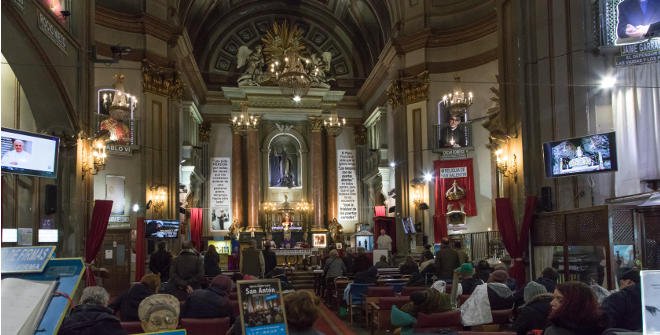
Jesús Bastante has discovered aporophobia in Chueca, a finding with the same merit as locating a 1962 missal in the newsroom of Religión Digital. The neighborhood of the rainbow flag on the balcony and diversity (with terrace license) turns out, according to his blog, to be a breeding ground for the rich who cannot bear to see the poor, with racism, xenophobia, and Islamophobia as garnish. All in one summer. And all because the residents of Hortaleza Street are complaining about what happens at the door of the church of San Antón, the one belonging to Father Ángel.
What the neighbors say has been published by El Mundo: daily fights, drug consumption at the temple doors, filth, insecurity. The Chueca and Salesas Residents’ Association has reported to the City Council a possible irregular use of a building classified as religious equipment and declared a Site of Cultural Interest, and is requesting an inspection. The City Council itself acknowledges preventive patrols by the Municipal Police and an urgent cleaning service that is activated every day. Bastante writes “alleged fights” and “alleged dealing.” The little adjective works hard. The alleged filth is removed every morning by municipal workers who are anything but alleged.
El Mundo also reports a homicide that occurred in June on a nearby street. It does not appear in Bastante’s article. Not even as alleged.
“Aporophobia” is a serious word. Adela Cortina coined it in the 1990s, Fundéu chose it as word of the year in 2017, and the Penal Code incorporated it as an aggravating factor in 2021. It designates rejection of the poor for the very fact of being poor. And there lies the trick: the neighbors complain about noise, garbage, brawls, and dealing, and Bastante hears “poor people.” The equation poor equals knife equals paper bag was not written by them, who perfectly distinguish between the man lining up for breakfast and the one pulling out a knife at dawn. The columnist wrote it. If anyone in this story has confused poverty with crime, it is the person signing its defense.
Then there is Berlanga. Bastante invokes Plácido to portray the rich who seat a poor person at their table for Christmas, and he invokes it without reviewing the plot. Plácido is the satire of a Christmas Eve campaign, “Seat a poor person at your table,” with artists arriving from Madrid, charity ladies, and a photographer: charity on display, with a fixed date on the calendar. The residents of Chueca do not organize Christmas Eve dinners with the poor and cameras. The one who organizes them, and appears on the evening news every December, is Father Ángel’s house, and Bastante himself boasts that there solidarity “does not rest even on Christmas Eve.” Berlanga already made the critique. Bastante has simply mistaken the target.
There is an older precedent. In Bethany, when Mary anoints Christ’s feet with a pound of nard worth three hundred denarii, someone protests: that could have been sold and given to the poor. In John’s version, the one who protests is Judas. He is the only character in the Gospel who uses the poor as a reproach against another, and he does not come off well in the scene. Christ’s response has two halves. The first, “the poor you will always have with you,” the residents of Chueca have verified to the letter: they have them at the entrance. The second, “you will not always have me,” is the one that usually falls away from these blog homilies, and it is the one that explains why a church, before being a dining hall, dormitory, or television set, is a temple.
The blog is titled El barón rampante, and the title is more accurate than it seems. Calvino’s Cosimo climbs an oak tree at the age of twelve and swears never to set foot on the ground again; from the branches he sees everything and opines about everything, except what happens at ground level. From that height one understands why the article jumps from Hortaleza to Ceuta, and from Ceuta to Haiti, Venezuela, and Gaza, in two paragraphs; why it puts in quotation marks a paraphrase of Pope Leo (the quote that is not a quote, a new genre); why it accuses an unnamed subject of having “hidden” the poor during the papal visit, without saying who or how; and why it rescues a verse by Sabina that, according to Bastante himself, Sabina erased. Even the singer-songwriter corrected himself.
What the neighbors are asking for, according to their complaint, is an inspection: to know what use is being made of a protected temple and whether it conforms to its classification. It is an urban-planning question, not a theological one, and it is answered with an ordinance. There is another question the article does not formulate: whether eleven years of open doors have taken anyone off addiction or off the street, or whether they have merely given them an address at number 63 Hortaleza. Bastante speaks of “new opportunities.” Eleven years are enough to count them.
The best paragraph of the article is the last one, because it says everything without meaning to. At San Antón, Bastante writes, no one is invisible and no one is superfluous. And immediately afterward he clarifies who is superfluous: the one who is ashamed of having the poor nearby, that is, the neighbor. The church of inclusion already has its excluded person. He lives across the street.