


By Robert Royal
Deo volente, and if air-traffic disruptions allow, I’ll be home this morning after a late pilgrimage in America following an overloaded summer. I planned to follow El Camino Real (“The Royal Road”) in California, starting from San Diego and heading north, stopping at several missions founded mostly by Spanish Franciscans, up to San Francisco and the two final sites across the bay, San Rafael and Sonoma. Faith is dogma and worship, but it is also a lived experience of what remains sacred history. Our bishops would have done well to remind us far more of the significant, continuous, yet now often forgotten Catholic presence in this land, as the nation celebrates its 250th anniversary.
California’s coastal roads and trails began as eighteenth-century footpaths, forged mostly by Franciscan friars (a “royal” road only in aspiration at the time). Today, California 101 basically follows what the missionaries opened on foot. All those saints’ names along the Pacific—and a capital called Sacramento—reflect the long and rich history of the Church’s missionary work in the Americas.
It is fitting that we began in San Diego, because Diego is a variant of the Spanish name for Santiago. That first of the missions evokes the Camino of Santiago in Compostela, the most famous of Christian pilgrimages. The missionary friars, however, were not on a spiritual pilgrimage; they were relentless and intrepid in pursuing the dominical mandate to preach the Gospel to all nations.
Today’s revisionist histories often reduce their efforts to mere collaboration in colonization—even the holy acts of the great St. Junípero Serra. The missions did have to rely on some support from Spanish soldiers. But eighteenth-century California was a beautiful, if rugged, territory, not a place suited to exploitation. Pairs of Franciscans and a handful of soldiers at each mission carried out exploration, development, and—above all—evangelization.
The best way to grasp all this is, of course, to make the effort to visit some sites physically yourself. But we also have the works of the great American Catholic historian Kevin Starr, who taught at several universities and for a decade was California’s official state librarian. In California, and especially in Continental Ambitions: Roman Catholics in North America, Starr tells a fascinating and moving Catholic story.
I had visited some of the missions before, but never deliberately. San Juan Capistrano is one of my favorites, both for its sheer beauty and because California’s wine industry began there. Our Lord’s first miracle, at the wedding in Cana, turned water into wine of great quality and abundance. And at the Last Supper He gave us bread and wine as His body and blood. So let no teetotaler or grape-juice fundamentalist deny the Christian gift.
Several missions were damaged by earthquakes—and rebuilt—over the years. Parts of Capistrano, for example, recall the kind of evocative ruins one sees in Rome. But some are still functioning: there were funerals at Capistrano and Santa Barbara in recent days, and a wedding at Carmel.
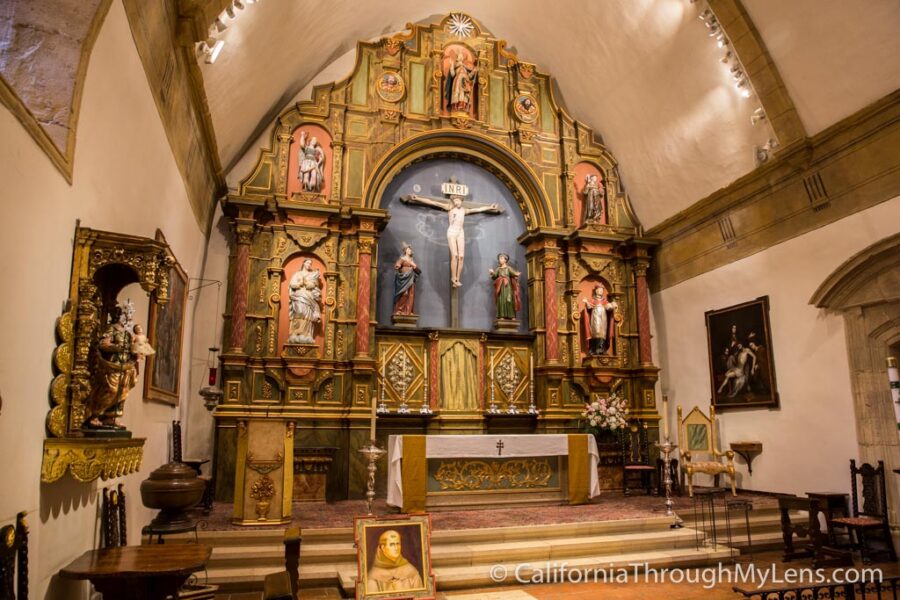
The Carmel mission (more properly San Carlos Borromeo) is the most impressive. There is a deeply contemplative Carmelite church by the ocean in Carmel-by-the-Sea, which gave the city its name. But at the Carmel “mission” rest the mortal remains of St. Junípero Serra in a church lovingly restored by local artisans. Serra is largely forgotten, even by Catholics today, but his contributions to the state of California and to America almost defy belief.
He was born in Mallorca to poor farmers, but from early on he knew he had a vocation. In the seminary he excelled academically and became a professor of theology. At thirty-five he felt the call to missionary work. He left a comfortable university life, undertook the seventy-day crossing to Veracruz, studied at the missionary school in Mexico City, and worked in Mexico itself before heading to California, where he founded seven missions and baptized thousands.
The whole question of “missions” today raises concerns about imperialism, colonialism, cultural domination, and all the current doubts of our Western culture—sadly, even within the Church. The truth is that no interaction between native peoples and Europeans could have been perfectly harmonious. But if one looks dispassionately at what the friars did, it was heroically charitable.
They were the ones who most protected native peoples—who at that time were nomadic hunter-gatherers—from far less charitable figures; they taught them skills such as agriculture, cattle-raising, weaving, the catechism, and much more. A farmer’s son himself, Fr. Serra did the physical work alongside the Indians and the Spaniards.
In fact, when newly independent Mexico and then the United States sold the missions to ranchers, the worst disruption of native lives occurred. The Church asked President Lincoln in 1865 to return the properties: the government returned the buildings but refused to return the lands to the natives.
Only our present self-doubt leads us to believe it would have been better to leave the nomadic hunter-gatherers of those days as they were, rather than integrate them in the kindest possible way into a wider world—including Christendom.
It is a form of infidelity in our time to believe that welcoming the “marginalized” means not introducing them to what God Himself has revealed to us. Or that going out to the “peripheries” somehow means not drawing people inward, but turning away from our own Christian heritage.
After daily contact with this inspiring American Catholic heritage, it is somewhat jarring to return to the usual crises—Iran, Ukraine, Gaza, the price of gasoline, inflation, synodality, liturgical wars—that do not seem to have changed much in the days of absence. They must be faced, of course, but perhaps there is something to learn from the sheer audacity, perseverance, courage, and fidelity of those Franciscan padres in difficulties at least as great as any we face. And perhaps their example casts a different—and much-needed—light on how to meet our own challenges.
About the Author
Robert Royal is editor-in-chief of The Catholic Thing and president of the Faith & Reason Institute in Washington, D.C. His most recent books are The Martyrs of the New Millennium: The Global Persecution of Christians in the Twenty-First Century, Columbus and the Crisis of the West and A Deeper Vision: The Catholic Intellectual Tradition in the Twentieth Century.