


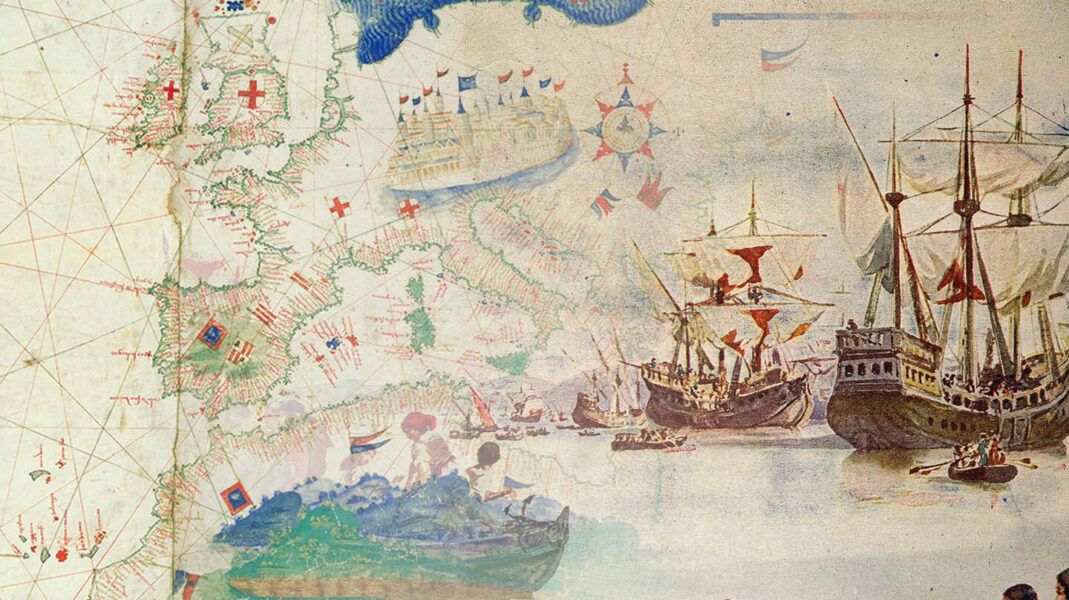
Having reached the western coast of the Indian subcontinent in 1498, Vasco da Gama and his crew returned to Portugal in the summer of 1499.
1.-Cabral’s Expedition and Vasco da Gama’s Second Voyage to India
Gama’s first voyage was followed by another that set sail only six months after Vasco da Gama’s arrival at the mouth of the Tagus River, in March 1500, this time led by the Portuguese nobleman Pedro Álvares Cabral. The aim of this expedition was to establish a permanent trading post. Thirteen ships, twelve hundred men, and investment from Genoese and Florentine bankers. The objective, as in all previous expeditions, was holy war against Islam and trade. It was an enormous national effort, departing from a kingdom as small and sparsely populated as Portugal. They now sought to settle permanently in Indian ports and consolidate their position on the Indian coast. A delegation of Franciscan friars joined the crew to instruct the Indians in the faith “for the salvation of their souls.”
With his excellent prose, Roger Crowley describes the departure thus: “There was a penitential mass and the blessing of the royal standard, emblazoned with five circles symbolizing the wounds of Christ. This time it was Manuel who handed it to Cabral; then the procession was led by the friars, ‘and the king went with them to the beach, where all the people of Lisbon had gathered.’ Manuel accompanied the fleet by boat to the mouth of the Tagus, where the departing ships felt the blow of the sea and turned their prows southward.”
Sailing westward to circumnavigate the African continent, the expedition unexpectedly reached the Brazilian coast. Following the chroniclers, Crowley explains how the Portuguese perceived the inhabitants—naked—very different from the tribes they had encountered on the African coasts. Peaceful people whom they proposed to convert to the true faith. This place, which they baptized as the Land of the True Cross, had abundant water and fruit, and strange animals. A vessel was sent back to Portugal with news for King Manuel about the land discovered. The rest of the expedition set course east, toward the southern tip of the African continent, and began to ascend the Indian coast, in order to reach Calicut, in India. The Portuguese king’s instructions to Cabral were clear: establish friendly relations with the ruler of Calicut—who Vasco da Gama had understood to be Christian, albeit somewhat peculiar—and wage war on Islam: “If you find at sea ships belonging to the aforementioned Muslims of Mecca, you must strive as much as you can to seize them, their goods and property, and also the Muslims found on the ships, for your benefit as best you can, and make war on them and cause them the greatest possible harm as a people with whom we have such great and ancient enmity.” These instructions would remain stable for all Portuguese expeditions to the east. The Portuguese had the pope’s permission and sought to fulfill God’s mandate to baptize all peoples. Moreover, Portuguese ammunition was infinitely superior to that of their adversaries on the coasts of the Indian Ocean.
Communication with the ruler of Calicut proved very difficult and full of misunderstandings. On his side were Arab merchants, accustomed to trade in those ports, who battled against Portuguese pretensions. In a hard struggle on land, more than sixty Portuguese died, including some Franciscan friars, known as the first Christian martyrs in India. Negotiations with the Indian ruler failed. The Portuguese razed the city of Calicut and also established themselves in the port of Cochin (present-day Kochi). This was the first of a long battle for faith and trade that was beginning in the Indian Ocean.
At that moment, entering a power struggle for control of the land and trade between Hindus, Muslims, and the newly arrived Portuguese, they finally met the first Indian Christians: two priests from nearby Cranganore (Kodungallur) approached the Portuguese ships. It is said that the apostle Saint Thomas had arrived in India and there had begun a small Christian community from the early centuries of the Church.
Upon Cabral’s return to Lisbon, in the summer of 1501, with half the fleet with which he had departed, King Manuel already had the next expedition prepared. They had already accumulated exhaustive knowledge of the functioning of tides and winds, as well as of the ports and peoples they encountered, which allowed them to be increasingly better prepared. At the same time, the Portuguese were gaining the upper hand in the spice trade against the Venetians, who bought them from Muslim intermediaries in the Egyptian port of Alexandria. By eliminating the intermediaries and obtaining the spices directly from the source, the Portuguese were in a position to establish a commercial monopoly and set prices.
The situation in Calicut, however, was difficult for Portugal: the Hindu ruler, now allied with the Muslims, massacred the Portuguese established at the trading post and eliminated it. In 1502, Cabral refused to set sail again and the king sent Vasco da Gama to India, this time with twenty ships and with instructions for revenge against the king of Calicut and to definitively expel the Muslims from the Indian trade routes, as well as to reestablish the trading posts of Calicut and Kochi. It was the time of gunboat diplomacy, in Roger Crowley’s words, convinced as the Portuguese were of the superiority of their artillery.
The new expedition was prepared with the usual departure rituals. In the mass celebrated in Lisbon’s austere crusader cathedral, Gama formally received his title of admiral of the Indies and was adorned with the symbols of empire and war. Dressed in a crimson satin cape and adorned with a silver chain, with a drawn sword in his right hand and the royal standard in his left, he knelt before the king, who placed a ring on his finger.
The Portuguese wanted both to trade on the eastern coasts of Africa and to establish safe footholds there as way stations for resupplying and regrouping fleets scattered by the turbulent Atlantic passage. After the tense negotiations and mutual distrust that had pursued Gama on his first visit to Mozambique and Mombasa, it is clear that he had decided to adopt a more energetic approach. He grew impatient with the nuances and fickleness of Eastern diplomacy and trusted that European cannons could command respect. He also realized that the monsoon was an inflexible taskmaster.
2.-Portugal and the Crisis of the Indian Ocean Trading System
Vasco da Gama first visited Sofala and Mozambique, where the usual round of suspicious hostage exchanges and armed landings allowed them to buy some gold with fairly good grace. But his main objective, Kilwa, the key trading port on the coast, had received Cabral coldly. Gama arrived with his entire fleet of twenty ships, flags waving and a salvo from his bombards to declare the magnificence and power of the Portuguese crown.
Gama demanded the right to trade in gold and a generous annual tribute to the king of Portugal, in recognition of whose lordship the sultans of the coastal cities should also fly the royal flag. The arrival of the Portuguese, with their commercial monopoly mentality and struggle against Islam, meant a great crisis for the Swahili system of multi-focal, non-monopolistic trade. In Roger Crowley’s words, “The Iberian powers that had divided the world at Tordesillas in 1494 were conditioned to believe in commercial monopoly and the obligation of crusade.”
The crossing of the Indian Ocean passed without incident, and on August 20 the entire fleet was at the Anjediva Islands. In early September, Gama was at Mount Deli. The struggle against Muslims and Hindus intensified from then on along the western Indian coast, known as the “Malabar Coast.” The inhabitants and merchants of the coast had by then realized that the Portuguese were not passing through the place. Their expeditions had become annual enterprises and they sought to establish permanent trading enclaves. Moreover, the Portuguese insisted on the expulsion of Muslim merchants from the trade routes, something to which the Hindu rulers apparently were not in a position to yield. Nor were they accustomed to Portuguese violence. Gama besieged Calicut and attacked, with no disposition to negotiate further, and in February 1503 undertook the return journey to Lisbon, leaving two trading posts on the Malabar Coast: Cannanore and Cochin.
The Portuguese began to introduce a toll system for navigation along the Malabar Coast; they issued safe-conducts that guaranteed protection for the ships of friendly powers. It was a tax on trade. Over time, it would force the merchant marine to trade in ports controlled by Portugal and, moreover, to pay substantial import and export duties. The safe-conducts, called cartazes, bore stamped images of the Virgin Mary and Jesus, and represented a radical change in the Indian Ocean. With the arrival of the Europeans, the sea ceased to be a zone of free trade. The cartaz system introduced the alien concept of territorial waters, a politicized space controlled by armed force and Portuguese ambition to dominate the sea.
In 1503, following the rhythm of the monsoons, a new expedition arrived on the Malabar Coast, commanded by Afonso de Albuquerque, a man with an extensive record of fighting against Islam in the Mediterranean. With him sailed his brother Francisco and Duarte Pacheco Pereira. They had orders to load the ships with spices and return to Portugal. However, the precarious situation of their trading post in Cochin made them act differently from what King Manuel had instructed: they had to rebuild the fort. The primitive fort, square in plan, with an earth and wood palisade and a rough stone keep, took a little over a month to build. It was, according to the chronicler Empoli, “very strong… with deep moats and ditches around it, and well garrisoned and fortified.” It marked an important milestone in the Portuguese imperial adventure.” It was the first solid foothold on Indian soil, and its completion was auspiciously celebrated with all the ceremony that could be gathered on All Saints’ Day, November 1, 1503. Dressed in their best clothes, with flags waving on the walls, they attended a solemn mass.
The Albuquerque brothers, however, were far from harmonizing in their decisions, producing a crisis in the Portuguese delegation that grew worse. A friar had to intervene to mediate. Francisco wanted the fort to be called Albuquerque, while Afonso, closely linked to King Manuel’s messianic ideas, wanted to name it after the monarch; finally, the latter’s idea prevailed. When they departed back to Lisbon loaded with spices, Duarte Pacheco Pereira remained at the fort with a small troop, determined to consolidate the Portuguese presence against the continuous local rearmament attempts and attacks on the port of Cochin. Pereira resisted the continuous attacks of the king of Calicut and managed to consolidate the fort. In the autumn of 1504 a new Portuguese fleet arrived on the Malabar Coast. Hindus and Muslims began to think that the Portuguese were invincible, and Islamic merchants withdrew from many Indian trading ports. The Portuguese began the year 1505 with the confidence of permanently occupying the Malabar Coast.
The Portuguese presence and their commercial monopoly system enormously altered Indian trade networks; and not only on the Indian subcontinent, but also on the Swahili coast, the eastern shores of Africa.
The enormous wealth generated by the Portuguese expedition resulted in the transformation of Lisbon, capital of the Empire. From the year 1500, in Roger Crowley’s words, a new royal palace was built on the banks of the Tagus River. Alongside it developed the imperial administrative structure: the Casa da Índia, the arsenal, and other departments.
The Portuguese commercial monopoly was harming Venetian merchants, who played a more than questionable role of alliance with the Sultan of Cairo, who threatened the Portuguese with destroying the holy places of Jerusalem if they did not abandon their imperial enterprise in the Indian Ocean.
3.-1505: Lisbon Changes Strategy:
On February 27, 1505, King Manuel sent a letter “to all those involved in the India business” that read as follows: “…that by this our letter of authorization as evidence, that we, for the great confidence we have in Don Francisco d’Almeida… give him charge as captain-major of all the said fleet and armada and of the said India and that he remain in possession of it for three years.” This letter unfolded a new strategy, an ambitious long-term program: to establish a permanent Empire in India backed by military force and gain control of all trade in the Indian Ocean. The king of Portugal had realized that delays in communications made control from Lisbon impractical, so he decided to delegate to an elected representative and cede him the baton of command long enough for effective plans to be put into practice.
Although the king’s instructions also intended to leave Almeida some freedom of action in the face of unforeseen eventualities, in practice they imposed a rigid agenda. Manuel had never seen nor would see the world whose conquest he demanded, but the regiment revealed an astonishing knowledge of the choke points of the Indian Ocean and an authoritative geo-strategic vision to control them and build his own empire. The speed of the discoveries was astonishing: seven years after their irruption into the new world, the Portuguese understood how the twenty-eight million square miles of the Indian Ocean worked, its main ports, its winds, the rhythm of its monsoons, its navigation possibilities and its communication corridors… and were already looking toward more distant horizons.
Almeida’s fleet was enormous: twenty-one ships and fifteen hundred men enrolled, constituting a microcosm of the society sent to create a Portuguese State beyond the sea. There were noble knights as well as outcasts and the lowest rungs of society, passing through adventurers and foreign merchants. Even some women managed to enlist. They had been chosen not only to sail and fight, but to establish a new State, to colonize a new world: they were going to stay in the new Portuguese territories.
Roger Crowley narrates in his cited work “Conquerors” in great detail how the importance of this expedition was reflected in the ritual mass celebrated on March 23, 1505, in Lisbon Cathedral. The chronicler Gaspar Correia left a valuable account of this theatrical event. After the mass, the ceremony of delivering the standard, “of white damask emblazoned with the cross of Christ in red satin, outlined in gold and bordered with gold tassels and a gold star”; the king appeared through a curtain to deliver this talisman, which bore “the sign of the true cross,” to his viceroy, accompanying it with a long speech of blessing and an exhortation to perform great deeds and “the conversion of many infidels and peoples.” Almeida and all the nobles and captains knelt to kiss the king’s hand. Then the sumptuous procession to the waterfront, with “Don Francisco de Almeida, governor and viceroy of India,” and his captains on horseback, the retinue on foot. With a thunderous artillery salute, the anchors were raised and the ships headed to Restelo for a new ceremonial blessing at the sanctuary of Santa Maria de Belém. “Finally they departed on March 25, the auspicious day of the Annunciation of the Virgin.”
Meanwhile, the friar sent by the Venetians with the threat from the Mamluk sultan arrived to King Manuel. His response was not long in coming: not only would they not withdraw from the Indian Ocean but, if the Mamluks insisted on provoking him, he would launch a crusade through the Mediterranean to destroy Cairo and recover the holy places of Jerusalem. Moreover, the proof that Portuguese expansion in the Indian Ocean was not due solely to commercial criteria but, above all, was driven by the spirit of crusade, so often silenced by historiography, is found in the “crusade tax” that the pope granted to King Manuel for two years, with remission of sins, for all those involved in the crusade.
For his part, in the ambitious expedition to the Indian Ocean, Almeida was not only to be captain-major. He was also granted the elevated title of viceroy, nominally with executive power to act in place of the king. What this meant in practice was explained in the regimento, the instructions the king gave him. After sailing around the Cape, Almeida received the order to take control of the Swahili coast, the eastern coast of Africa. The recommended method consisted of arriving with an appearance of friendship, attacking the cities by surprise, imprisoning all Muslim merchants and seizing their wealth. Forts had to be built and control the sources of gold, necessary to trade on the Malabar Coast in exchange for spices. It was going to be a war mission, disguised as peace. The cities of Mombasa and Kilwa (in the present-day states of Kenya and Tanzania, respectively) resisted agreeing to the vassalage that Portugal sought to impose. Kilwa, as historian Mónica Batlle explains, was a particularly important point, since it controlled the gold trade coming from Sofala, in the continental interior. Both Kilwa and Mombasa were taken by force, the latter razed by fire, becoming vassals of Portugal and obliged to pay tribute to the Portuguese king. Between 1503 and 1507, all coastal cities, except Mogadishu (in present-day Somalia), were attacked and subjugated, with the collection of tributes becoming generalized in all of them. Portugal did not seek physical colonization, but to establish commercial enclaves like the ports of the Malabar Coast in the Swahili city-states.
To the north, another fort was to be built at the mouth of the Red Sea or near it and near the kingdom of Prester John, to strangle the spice trade of the Mamluk sultan and ensure that “all India would be stripped of the illusion of being able to trade with anyone other than ourselves.” Two ships would permanently patrol the African coast to the Horn of Africa.
Almeida was to demand in the coastal ports an annual tribute to the king of Portugal; order these states to break all commercial relations with Arab merchants from Cairo and the Red Sea; capture all Muslim navigation along the way. To pay for all this, he had to guarantee the complete embarkation and prompt departure of the annual spice fleets.
On the coasts of the Indian subcontinent, Almeida was to build four more forts: on the stopover island, Anjediva, as a support and supply center, and in the friendly cities of Cannanore, Quilon and Cochin.
From the base of the port of Cannanore, Almeida diligently devoted himself to building the infrastructure necessary for the establishment of a colony: he built a fort, a hospital, a customs house and all the infrastructure required for imperial administration; dwellings, chapels and churches were also erected. Maritime security was maintained by means of a permanent naval force.
Manuel’s ambition did not end there. After attending to the spice ships, the viceroy received the order to open new frontiers by “discovering” Ceylon, China, Malacca and “any other parts that have not yet been known.” The distance, however, from India, and the delay in communication, led Manuel to seriously doubt Almeida’s efficiency, to the point that he decided to replace the man to whom he had promised total confidence with Afonso de Albuquerque only a year later, in 1506. Albuquerque’s conditions, however, were not the same as Almeida’s: while the latter had been appointed viceroy, Albuquerque received the inferior title of governor. Albuquerque devoted himself diligently to ending the Muslim presence and trade on the shores of the Arabian Peninsula and the Red Sea. The state of war was constant both on the Arabian coast and on the shores of the Indian subcontinent.
In the ports of Kochi and Cannanore, local low-caste Hindu women began to marry Portuguese men, producing a progressive Christianization of society that fueled the hatred of the Muslims who inhabited these enclaves. When the Egyptians took the important trading port of Diu in 1507, one of the key ports of Gujarati trade, the Portuguese took two long years to reach there to conquer the place, involved as they were in a long, no-quarter battle against the Mamluks in Ormuz. In February 1509, the Portuguese arrived at Diu, confident of being able to take all of India if they could conquer this strategic port. Seeing that the Muslim ships did not come out to face them, Viceroy Almeida sent a missive to the captains of his fleet that said: “Gentlemen, the Saracens will not come out, since they have not done so until now. Therefore, remembering the Passion of Christ, be attentive to the signal I will make when the sea breeze begins to blow, and we will go serve them lunch; and, above all, I recommend that you take great care… to escape the fire, in case the Muslims set it to their own ships to burn them with yours or to drag you to shore by cutting the cables of their anchors.”
Almeida had composed a rhetorical and moving message, heavy with a sense of holy war, which continued: “Don Francisco de Almeida, viceroy of India by the most high and excellent king Don Manuel, my lord. I announce to all who see my letter, that … on this day and at this hour I am on the shore of Diu, with all the forces I have to give battle to a fleet of the Great Turk which he has ordered, which has come from Mecca to combat and harm the faith of Christ and against the kingdom of the king my lord.”
With their traditional war cry of “Santiago!”, the Portuguese unfurled their flags. The ships enter the channel to the sound of trumpets and drums. The Muslim cannons were prepared on the shore of an island on the other side of the channel as the fleet passed. Almeida had chosen his oldest ship, the Santo Espírito, to lead the way. The Santo Espírito was bombarded and fire was opened in all directions. Finally, the Portuguese triumphed in that decisive battle, annihilating the rival Muslim fleet, composed of Turks, Egyptians and Abyssinians.
Roger Crowley states that “it is not known exactly when or why Albuquerque decided to attack Goa, but the facts show that, weeks after finally razing Calicut in early 1510, he devised a plan for an ambitious campaign of conquest. Goa, located on a fertile island between two rivers, was the most strategic trading post on the eastern coast of India; but this enclave had never been in Portuguese plans. It lay on the dividing line of two rival powers: to the north, the Muslim kingdom of Bijapur and to the south, its rivals, the Hindu rajas of Vijayanagar. Over the centuries, control over Goa had changed hands repeatedly. It was very fertile land, with a deep port sheltered from the monsoons and the city of Tiswadi itself (or Goa Island) allowed taxes to be levied on goods imported and exported at its customs posts, being the perfect place for the spice trade. And, above all, Goa had been chosen by the Muslims as a strategic base for the counterattack against the “Franks” (Portuguese). The conquest of Goa was simple for the Portuguese. On March 1, 1510, the governor took possession of the island with great ceremony, and Albuquerque devoted himself to the creation of Portuguese Goa with great zeal. Unlike the commercial port enclaves founded until then, Goa was to be the first Portuguese territorial acquisition in Asia.
The Portuguese minted the cruzados, a gleaming gold disk with the cross on one face and on the other an armillary sphere, symbol of the Portuguese king, to stimulate trade.
Albuquerque had initially promised religious freedom in Goa, but instead recoiled in horror at the practice of Hindu widow immolation on the funeral pyres of their husbands and prohibited it. The underlying sense of the Christian mission and his own stubbornness also led him to order summary executions that were to provoke disturbances. The governor also rebuilt the fort of Goa, since the Muslims awaited the opportunity to besiege the island. The local inhabitants, Hindus and Muslims, could align themselves with the invaders at any moment, so Albuquerque and his men had to be alert. In May 1510 a fierce battle broke out between the Portuguese and Muslim forces, which extended until the month of December. The Portuguese triumphed, and what developed afterward surprised the world by Albuquerque’s reconsideration. It is important to make a digression here to emphasize how, contrary to what Roger Crowley considers a “brilliant strategy,” what was in the governor’s mind was a thought of Christian civilization, of Christendom.
Albuquerque—in Roger Crowley’s words—“aware of how few the Portuguese were, of their high mortality rate and their lack of women, immediately launched into promoting a policy of mixed marriages, encouraging the union of the Portuguese troops—soldiers, masons, carpenters—with local women. Generally, these were low-caste Hindus, who were baptized and granted a dowry. The married also received economic incentives for contracting marital ties. Two months after the reconquest of Goa, he had arranged two hundred marriages of this type. This policy was pragmatic in its attempt to create a local Christianized population loyal to Portugal, but Albuquerque also showed a certain enlightened concern for the general welfare of the women of Goa, by granting them property rights. His marriage policy set in motion the creation of a lasting Indo-Portuguese society.”
Regarding the previous paragraph, I consider that Crowley performs a fabulous documentary work, but incurs in the common error of presentism, applying his modern perspective to Albuquerque’s ideas, and seeing strategy and “enlightened thought” in his policy toward women in what is merely an application of the Christian worldview.
Returning to events on the Malabar Coast, the Portuguese did not manage to definitively defeat the Muslims until 1512. It was then that the surrounding local powers assumed that the Portuguese presence would be permanent and began sending ambassadors to Goa. Even an envoy from the Christian king of Ethiopia arrived there, with interesting proposals to fight together in the Red Sea and even the Mediterranean shore against Islam.
In 1514, the Portuguese king Manuel sent an impressive entourage to the Pope, composed of men, exotic animals (panthers, leopards, parrots, elephants and even rhinoceroses) and gifts for the pontiff.
And in 1517 the Protestant heresy exploded in the center of Europe, which in a few decades broke Christendom. Thus, as Francisco Elías de Tejada aptly defined it, these first decades of the sixteenth century were already times of crisis in Greater Christendom (christianitas maior), the Christian civilization that reached its apogee in the thirteenth century. The fourteenth and fifteenth centuries saw the development of the seeds of Protestant heresy and its consequence, the rupture of Christendom and the irruption of modernity: nominalism, devotio moderna, humanism and Renaissance; issues that would only worsen in the following centuries. The religious rupture and, therefore, of the worldview of Christendom, would have repercussions on the Portuguese Overseas Empire, since, from 1517, the Portuguese would have to face mainly the Dutch, Protestants, as their main adversaries on the high seas.
In conclusion, we see that the situation that the Portuguese encountered and had to battle in the Indian Ocean was very different from what the Spanish found upon arriving on the American continent. While the latter found pagan peoples, with high technical development in some areas and inhuman and savage practices in others, the Portuguese went to war against a fierce Islam, a religious and commercial enemy that, with strategic alliances with Hindus and other pagans, fiercely resisted them for decades in the Indian Ocean. The spirit and objective of crusade is crystal clear in these narratives, however much academic historiography always tries to emphasize that it was an eminently commercial enterprise.
Bibliographic References
Abellan, P., 2002. “Introduction to the Study of the Indian Ocean as a Cultural Whole. Historiographic Revisions and New Proposals.” Research for obtaining the DEA, 2000/2002.
Crowley, R., 2005. “The Sea Without End”, ed. Ático Libros.
Elías de Tejada, F., 2021. “The Roots of Modernity”, Collana di Studi Carlisti, Solfanelli.
Iniesta, F., et al., 1989. “Report: Unknown Africa, the Swahili”, Historia16, year XIV.
Olivera Ravasi, J., 2018. “Don’t Let Them Tell It to You. The Falsification of History”. Vol III. Ed. Katejon