


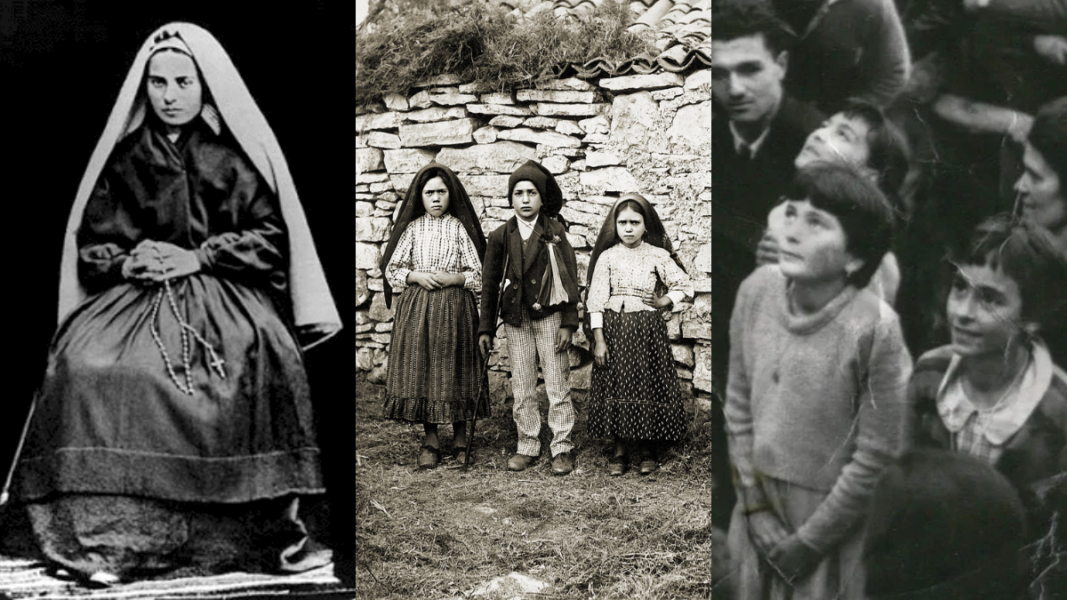
The Consistency of the Witnesses
Not all Marian apparitions can be placed in the same devotional showcase simply because their protagonists are children, the rosary is prayed, crowds gather, or phenomena difficult to explain occur. The Church, which knows the immense distance between supernatural grace and any experience born of suggestion, fantasy, collective contagion, or even still-unknown causes, does not discern a presumed apparition by the emotion it arouses, but by the convergence of very diverse indications: the doctrinal quality of the message, the psychic and moral freedom of the visionaries, their truthfulness, obedience and disinterestedness, the stability of their testimony, the spiritual fruits, and finally, the judgment of the competent authority. Among these indications, the perseverance of the witness subjected to contradiction occupies a singular place, not because firmness alone proves the intervention of heaven—after all, a fanatic can also persist in error—but because a revelation that claims to be objective needs initially to rest on someone capable of declaring, with humble assurance: this is what I saw, this is what I heard, and I cannot say otherwise without betraying the truth.
The comparison between Bernadette of Lourdes, the little shepherds of Fátima, and the girls of San Sebastián de Garabandal is, therefore, enlightening, provided it is done with precision and charity. It is not a matter of raising the holiness of some above the humiliation of others, nor of judging the conscience of four peasant girls who became trapped in an overwhelming social phenomenon, but of observing the different objective consistency of three testimonies. In Lourdes and Fátima, the visionaries upheld the apparitions when denying them would have immediately ended their sufferings; in Garabandal, by contrast, the protagonists themselves came to retract their statements, although three of them later recovered or reaffirmed their conviction of having experienced something supernatural. This oscillation does not mathematically prove the falsehood of Garabandal, but it does establish a serious difference that no serious discernment can hide behind pious explanations added after the facts.
Lourdes: the unyielding firmness of a bonne à rien
Bernadette Soubirous was fourteen years old when, on February 11, 1858, she claimed to have seen in the grotto of Massabielle a young lady dressed in white, girded with blue, and with a yellow rose on each foot. Bernadette was poor, sickly, barely educated, and belonged to a family sunk in such misery that they lived in the former jail of Lourdes. Precisely for that reason, it was easy to intimidate her, discredit her, or make her fall into contradiction. Commissioner Dominique Jacomet had her brought to his house and began a series of interrogations aimed at dismantling her account. She was threatened with prison, attempts were made to catch her by altering words in her statement, and pressure was exerted on her family. Historical documentation indicates that, throughout eight interrogations and despite threats of imprisonment, Bernadette invariably maintained the same version.
Bernadette’s strength was not defiant. She never sought to impose on others the obligation to believe her, nor did she rebel against those who doubted. Her famous distinction—she was charged with saying it, not with making others believe it—expresses an extraordinarily pure form of interior freedom. She did not argue theories, did not embellish the account to make it more convincing, did not turn the apparition into personal property, nor did she take advantage of the expectation to escape poverty. When parish priest Peyramale demanded the name of the Lady, she returned to the grotto and asked; upon receiving the reply Que soy era Immaculada Councepciou, she repeated those words she could not understand, so as not to forget them before reaching the rectory. Before the commissioner, the imperial prosecutor, the doctors, the priests, the curious women, and the crowd, she always remained the same: a poor and clean girl, neither adding nor removing what was essential.
The Church did not canonize Bernadette because she had seen the Virgin, but for having lived the Gospel heroically; nor did it recognize Lourdes solely because she had not contradicted herself. The diocesan commission worked for nearly four years, questioned the visionary, studied the healings, and consulted doctors and scientists. Nevertheless, Bernadette’s testimony was the human cornerstone on which that investigation could begin. The declaration of Bishop Laurence, promulgated on January 18, 1862, recognized the eighteen apparitions after that meticulous examination and affirmed that they bore the marks of truth. The ecclesiastical recognition rested on Bernadette’s decisive testimony and on a long process of investigation and discernment. Lourdes did not have to invent afterward an explanation to justify that its visionary had denied the facts: the girl who saw was the same who suffered for having seen and the same who, when the time came to testify, did not retreat.
And in Lourdes, the Immaculate indicated the healing spring that for more than a century and a half has been healing the sick.
The pastorinhos of Fátima: Se nos matarem, daqui a pouco estamos no Céu!
Even more impressive, because of the age of its protagonists and the violence of the threat, was what happened in Fátima. Lucia was ten years old, Francisco nine, and Jacinta seven. In August 1917, when the event was beginning to attract crowds, the administrator of the council of Vila Nova de Ourém, Artur de Oliveira Santos, a mason and freethinker, decided to prevent the children from going to Cova da Iria on the 13th. By deception he took them to Ourém, repeatedly interrogated them to extract the secret entrusted by the Lady, and finally locked them for some time in a cell with adult prisoners. According to the account preserved in Sister Lucia’s memoirs, they were threatened with being fried in oil if they did not reveal the secret.
The staging was cruel. They were called out separately, made to believe that the companion who had just left had already been thrown into the cauldron. It should be noted that there was no cauldron prepared and that the children were not physically led before it; the test consisted in making them plausibly believe they were going to die in that way. But, on the moral level, that is enough to measure their courage: they did not know it was an intimidatory performance. Jacinta wept for her mother; Francisco maintained a disconcerting serenity; Lucia bore the responsibility for the other two. None revealed the secret or agreed to deny the apparitions. Francisco’s reply, transmitted in the memoirs, contains all the stark theology of those children: if they were killed, they would go to heaven. They were returned to their families on August 15 and met the Lady again on the 19th, in Valinhos. Historical documentation confirms their detention in Ourém and the subsequent recognition of the apparitions by the bishop of Leiria in 1930.
That firmness expressed the transformation of their lives. Francisco and Jacinta, who died a few years later, offered their illnesses and sufferings with a spiritual maturity humanly disproportionate to their age; Lucia guarded for nearly nine decades the substance of the message, subject to the Church: first as a Dorothean religious in Pontevedra and Tuy, and later, from the age of forty, for nearly sixty years, as a Discalced Carmelite in Coimbra, without altering the essentials of what had been declared in 1917. Nor here does later sanctity constitute a mechanical proof of the apparition, but it is its most eloquent moral fruit. The experience did not make them feel like exceptional personages: it made them worshippers, penitents, and offerers. Their journey was a continual renewal of the initial fiat, expressed in prayer, sacrifice, and concern for the conversion of sinners. Those children did not become saints because they knew how to resist a threat; they resisted because something had already begun to sanctify them from within.
And in Fátima, Our Lady announced for October 13, 1917, the miracle that seventy thousand people saw on the appointed day.
Garabandal: denial turned into favorable proof
Between 1961 and 1965, Conchita González, Mari Loli Mazón, Jacinta González, and Mari Cruz González, aged ten to twelve when the events began, claimed to have seen first Saint Michael the Archangel and then the Blessed Virgin under the title of Mount Carmel. The succession of presumed apparitions was extraordinarily abundant; crowds, physical proofs, photographs, objects presented to be kissed, ecstatic walks, and the pressure of believers, the curious, and detractors all grew. Those girls undoubtedly endured a situation that would have overwhelmed many adults, and any Christian consideration of the case must begin by acknowledging their vulnerability. They were not responsible for the international propaganda machinery that would later be built around their names.
But there is a documentary fact that cannot be eliminated. At the request of the interested parties themselves, the bishop of Santander, Bishop Vicente Puchol, ordered that they be interrogated again. The official note of March 17, 1967, states that, from the declarations of Conchita, Mari Loli, Jacinta, and Mari Cruz, it appeared that there had been no apparition of the Virgin, the archangel, or any heavenly personage; that there had been no message and that the events had a natural explanation. The bishop attributed the prolongation of the episode to social pressure that had prevented what had begun as “an innocent game of little girls” from fading away through the action of the girls themselves.
The defenders of Garabandal reply that those denials arose from fatigue, confusion, fear, and psychological pressure; they cite the later reaffirmations of Conchita, Mari Loli, and Jacinta, and even maintain that the Virgin herself would have announced to them that they would come to deny what they had seen. It is fair to record this. Mari Loli would later declare that they were filled with doubts, but that she was again certain of the reality of those events; Jacinta explained her denial as a moment of bewilderment; Conchita also went through a stage in which she wanted to tell the bishop that everything had been illusion, dream, or lie, before recovering her initial conviction. The denials, therefore, were not definitive in all of them.
However, explaining the retraction by means of a supposed prophecy that had already announced the future retraction contains an evident logical difficulty: it turns any contradiction into confirmation and makes the phenomenon practically immune to all proof. If they claim to have seen, the apparition is confirmed; if they deny having seen, it is also confirmed because the apparition would have predicted the denial. Such reasoning does not discern the facts but encloses them in a devotional circle from which nothing can escape. A private revelation cannot authenticate itself by means of a clause that turns into favorable proof precisely what objectively weakens its witnesses.
And in Garabandal, for sixty-five years there have been waiting, warnings, chastisements, healings of the blind, and incorrupt bodies. miracles
Does the silence of the USA equal the truth of Avilés?
The case of Mari Cruz, who today lives in Avilés, is even more significant because it does not allow all the denials to be indiscriminately attributed to ecclesiastical coercion. In 1984 she declared that she had not seen the Virgin, pointed to Conchita as the initiator of the episode, and attributed its prolongation to the environmental pressure of those who demanded visions and messages. She also stated that whenever she had the opportunity she made her truth known, although the promoters did not want to listen to her. Many years later, when expressly asked whether the ecclesiastical authorities had pressured or manipulated them, she denied it: she said that the commission had been prudent, that it had limited itself to interviewing them, and that the bishopric had not pressured them “at all.” She acknowledged that there had been experiences and contacts that they then interpreted as apparitions, but she reduced the relevance of the physical phenomena and stated that those walks and events had nothing supernatural about them. Her recollection can be disputed, like all retrospective testimony, but it is not licit to silence it in order to keep an apologetic construction intact.
Here appears the essential difference. Bernadette was interrogated and threatened by authorities who wanted her to recant, and she did not recant. Lucia, Francisco, and Jacinta were kidnapped, imprisoned, and threatened with a horrible death to force them to reveal the secret or break their testimony, and they did not yield. The girls of Garabandal, without suffering anything comparable to that threat of death, all came, in one way or another and at some moment, to deny or radically call into question what they had declared. Three later reaffirmed their statements; one substantially maintained her denial and rejected that it had been obtained through ecclesiastical manipulation. The difference does not authorize labeling them as liars, but neither does it permit equating the consistency of their testimony with that of Lourdes or Fátima.
Nor is it an argument against them that three married and settled in the United States, while Mari Cruz formed her family in Avilés. Marriage is a path of holiness and an authentic visionary is not obliged to become a religious. It would be petty to contrast the conventual life of Bernadette and Lucia with the legitimate married vocation of other women. The issue is not that the visionaries of Garabandal were wives and mothers, but that the movement ended up acquiring a strength and continuity far greater than the public, consistent, and stable testimony of its protagonists. While Lourdes rested on the transparency of Bernadette and Fátima on the word and the transformed life of the three little shepherds, Garabandal increasingly needed interpreters, centers, associations, lecturers, and apologists determined to explain why the denials were not denials, why the contradictions confirmed the account, and why the lack of recognition should be interpreted as a kind of postponed recognition.
The peculiar fan club of a movement never recognized by the Church
The intervention of the Holy See is particularly instructive. In 1970, the Congregation for the Doctrine of the Faith clarified that it had never approved, even indirectly, the Garabandal movement, that it had neither encouraged nor blessed its promoters or centers, and that it considered the dispositions of the bishop of Santander a sufficiently safe orientation for the faithful. The same letter lamented that certain persons and institutions continued to promote the movement in contradiction with the competent authority, causing confusion especially among simple people. Although subsequently the prudential formula that “supernaturality is not established” prevailed and some pastoral restrictions were softened, there was never ecclesiastical recognition of the supposed apparitions.
This does not prevent acknowledging that in Garabandal people prayed, there were conversions, Eucharistic devotion was awakened, and many persons received spiritual goods. God can make use of a humanly ambiguous circumstance to touch a heart, just as He can grant a grace during a pilgrimage born of debatable premises. But subjective fruits do not automatically authenticate the cause to which they are attributed. Someone can make a good confession in Garabandal without it following that the Virgin walked there at night, kissed thousands of objects, or dictated the messages spread in her name.
The conclusion must be as serene as it is clear. The firmness of Bernadette and the little shepherds does not by itself constitute the supernatural proof of Lourdes and Fátima, but it forms an admirable consonance with everything else: the sobriety of the phenomenon, the coherence of the message, the spiritual transformation of the children, the stability of their declarations, and the subsequent discernment of the Church. In them, the apparition seemed to sustain its witnesses from within; it gave them a strength superior to their age, their culture, and their temperament. They did not seek defenders who would continually reinterpret their words: their words and their lives ended up defending themselves.
In Garabandal something noticeably different happened. The protagonists were overwhelmed by the event, doubted, denied, and contradicted themselves; afterward they followed different, legitimate, and respectable paths, while an international movement assumed the function of sustaining the certainty that they themselves had not always sustained. Perhaps the most eloquent image of the difference is this: Lourdes and Fátima did not need the devotees to know more than their visionaries; in Garabandal, too many followers seem to know not only more than the Church, but more than the discreet wives who emigrated, to the point of correcting them when they speak, excusing them when they deny, and turning their hesitations into new prodigies. But a truly supernatural apparition cannot indefinitely need the stubbornness of its partisans to save it from the testimony of those who claimed? to have beheld it.