


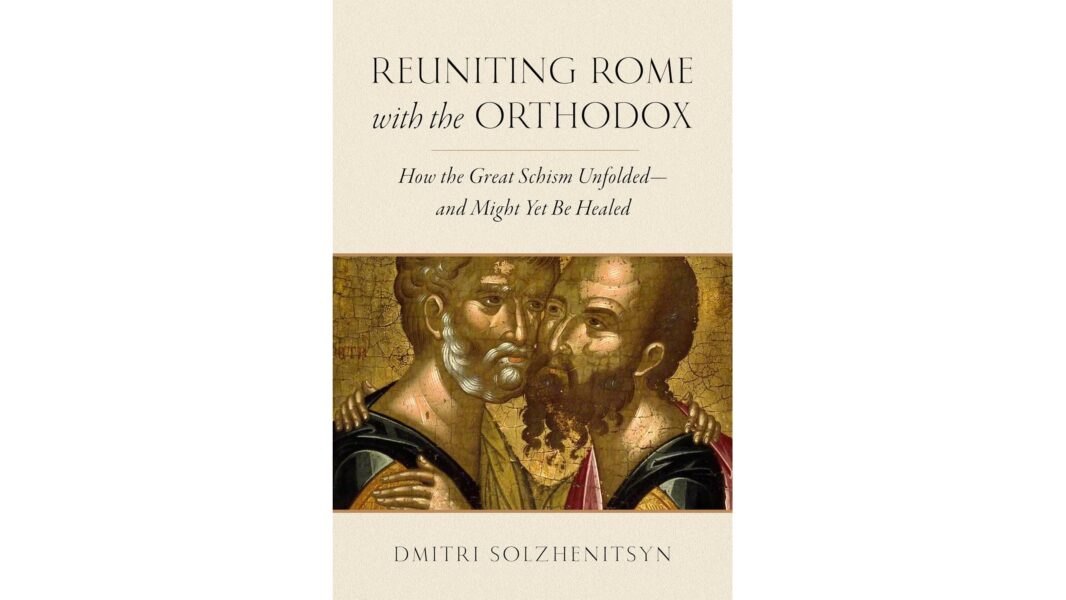
By Dmitri Solzhenitsyn
In August 2026, America Magazine reported that “the liturgical wars are back (and they never really went away).” The dispute Catholics have intermittently maintained—over the Traditional Latin Mass versus the Novus Ordo, Traditionis Custodes versus Summorum Pontificum, and so on—spans nearly six decades. Yet, as far as the Orthodox are concerned, the original liturgical-canonical divergence dates back more than twenty-five times as far.
In Catholic-Orthodox dialogue, liturgical issues are usually not as controversial as theological ones. (Among the latter are papal authority and the filioque, as I explore in my book Reuniting Rome with the Orthodox.) Nevertheless, differences in rites can hinder the ability of the communions to claim the same experience of worship and, at the extreme, may even make it difficult for them to recognize one another as Christians. Consequently, it is worth exploring the gradual East-West divergence.
Rome and the East still had more in common than differences throughout the early Christian period. However, by the fourth century significant differences were already appearing.
Toward the end of the 300s, the invocation of the Holy Spirit in the Liturgy of the Eucharist was emphasized more in Constantinople and the Greek Churches than in the Western Churches, which instead focused on the words of institution.
Also, during the late 300s, the Greek liturgy was refined in a singular way: vestments such as the sticharion (a kind of long tunic), hymnography such as the brief troparia, and sophisticated vessels were a much more prominent feature of the Byzantine rites than of the simpler Latin rites.
Differences of language also emerged: while Rome had initially used Greek, Latin was added in the third century and became dominant in the fourth. To express their faith, the West preferred the pre-Nicene Apostles’ Creed (the “Roman Symbol”); the Greeks adopted the Creed of Faith produced at Nicaea.
By the end of the seventh century, East and West had divergent prayers, hymns, cadences, and even iconography. And by the ninth century, the West had switched to unleavened bread in the Eucharist, while the East retained leavened bread. All of this established the Roman rite as distinct from the Byzantine.
Meanwhile, from the fourth century onward, East and West also developed markedly different attitudes toward clerical celibacy. Priests throughout the communion of the Orthodox Churches had been permitted to marry before ordination. Rome, however, campaigned to make celibacy universal. By the 700s, papal decretals had solidified the Western practice.
On the other hand, the Apostolic Canons, better received in the East, prohibited the clergy from divorcing their wives on grounds of celibacy—under penalty of excommunication—and the Synod of Gangra anathematized certain radical proponents of clerical celibacy. At the Quinisext Council of 692 under Justinian II, the Eastern Churches limited celibacy to the episcopate.
Those differences could be tolerated for a long time. But in the eleventh century, when cultural contacts became more widespread, the combination of ancient isolation and sudden contact dramatically soured East–West relations. Long-endured differences of discipline—unleavened versus leavened bread, fasting, clerical celibacy—came prominently and painfully to the fore.
Patriarch Cerularius of Constantinople wrote combatively to Pope Leo IX in 1053, criticizing the use of unleavened bread (azymes) in the Eucharist and fasting on Saturday. And the infamous schism of 1054 was inspired, at least in part, by disputes over celibacy and the azymes.
The list of ritual grievances only grew after the Schism. By 1438, new grievances against Catholics included “the veneration of three-dimensional figures in addition to, or rather instead of, icons; the multiplication of forms of monastic life; the use of round, not square, patens for the Mass,” and “the objection that the Roman liturgy (as then constituted) lacks an explicit epiclesis, or consecratory prayer to the Holy Spirit over the bread and wine.”
That last point was still being actively pressed in 1848. The Orthodox patriarchs asserted that the “Roman Church [is] not only rejecting from her Liturgical Canon, at the suggestion of the schoolmen, the very ancient and apostolic invocation of the Consecrating Spirit, and miserably mutilating the Sacrifice in its most essential part, but also hastening with urgency to cut it off from the Liturgies of other Christian Communions.”
The next great turn was a reform of the Latin rite itself through the Novus Ordo Missae of 1969 after Vatican II. The changes of the New Mass tended to be received negatively by the Orthodox (as well as by many traditional Catholics). Among the modifications were the shift from Latin to the vernacular; fewer genuflections; celebration versus populum instead of ad orientem (an orientation long shared with the Orthodox); Communion in the hand instead of exclusively on the tongue; women as lectors and extraordinary ministers of Communion; the alteration or omission of many previous (Tridentine) prayers; new eucharistic prayers, including an explicit epiclesis; and freestanding altars.
Orthodox theologian Laurent Cleenewerck, himself sympathetic to Catholic-Orthodox unity, admitted: “The liturgical metamorphosis of the Roman Catholic Church… widened the gulf” between the two communions. (On the positive side, the addition of an explicit epiclesis in the Novus Ordo indirectly addressed a major Orthodox complaint.)
Notwithstanding these developments, Metropolitan Kallistos Ware’s insistence on the “vital distinction between Tradition and traditions” is remembered, where many liturgical issues fall into the latter, less essential category.
Catholic thinkers have made a similar distinction, and Pope Benedict XVI even called for a “mutual enrichment” between varied forms of worship. If Catholic and Orthodox Christians reflect honestly on which elements of the faith deserve to be “fought over,” they may better discern—even in the post-conciliar liturgical landscape—how to observe Christ’s prayer “that all may be one.”
About the author
Dmitri Solzhenitsyn is the author of Reuniting Rome with the Orthodox, and his writings have appeared in The Catholic Herald, National Review Online and the Pittsburgh Post-Gazette. A Harvard College alumnus, where he was named a John Harvard Scholar, Dmitri is the founder of Paulie Prep, a college admissions consultancy, and a former McKinsey consultant. He has contributed editions and translations to several English editions of Aleksandr Solzhenitsyn.