


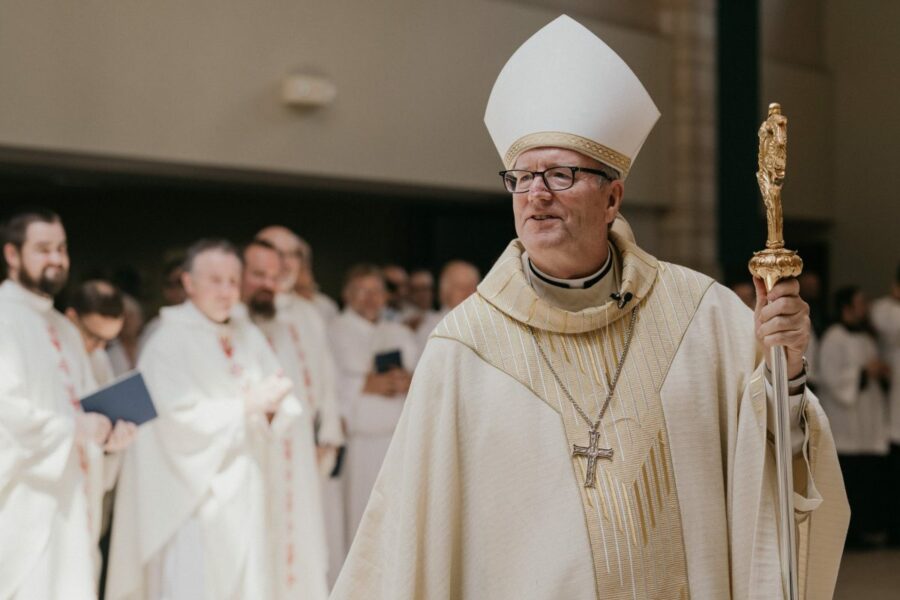
Bishop Robert Barron, head of the Diocese of Winona-Rochester (Minnesota), has been appointed a member of the United States Commission on International Religious Freedom (USCIRF), the independent federal body that monitors violations of religious freedom abroad and makes recommendations to the president, the Department of State, and Congress.
The appointment was made by President Donald Trump and announced by USCIRF itself. Barron thus joins an institution that closely follows everything from the direct persecution of religious communities to imprisonments for reasons of faith and state restrictions on worship.
Barron: “It is an honor to accept the invitation”
“It is an honor to accept President Trump’s invitation,” Barron said after his appointment was announced. The prelate highlighted the bipartisan nature of the commission and recalled several Catholics who have served on the body since its creation.
Among them are Professor Robert George; Mary Ann Glendon, former U.S. ambassador to the Holy See; Jesuit Thomas Reese; Archbishop Emeritus of Philadelphia Charles Chaput; and the late Bishop William Murphy, who was head of Rockville Centre.
Barron joins Pastor Andrew Brunson, a former missionary in Turkey who spent two years imprisoned in that country, and Joe Grogan, former director of the White House Domestic Policy Council. All three were appointed by Trump as commissioners.
A commission dedicated to monitoring religious persecution
USCIRF was created by Congress through the International Religious Freedom Act of 1998. Its mission is to monitor, analyze, and report on the state of freedom of religion or belief outside the United States and to recommend foreign policy measures to the president, the secretary of state, and Congress.
The commission examines restrictions imposed by states, the persecution of religious communities, and imprisonments linked to faith, among other violations. In recent months, it has issued reports and statements on the situation in countries such as India, Somalia, Syria, Saudi Arabia, Cuba, and Vietnam.
Two days before announcing Barron’s appointment, for example, USCIRF called on Trump to raise with Chinese President Xi Jinping the situation of prisoners held in China for reasons related to their religion or beliefs.
The body has a bipartisan composition. Three commissioners are appointed by the president of the United States, three by the leaders of the Senate, and another three by the leaders of the House of Representatives. With the three appointments made by Trump, USCIRF once again has the number of members provided for by law.
Barron’s second assignment on religious freedom
This is not the first time Barron has participated in a U.S. structure dedicated specifically to religious freedom. The bishop served on the Religious Liberty Commission, created by Trump in May 2025 to address issues related to the exercise of this right within the United States.
The difference between the two bodies is substantial. The 2025 commission deals with domestic U.S. issues, while USCIRF focuses its activity on the state of religious freedom in the rest of the world and on the responses that Washington’s foreign policy can adopt.
Barron, 66, has been bishop of Winona-Rochester since 2022 and founder of Word on Fire Catholic Ministries. Francis appointed him auxiliary bishop of Los Angeles in 2015.
His appointment comes at a time when Barron himself has once again focused on the persecution of Christians. This week, Word on Fire released a conversation with the bishop dedicated to contemporary Christian martyrdom and the testimonies collected in his recent book What Do Their Deaths Demand?. From USCIRF, that concern now also moves into the institutional realm of monitoring violations of religious freedom worldwide.