


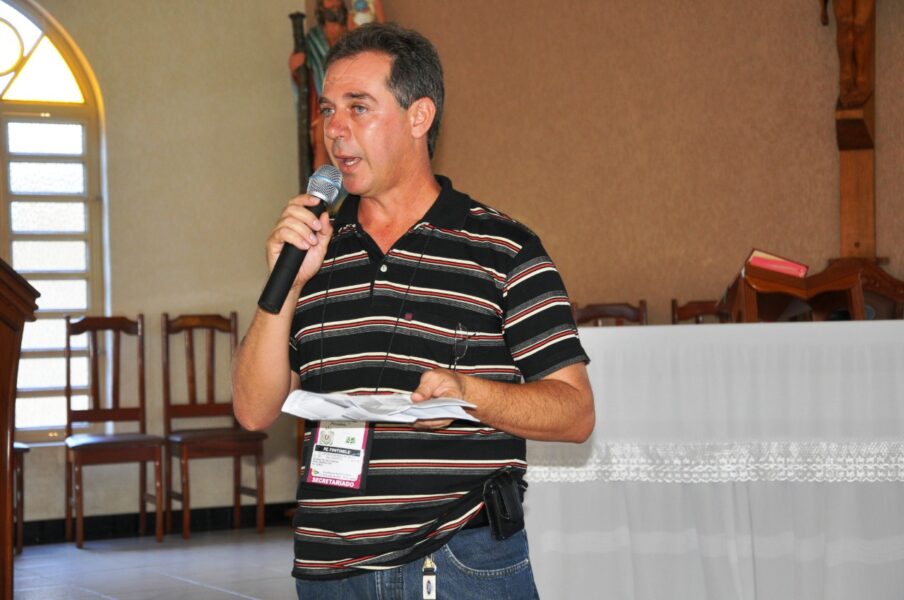
Pope Leo XIV has appointed Monsignor Antônio Fontinele de Melo as the new bishop of Rio Branco, Brazil, in the Amazonian state of Acre, transferring him from the diocese of Humaitá. The decision makes the same prelate who had been governing it provisionally since July as apostolic administrator the titular holder of the see.
Fontinele had temporarily assumed Rio Branco after Leo XIV accepted the resignation of the Spanish Augustinian Recollect Joaquín Pertíñez Fernández, who remained at the head of the diocese for 27 years. Rome has now chosen to definitively entrust him with a see he already knows and for which he brings a trajectory closely linked to the pastoral care of the Brazilian Amazon.
From apostolic administrator to Pertíñez’s successor
The transition began in July, when Leo XIV accepted Pertíñez’s resignation and provisionally entrusted the governance of Rio Branco to Fontinele while awaiting the appointment of a new bishop.
The decision announced this Friday ends that provisional status: Fontinele leaves the diocese of Humaitá and formally takes over the see of Rio Branco.
The new bishop is 58 years old. He was born on May 9, 1968, in Camocim, in the state of Ceará, and completed his formation in Philosophy and Theology at the São João XXIII seminary in Porto Velho. He holds a licentiate in Philosophy from the Catholic University of Brasília, a bachelor’s degree in Theology, and specializations in Higher Education Teaching Methodology and Sacred Scripture. He was ordained a priest on September 18, 1999, for the archdiocese of Porto Velho.
Before becoming a bishop, he served as a parish priest, rector of the Dom Hélder Câmara vocational house, pastoral coordinator, and professor of Introduction to Sacred Scripture and Ecclesial Management. He also served as parish priest of the Cathedral of the Sacred Heart of Jesus in Porto Velho and as archdiocesan treasurer. Francis appointed him bishop of Humaitá in August 2020, and he received episcopal ordination on October 17 of the same year.
Basic Communities and a “synodal” Church
His trajectory allows for a more defined pastoral profile than the brief curriculum released by the Holy See. Between 2009 and 2012, Fontinele served as advisor to the Ecclesial Base Communities of the Northwest Regional of the National Conference of Bishops of Brazil (CNBB), after also having coordinated the regional commission of presbyters.
During his governance in Humaitá, synodality has occupied an explicit place in diocesan planning. The diocese’s pastoral plan includes words from Fontinele himself in which he maintains that the Church must be “synodal, of listening, of communion” and defines that listening as reciprocal, so that each person has “something to learn and teach,” while all remain attentive to the Holy Spirit.
The XVIII Diocesan Pastoral Assembly, held in November 2025, was dedicated precisely to “synodality” based on the Brazilian Church’s guidelines for 2025–2028 and the final document of the Synod. Fontinele then presented the meeting as a time of “listening, prayer, and communal discernment” aimed at renewing faith and mission.
This orientation continues to be present in his most recent texts. In August of this year, when presenting the fifth edition of Diocese em Missão, he asked that Humaitá become increasingly a Church “on the way out, synodal, merciful,” although he expressly placed that horizon within Christ’s missionary mandate: “to make disciples,” to lead people to an encounter with Jesus Christ, and to form communities nourished by the Word, the Eucharist, charity, and hope.
Laity, Base Communities, and communion with Rome
Fontinele has also dedicated numerous texts during his episcopate to the role of the laity in the Church. In one of them, published in 2024, he defended the need for a “change of mentality and structures” and greater participation of the laity in pastoral action.
In other writings, however, he has pointed out explicit limits to Base Communities, movements, and associations. When addressing the criteria of ecclesiality, he recalled the need to profess the Catholic faith in its entirety, maintain a “solid communion with the Pope and with the bishop,” and integrate into the pastoral care of the particular Church to avoid “parallel Churches.”
His approach to ecumenism also appears in a reflection published in May 2024, in which he stated that ecumenism “does not lead to the loss of Catholic identity,” but rather constitutes an instrument of evangelization and the search for unity among Christians.
Indigenous permanent deacons and the “right to the Eucharist”
Another element of his episcopate in Humaitá has been the development of the permanent diaconate in Amazonian communities. In May 2025, he ordained two married men belonging to indigenous peoples as deacons: Andrelino Rodrigues da Silva, of the Munduruku ethnic group and father of three children, and Manuel Messias de Souza Ferraz, of the Mura ethnic group and father of four.
During the celebration, Fontinele highlighted the deacon’s service in the proclamation and preaching of the Gospel, presiding over worship, baptisms, assistance at marriages, and the distribution of Communion.
That same year he participated in the Eucharistic Congress of the archdiocese of Porto Velho with a conference entitled “Guaranteeing the right to the Eucharist in the Amazonian Church.” The program placed his intervention alongside others dedicated to the Eucharist, the Amazon, and Querida Amazonia.
There is no record in the sources consulted that Fontinele has publicly linked that formulation to the priestly ordination of married men, one of the proposals discussed during the Synod of the Amazon. His documented activity has so far focused on the permanent diaconate, provided for by Church discipline for married men.
A fully Amazonian diocese
Fontinele definitively succeeds Joaquín Pertíñez Fernández, an Augustinian Recollect native of Monachil (Granada), who arrived in Brazil as a missionary in 1988 and was appointed bishop of Rio Branco by Saint John Paul II in 1999.
During his 27 years of episcopate, Pertíñez had to face the difficulties inherent to an Amazonian diocese characterized by enormous distances between communities, a shortage of priests, and the growth of evangelical groups.
With the appointment of Fontinele, Leo XIV now entrusts the diocese to a bishop whose priestly and episcopal trajectory has developed almost entirely in the western Brazilian Amazon. His passage through the Ecclesial Base Communities, his commitment to synodal structures, and the promotion of the permanent diaconate are part of that profile, along with an explicit insistence on evangelization, the Eucharist, ecclesial communion, and the mandate to “make disciples.”