


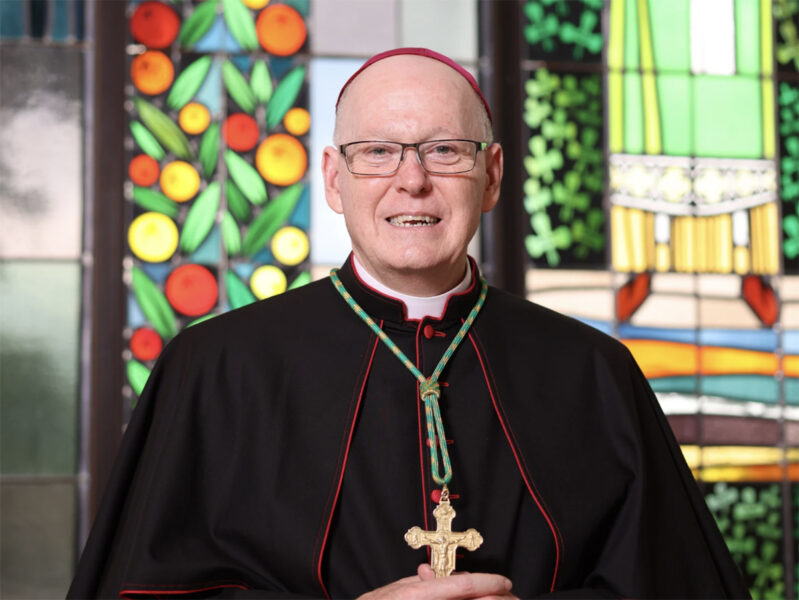
Pope Leo XIV has appointed this Thursday Mons. Brendan John Cahill, until now bishop of Victoria, in Texas, as the new bishop of Joliet, in Illinois. The American prelate, 62 years old, leaves the Texan diocese after eleven years at its head and arrives at a see located in the metropolitan area of Chicago.
The appointment was announced this September 17 by the Holy See and communicated in the United States by the apostolic nuncio, Mons. Gabriele Caccia. Cahill had been appointed bishop of Victoria by Francis on April 23, 2015, and received episcopal consecration on June 29 of the same year.
From Florida to priestly formation in Houston
Brendan John Cahill was born on November 28, 1963, in Coral Gables, Florida, within the territory of the archdiocese of Miami. He studied Psychology and obtained the Master of Divinity at the University of Saint Thomas in Houston, in collaboration with the Saint Mary seminary.
He was ordained a priest on May 19, 1990 for the archdiocese of Galveston-Houston. His first assignments were as parochial vicar at Saint Frances Cabrini, in Houston, between 1990 and 1992, and Christ the Good Shepherd, in Spring, between 1992 and 1994.
He later obtained a master’s degree in African American Studies at Xavier University of New Orleans and moved to Rome, where he completed his licentiate and doctorate in Dogmatic Theology at the Pontifical Gregorian University.
A decade as seminary rector
A large part of his ministry before the episcopate was linked to priestly formation. He was part of the faculty of the Saint Mary seminary in Houston between 1998 and 2001 and served as rector between 2001 and 2010.
In 2010 he assumed the direction of the Secretariat for the Formation of the Clergy and the Chaplaincy Services of Galveston-Houston. Later he was vicar for the Clergy, presided over the body in charge of priestly personnel, and was part of the presbyteral council.
Francis chose him on April 23, 2015, as bishop of Victoria. He was consecrated on June 29 of the same year and has remained at the head of the diocese in southeast Texas ever since.
One of the USCCB voices on immigration
In addition to his diocesan governance, Cahill has gained a significant presence in recent years within the United States Conference of Catholic Bishops (USCCB). He currently chairs its Committee on Migration, a responsibility from which he has repeatedly intervened in the debate on the immigration policy of the Trump Administration.
In January, together with Mons. A. Elias Zaidan, he asked the Administration to extend Temporary Protected Status (TPS) for Haitians residing in the United States. After the government’s June decision to end temporary protections for Haitians and Syrians, Cahill maintained that withdrawing legal status from hundreds of thousands of people when return to their countries is not safe generated a “moral crisis” and stated that the country could not “close its eyes to such injustice.”
He has also called for limits on immigration enforcement operations in churches and other places of worship. In February, together with Archbishop Alexander Sample, he signed a letter to Congress in which both prelates asked to avoid immigration actions in those spaces except in exceptional circumstances and to guarantee access to religious and pastoral services for detainees. The document also recognized the difficulty of the work of law enforcement agencies and the need for reform of the immigration system.
In June, Cahill also asked the House of Representatives to reject a bill against criminal gangs, considering its definition of association with these groups excessively broad. Among his objections, he warned that the measure could even affect foreign priests and religious who, in the exercise of religious or humanitarian work, provided assistance to certain individuals.
His position, however, does not equate to denying the State’s right to enforce its immigration laws. The public interventions of the Committee he chairs have combined criticism of certain measures with recognition of the responsibility of authorities in immigration control and law enforcement. In July, Cahill and Mons. Daniel Garcia insisted both on the dignity of immigrants and on the rejection of the denigration of agents charged with enforcing the rules.
He promoted the synodal process in Victoria
Another element of his episcopate in Texas has been his involvement in the Synod on Synodality convened by Francis. The diocese of Victoria developed the process under the motto “A Listening Church” and organized listening sessions in most of its parishes and in various diocesan groups.
Several of the sessions were held directly with Cahill. The bishop himself described the process as an opportunity for the faithful to listen to the experiences of others and discern the will of God. The contributions gathered in Victoria were later incorporated into the synthesis of Region X, formed by the dioceses of Texas, Oklahoma, and Arkansas.
Leo XIV thus sends to Joliet a bishop with extensive experience in priestly formation and eleven years of diocesan governance, but also with a recognizable public profile within the American episcopate: active in the synodal process and, especially, in the USCCB’s response to Washington’s immigration policy. His transfer leaves the diocese of Victoria vacant, pending the appointment of a new bishop.