


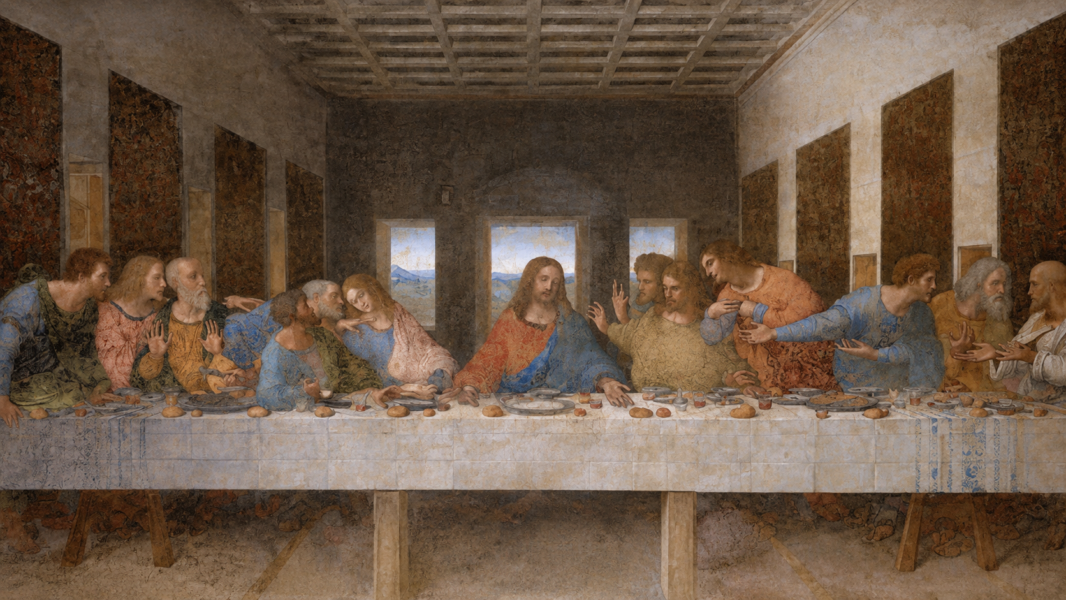
Javier Sierra told it on Tuesday in his mysteries section on Herrera en COPE, on the occasion of the reissue of The Secret Supper, and the network’s website headlined it with a phrase from the novelist: in the mural of Santa Maria delle Grazie, “Jesus is not instituting the sacrament of the Eucharist.” A Cathar catechesis followed in the morning slot. No one objected.
It is not that a novelist is selling his novel (which is his job, and he does it professionally). It is that the Episcopal Conference’s radio station has broadcast as a “very well-founded” suspicion a gnostic reading of the Lord’s Supper, supported by errors that any parish catechist would have stopped in the first minute.
The argument, summarized without trickery, is this. Leonardo painted the Twelve without halos and portrayed himself in Judas Thaddeus, with his back to Christ, in the house of the Dominicans, “who were the inquisitors” (it took courage, it was said). He put fish and not lamb. He dressed in white, never married, never painted a crucifixion…
All of this would betray a sympathizer of the last Cathars, heretics who, in the radio version, believed that every man carries a “divine spark” to deal with God without intermediaries, so that the Pope and the priests were superfluous.
The clinching proof came later. The Cathars, Sierra explained, had a sacred book, the Interrogatio Iohannis or Secret Supper (hence the title of the novel), according to which the traitor would be the one who put his hand in Jesus’ dish. And in the mural there is “one character, only one,” who stretches it toward the same dish as Christ. Conclusion: “everything fits with the Cathar faith.”
Saint Matthew, chapter 26, verse 23.
And Saint Mark, chapter 14, verse 20. The Church proclaims it every Holy Wednesday, and the apocryphal text merely copies it: it opens with John reclining on the Lord’s chest, asking who will betray him, and the answer is Matthew’s. Leonardo painted Matthew, the heretic copied Matthew, and on the bishops’ radio no one recognized Matthew.
Nor was it explained on air what that little book teaches, which the network’s web chronicle calls a “Cathar sacred text.” It is short. Satan models man’s body from clay and encloses an angel in it. The Virgin is an angel. Christ enters her and exits through the ear. The Baptist is an envoy of Satan. The law of Moses is dictated by the devil.
The Carcassonne copy closes with a note, probably from the inquisitors, identifying it as the secret book of the heretics of Concorezzo, brought from Bulgaria by their bishop Nazarius, and warns that it is full of errors. The inquisitors noted it as error. The bishops’ radio presents it as sacred.
That has had a name for eighteen centuries. A fallen angel who fashions flesh, celestial souls imprisoned in clay, a Christ who takes nothing from his mother (Nazarius taught that he assumed not human but angelic nature), a spiritual baptism that makes perfect: it is gnosis, with a Bulgarian accent. Saint Irenaeus devoted five books to it. Tertullian dispatched it in three words, caro salutis cardo: flesh is the hinge of salvation.
Against its medieval version the first chapter of the IV Lateran Council was written in 1215: one God, creator of the spiritual and the corporeal; a Christ who suffered on the wood of the cross and rose in the flesh; a resurrection with the bodies we now have; a body and blood truly contained in the sacrament of the altar, under the species of bread and wine.
The version that reached the listener was gentler: an interior religion without clergy that the Church could not tolerate. It is false. The Cathars attributed the visible world to the devil, had only one sacrament—an imposition of hands—refused to receive communion or venerate the cross, and organized themselves into a hierarchical church, with bishops and deacons. The consolamentum was given only by their perfect ones. They had intermediaries: those who rejected them were the ones in Rome.
Nor was that rite a fast until death, as was said on air. That is the endura, a ritual suicide sometimes permitted or advised to the gravely ill who had just received it. The station confused the sacrament of a heresy with the darkest of its practices.
The spark without mediations also has a modern name. In 2018, the letter Placuit Deo, from the Congregation for the Doctrine of the Faith, described a neo-gnosticism of merely interior salvation, enclosed in subjectivism, bent on freeing the person from the body and the material cosmos, and opposed to it the mediation of the Church and the sacramental economy. The agency note on that letter is still hanging on COPE’s website (the archive has those things).
There remains the headline. That Leonardo’s Supper does not show the Eucharist is a debatable thesis and in any case not unusual: the refectory cenacles from Castagno to Ghirlandaio painted the announcement of the betrayal, with Judas isolated on the other side of the table. And Leo Steinberg, who devoted an entire book to the mural, maintains that it represents both the announced betrayal and the instituted Eucharist, with Christ’s left hand toward the bread and the right toward the wine.
The Church does not need Steinberg. Saint Paul wrote that the Lord took the bread “on the night he was to be betrayed,” and so it is proclaimed at Mass; Sacrosanctum Concilium repeats it. Betrayal and sacrament do not dispute the mural. They are the same night.
On his website, the author is clearer: Leonardo’s Christ would not be holding host or cup, but would be making with his hands a gesture identical to the Cathar ceremonies. Where the Church sees the altar, he sees a Cathar rite. And the bishops, instead of correcting him, give him a radio and a microphone.
The Catharized Leonardo does not withstand the archive either. When he painted the Cenacolo, Italian Catharism had been history for almost two centuries: the heretics captured in Sirmione burned in the Arena of Verona in 1278 and the last outbreak was organized from Piedmont between 1290 and 1320. The Anonymous Gaddiano remembers him with a pitocco rosato to the knee (the white was added by the radio).
On the opposite wall, at the foot of Montorfano’s Crucifixion, are the portraits of Ludovico il Moro, Beatrice d’Este and their children that are almost certainly attributed to Leonardo. The man who never painted a crucifixion painted one on a wall.
His will, of April 1519, asks for burial in Saint-Florentin of Amboise, sixty poor with torches, three solemn Masses and thirty low Masses. A lot of Mass for a Cathar. The suspicion usually rests on Vasari, who in 1550 attributed to him a spirit so heretical that he adhered to no religion and who suppressed the passage in 1568. He was speaking of a skeptical philosopher, not of a perfect one.
And it is no accident. Sierra has had a weekly section on the program since 2017, and the network had already devoted another piece to “the mysteries of the Last Supper.” Its web chronicle, moreover, records in its own phrases, without attribution verbs, the self-portrait of Thaddeus with his back to Jesus and the link between the fish without lamb and the Cathars. On a network that proclaims itself Catholic and places itself within the framework of the Church’s evangelizing presence.
Voegelin saw gnosis at the heart of modernity. He did not get to hear it on the bishops’ radio, shortly before a diplodocus from Teruel and some jokes about artificial intelligence.
In the Milan mural, the hand reaching for Christ’s dish is Judas’s, and so Saint Matthew tells it. Judas was also a bishop, like Cobo, like so many others.