


One learned long ago that Vatican documents are read twice, once for the text and once for the notes, and that the second reading is usually the one that counts. The document with which three dicasteries mark the sixtieth anniversary of Nostra aetate rewards that custom like few others. It cites its sources generously and stops, with clockmaker’s punctuality, just before the sentence in which those sources spoke of the truth. It then declares the firmness once sustained by that truth to be obsolete. And in the end it proposes as a pastoral path a practice that the same sources excluded. Three movements, a single gesture.
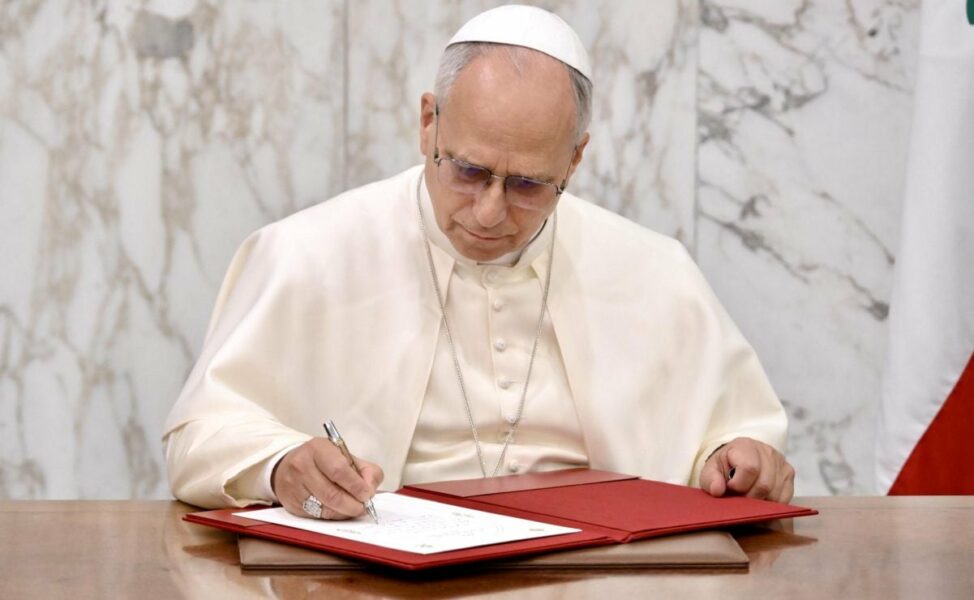
It is titled «A Path of Hope», dated 16 September and signed by Cardinals Fernández (whom, the enthusiasts told us, Leo was going to dismiss within hours after the habemus papam), Koch and Koovakad, heads of the Dicasteries for the Doctrine of the Faith, Christian Unity and Interreligious Dialogue, together with their three secretaries. Beneath the signatures are two further lines: «Ex Audientia, 22 June 2026» and «Leo PP. XIV». It follows the same pattern Francis used to promulgate Fiducia supplicans, and there is no reason to forget it now that the signatory is another. The Pope approved the text and ordered its publication, and Donum veritatis teaches that documents of the Doctrine of the Faith expressly approved by the Pope share in his ordinary magisterium. The same instruction admits that some magisterial documents may not be free of deficiencies. One takes refuge in that admission. What the document does not contain must be stated at once, because one does not write for the heresy-hunter. It denies nothing expressly. It affirms that Christ is the only redeemer, calls for a dialogue “free of ambiguities” that avoids “relativism and syncretism,” and rules out a single world religion in which all beliefs are levelled. It rules it out, to be sure, “out of respect for oneself and for others,” which is a very courteous reason for rejecting what was once rejected as false. The problem with the Note lies not in what it says, but in what it does with what others said.
It begins with the Council itself. The Note recalls that the Church “rejects nothing of what is true and holy in these religions” and looks with esteem on their “ways of acting and living, their precepts and doctrines.” There it places the period. Nostra aetate did not stop there: it added that those precepts and doctrines are considered with respect “even though they differ in many things from what she herself professes and teaches,” and immediately afterwards that the Church “has the duty constantly to proclaim Christ”. When the Note returns later to that paragraph, the duty to proclaim has become “the demand of fidelity to Jesus Christ.” Fidelity and proclamation are not synonyms. One can be faithful in silence, and the Council did not ask for silence.
With Paul VI the operation is more subtle. The Note praises the concentric circles of Ecclesiam suam, that geometry of dialogue which, it says, “has proved programmatic,” and refers in a note to the passage where they are drawn. In that same passage, when he reaches those who worship God in other religions, Paul VI warned that they could not be regarded as all equivalent and declared, out of loyalty, his conviction “that the true religion is one, and that it is the Christian religion.” The Note cites the circle and skips the centre. It is like reciting the Creed up to “creator of heaven and earth” and considering the rest already said.
With John Paul II the method is repeated. The Note footnotes the general audience of 22 October 1986, five days before Assisi, and takes from its number 5 a courteous phrase about religions that, after having caused divisions, now wish to contribute to peace. It does not take the immediately preceding sentence, which recalled the fundamental divergences that separate them. Nor number 2, where the Pope stated that only in Christ can men be saved. Nor number 4, where he explained why there would be no common prayer at Assisi: one could be present while others prayed, but one could not “pray together.” The formula chosen for the day was to be together to pray. One keeps the distinction, because it will return.
Worse still fares Dominus Iesus. It appears only once, in a note, without paragraph number, as one mentions in an obituary a relative with whom one no longer spoke. Its number 22 does not appear, according to which non-Christians may receive divine grace, yet find themselves objectively “in a gravely deficient situation” compared with those who possess in the Church the fullness of the means of salvation. John Paul II confirmed that declaration “with certain knowledge and by his apostolic authority.” This Note carries the ordinary formula: the Pope has approved it and ordered its publication. Quod non est in actis non est in mundo, the canonists say. The Note applies the maxim to its own sources.
Thus we arrive at number 54, where the document ceases to cite and begins to assert. It states that “monolithic and isolated models, which foster a closed vision of reality, are increasingly inadequate and ultimately become a source of violence and suffering for the weakest.” It adds that “the intransigent defence of one’s own position and proselytism, as the only form of encounter with ‘the other,’ no longer make sense in a world that increasingly resembles a global, interconnected village in continual ferment.” One is not going to be scandalised by the word proselytism, which has a bad press and good guarantors: Benedict XVI said in Aparecida in 2007 that the Church does not proselytise and grows by attraction; Francis repeated it many times; Leo XIV repeated it in January. The clause “as the only form” also saves the letter, because no one in the Church has maintained that proselytism is the only way to deal with one’s neighbour. And it is true that number 46 assures us that it is not a question of renouncing the truth, but of proclaiming it in an evangelical manner. It assures this eight numbers before explaining why firmness no longer makes sense.
What matters is the reason why. Benedict explained that the Church grows as Christ grows, drawing all to himself by the power of a love that culminated on the cross. Leo XIV made it precise before the cardinals on 7 January: it is not the Church that draws, but Christ. On 22 June, the same Leo XIV approved and ordered the publication of a text that gives another reason: the world increasingly resembles a global village. Where the Pope of January placed Christ, the Pope of June endorses connectivity. The rejection looks similar; the foundation is the opposite, and in theology the foundation is not a matter of style, it is the whole issue. What is upheld because Christ draws is upheld always. What ceases to make sense because the village has become global may change again when the village changes. One already hears the excuse that a Pope does not read every number of what he approves. It settles nothing: either he read number 54 and found the global village acceptable, or in Rome something is published in his name that he does not read. The reader should also note the adverb: “no longer” means that before it did, and the following number confirms this by speaking of the other believer who “before” was seen as an enemy. It is l’air du temps elevated to a theological criterion, with pontifical approval.
The first sentence of the number is even more delicate. It attributes violence to “monolithic” models and to a “closed vision of reality” without distinguishing between identitarian closure, which exists and does harm, and the claim to truth, which is something else and is, moreover, the Church’s proper task. The distinction is not a nicety. In 2007, the then Congregation for the Doctrine of the Faith, the same dicastery that now signs under another name, described as a growing confusion the idea that every attempt to convince others in religious matters limits their freedom, and countered those who see in the claim to have received the fullness of Revelation an intolerant attitude and a danger to peace. That doctrinal note even took the trouble to define proselytism: a word frequently used as a synonym for missionary activity and which only in recent times has come to mean religious promotion by means contrary to the Gospel. The 2026 Note uses it without defining it. John Paul II, for his part, had warned in Redemptoris missio, an encyclical the Note cites elsewhere, that the call to conversion is questioned or silenced because it is seen in it “an act of ‘proselytism.’” One does not say that the Note falls into that confusion. One says that it writes as if it did not know the confusion exists.
Nor does the authority invoked by number 54 say what is made of it. It is a speech by Francis at Chulalongkorn University in Bangkok in 2019, which speaks of the “logic of insularity” as a “valid mechanism for the resolution of conflicts.” Of conflicts, not of mission. And the same quotation includes a clause that the paragraph citing it seems to have read in haste: religions have much to contribute “without the need to renounce their own essential characteristics.” The essential note of Christianity, if one is not mistaken, has a proper name.
The third piece remains, the one that turns theory into agenda. In number 49, the Note lists the “more creative and courageous” forms of encounter developed by local Churches: dialogue commissions, joint projects, educational or humanitarian actions and “shared celebrations.” It proposes to compile them and network them in order to “identify and guide new pastoral paths.” It is not a description, it is a programme, and the programme does not say what a shared celebration is. The 1986 audience cited by the Note had already resolved it with the distinction between praying together and being together to pray. Ratzinger developed it in Faith, Truth and Tolerance: multireligious prayer, that of Assisi, gathers each person in the same place to pray separately; interreligious prayer intends to pray in common, and on whether that is possible with all truth and honesty he wrote “I doubt it.” He set conditions, the first of which an agreement on who or what God is that does not seem easy to gather around a bowl of coca leaves. Nor is the law neutral: canon 1381 requires a just penalty for the forbidden communicatio in sacris. One does not accuse the Note of authorising common worship, because it does not say so. One accuses it of something less showy and more serious in a text signed by the Doctrine of the Faith: of withdrawing the just criterion where it is most needed.
And it is needed. On 13 August, in Cusco, an official of the Dicastery for the Doctrine of the Faith and pontifical commissioner for the Sodalicio placed coca leaves in a “payment to the earth” at the opening of a meeting that Vatican News presented as part of the preparation for Leo XIV’s journey to Peru. A month and more later, the dicastery in which he works publishes a document, approved in June, that counts shared celebrations among the courageous forms of encounter without saying which ones they are. It would not have served him as a guide. Nor as a brake.
Sixty years later, the Note calls Nostra aetate a text “brief but bold.” It was. It dared to say in the same paragraph that the Church looks with respect on what is true in other religions and that it is obliged to proclaim Christ. The boldness of 2026 consists in keeping only the first half. The document, by the way, is dated on the memorial of Saints Cornelius and Cyprian. Cyprian, bishop of Carthage and martyr, wrote that no one can have God as father who does not have the Church as mother: habere iam non potest Deum patrem qui ecclesiam non habet matrem. One suspects that, written today, the sentence would have ended up in number 54, among the monolithic models.
Read also