


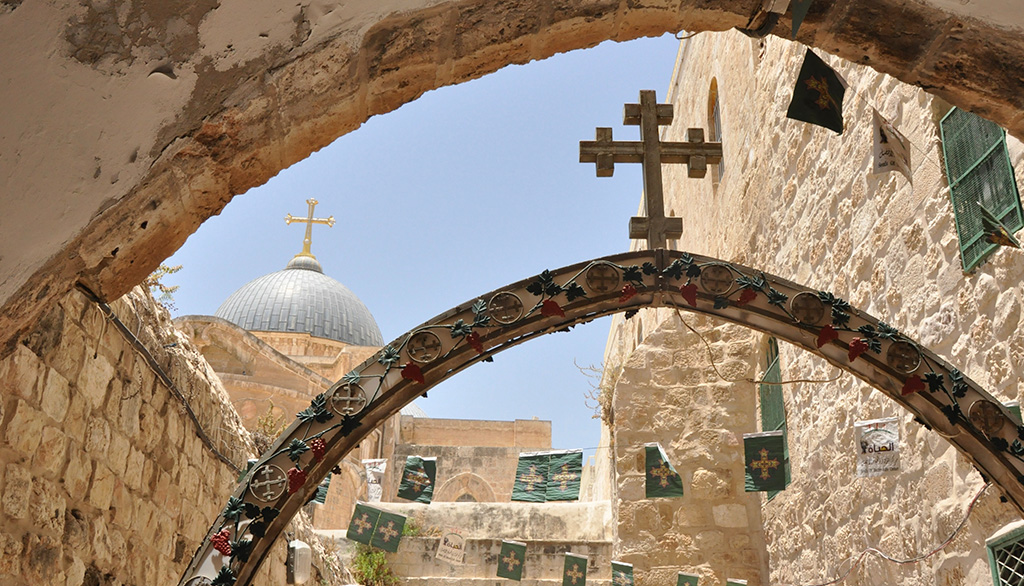
The custodian of the Holy Land, Friar Francesco Ielpo, recalled at the monastery of Santo Toribio de Liébana (Cantabria) that Christian hope does not consist in the promise of a life without suffering, but in the certainty that Christ is present even in the midst of trial. “The cross is not explained with words. The cross is crossed,” he stated during the celebration of the feast of the Exaltation of the Holy Cross.
The Franciscan pronounced these words this Monday, September 14, during the Mass that accompanied the twining between the Holy Sepulchre of Jerusalem and the Sanctuary of Santo Toribio de Liébana, presided over by the bishop of Santander, Arturo Ros. The Cantabrian monastery safeguards the Lignum Crucis, considered the largest preserved fragment of the Cross of Christ.
“Two places united by the same mystery”
Ielpo presented the bond between Jerusalem and Liébana from an essentially spiritual perspective: both places, he explained, are united by “the same mystery,” that of the Cross and of “a love that goes to the end.”
Drawing from the readings of the feast of the Exaltation of the Holy Cross, the custodian paused on the biblical image of the desert as a place of trial, where human securities disappear and man must decide where to place his trust.
“The temptation is always the same: to trust in God or to trust only in ourselves,” he noted.
The Franciscan then recalled the episode of the bronze serpent raised by Moses in the desert and Christ’s words about the necessity that the Son of Man be lifted up.
Faced with the apparent contradiction that an instrument of torment can become a sign of salvation, Ielpo pointed out that it is precisely in that paradox where God’s way of acting is manifested.
“He does not only show us how far man is capable of making others suffer; above all, He shows us how far God is capable of loving,” he affirmed.
“We do not exalt pain, violence, death”
The custodian thus clarified the Christian meaning of the Exaltation of the Holy Cross: “We do not exalt pain, violence, death. We exalt the love that, in the midst of pain and death, remains faithful to the end.”
The difference between human logic and that of Christ, he added, is manifested precisely in the face of suffering: “We would like to overcome by eliminating suffering. Christ overcomes by crossing it.”
From this, he explained, Christian hope is born. The Cross does not promise man an existence in which pain disappears, but the certainty that no circumstance is outside the presence of God.
“The cross is not explained with words. The cross is crossed, and it is by crossing it with Christ that we discover that even the place of trial can become the place where God manifests Himself as love,” he maintained.
The Holy Land and its “long desert”
Ielpo then transferred his reflection to the situation currently facing the Holy Land, which he described as a “long desert made of war, fear, violence, suffering, and lack of prospects.”
To those who ask where to find hope in these circumstances, the custodian noted that Christianity does not offer “easy explanations,” but directs the gaze toward Golgotha.
“God has not abandoned man on Golgotha. God entered into the wound of humanity, and a few steps from Golgotha there is an empty tomb,” he affirmed.
For this reason, he continued, “the cross is hope,” because it already contains the hope of the Resurrection.
The twining between the Holy Sepulchre and Santo Toribio thus acquires, according to Ielpo, a meaning that goes beyond the institutional bond between both sanctuaries: both are called to “safeguard and announce the meaning of the cross.”
From Jerusalem, he explained, Golgotha continues to proclaim to the world the love of God; and from Liébana, the Lignum Crucis recalls that that love “reached the cross.”
“This is the path of our faith: from the desert to trust, from temptation to abandonment in God. From the cross to life, from the wound to hope. Because the cross tells us that we have been loved without measure, loved to the end,” he concluded.