


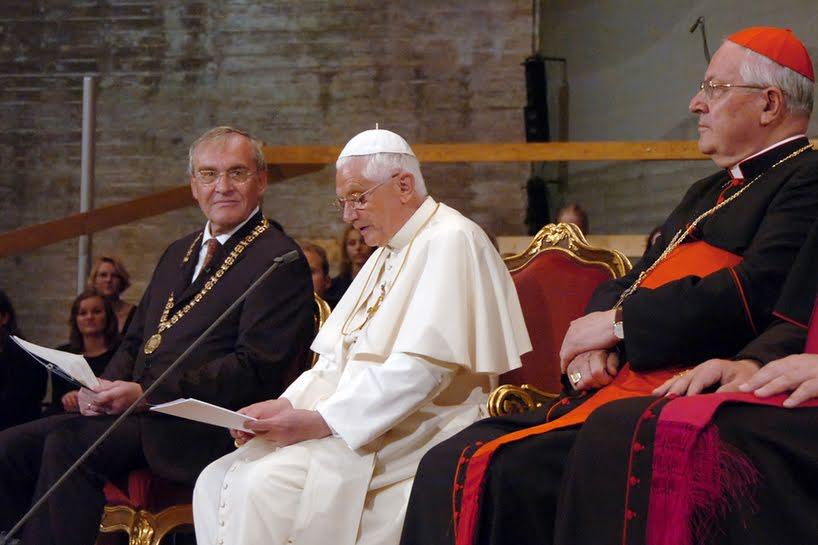
This Saturday, September 12, marks twenty years since the speech delivered by Benedict XVI at the University of Regensburg, Germany, one of the most debated interventions of his pontificate. The international controversy focused on a harsh medieval quotation about Muhammad and violence, but the argument developed by Joseph Ratzinger was considerably broader: the relationship between faith and reason and the consequences that arise when the two are separated.
Under the title Faith, Reason and the University: Memories and Reflections, Benedict XVI returned on that September 12, 2006, to the university where he had served as a professor. Before representatives of the academic world, he defended a conception of reason open to questions about God, truth, and the good, and maintained at the same time that the transmission of faith is incompatible with violence.
The full text of Benedict XVI’s speech at Regensburg remains available on the Holy See’s website.
The quotation from Manuel II Palaeologus that overshadowed the speech
To introduce his reflection, Benedict XVI drew on a dialogue held at the end of the fourteenth century between the Byzantine emperor Manuel II Palaeologus and a learned Persian about Christianity and Islam.
In that dialogue the emperor addressed the question of jihad and formulated a harsh criticism of Muhammad and the spread of religion by the sword. Before quoting it, Benedict warned of the “brusqueness that surprises us” in those words, a brusqueness he described as “unacceptable.”
It was that quotation that later triggered protests and reactions in numerous majority-Muslim countries. However, the reasoning that interested Benedict continued after those words.
Manuel II explained why he considered the propagation of faith through violence to be senseless. “Faith is the fruit of the soul, not of the body,” the passage cited by the Pope stated. Whoever seeks to lead another person to faith needs “the ability to speak well and to reason correctly,” “and not to resort to violence or threats.”
“To convince a rational soul one must not resort to one’s own arm,” the text continued.
Benedict then identified the proposition he considered decisive in that argument against forced conversion: “To act against reason is contrary to the nature of God.”
When faith and reason are separated
From that point, the Regensburg lecture moved away from the controversy over Islam to develop a reflection on the relationship between Christian faith and reason.
Benedict XVI surveyed various stages of what he called the “dehellenization” of Christianity and argued that the encounter between biblical faith and Greek thought had not been a historical accident from which Christianity could simply detach itself.
For Ratzinger, the assertion that acting against reason contradicts the nature of God found a profound correspondence between the biblical conception of God and the Greek logos.
The critique was also directed at modern Western culture. Benedict questioned a positivist conception that limits reason to what can be verified by the experimental method and leaves questions about God and ethics outside the realm of rational knowledge.
The Pope warned of the “pathologies” that can affect both religion and reason itself when such a separation occurs. Attempts to construct an ethics exclusively from evolution, psychology, or sociology were, in his view, insufficient.
Hence he also defended the presence of theology in the university, not merely as a historical discipline or human science, but as a discipline capable of rationally inquiring into faith.
A reason “deaf to the divine”
The reflection culminated in a question Benedict considered indispensable for dialogue between cultures and religions.
Against the claim that only positivist reason could be considered universal, he warned that deeply religious cultures perceive the exclusion of God from the realm of reason as an attack on their deepest convictions.
“A reason that is deaf to the divine and relegates religion to the sphere of subcultures is incapable of entering into the dialogue of cultures,” he stated.
The Regensburg proposal therefore consisted in once again broadening the horizon of reason and fostering a new encounter between reason and faith. Only in that way, Benedict maintained, would a true dialogue between cultures and religions be possible.
“Not religion and violence, but religion and reason”
The controversy sparked by the quotation from Manuel II forced Benedict XVI to return to the meaning of his intervention a few days later.
During the Angelus on September 17, 2006, the Pope declared himself “deeply distressed” by the reactions provoked in various countries and clarified that the words of the Byzantine emperor “in no way” expressed his personal thought.
Three days later, at the general audience on September 20, he explained in greater detail why he had used that text.
Benedict noted that he had cited the medieval dialogue to introduce “the problem of the relationship between religion and violence” and acknowledged that those words had lent themselves to an interpretation different from the one he intended.
“My intention was very different,” he explained. His purpose had been to start from Manuel II’s later words on the rationality necessary in the transmission of faith in order to show that “not religion and violence, but religion and reason go together.”
The Pope then insisted that the accusations formulated by the medieval emperor did not constitute his own assessment of Islam and reiterated his “profound respect” for the great religions and, especially, for Muslims.
He also clarified what the true object of that lecture had been: “The theme of my lecture—responding to the mission of the University—was, therefore, the relationship between faith and reason.”
A debate that continues twenty years later
Regensburg continued to be the subject of conflicting interpretations in the years that followed. The crisis also had consequences for Christian-Muslim dialogue.
In 2007, 138 Muslim intellectuals, clerics, and scholars promoted A Common Word Between Us and You, an initiative addressed to leaders of various Christian confessions that sought to establish common ground based on love of God and neighbor. The process would later contribute to the establishment of the Catholic-Muslim Forum.
Twenty years later, the discussion remains open. Last August, the German Jesuit and Islamologist Felix Körner, professor of Theology of Religions at Humboldt University in Berlin, described the Regensburg speech as an “objective error.” In his view, Benedict XVI inadequately contrasted Christian rationality with a particular conception of Islamic theology, although he acknowledged that the crisis ultimately favored new channels of dialogue.
Read also: A Jesuit describes the historic speech of Benedict XVI at Regensburg as an “objective error”
Two decades after that magisterial lecture, the text of Regensburg allows us to revisit an intervention that was marked by one of its quotations, but whose argument covered considerably broader ground. In the face of religious violence and in the face of a reason that excludes ultimate questions from its horizon, Benedict XVI proposed recovering the encounter between faith and reason as a condition for dialogue between religions and cultures.